Friday, July 15, 2022

'The Unlikely Escape of Uriah Heep' by H. G. Parry


The ultimate book-lover's fantasy, featuring a young scholar with the power to bring literary characters into the world, for fans of The Magicians, Mr. Penumbra's 24-Hour Bookstore, and The Invisible Library.

For his entire life, Charley Sutherland has concealed a magical ability he can't quite control: he can bring characters from books into the real world. His older brother, Rob -- a young lawyer with a normal house, a normal fiancee, and an utterly normal life -- hopes that this strange family secret will disappear with disuse, and he will be discharged from his life's duty of protecting Charley and the real world from each other. But then, literary characters start causing trouble in their city, making threats about destroying the world... and for once, it isn't Charley's doing.

There's someone else who shares his powers. It's up to Charley and a reluctant Rob to stop them, before these characters tear apart the fabric of reality.

MY THOUGHTS:  

Wow, what a treat for fans of Victorian classic literature. This fun novel is set in New Zealand. 

Dr. Charley Sutherland is a 26-year-old English lecturer who finds it increasingly difficult to control his gift. All his life he's had an uncanny knack of getting so invested in novels that he causes fictional characters to materialise in the real world. Once released, some of them are determined to stay at large. Uriah Heep understandably refuses to return to the pages of David Copperfield, since he thinks every circumstance there is pitted against him in favour of the eponymous character; a privileged little sycophant in his 'umble opinion. 

When Uriah makes a run for it, Charley is forced to call on the one person who has grown up helping with emergencies of this nature, his older brother Robert. But poor Rob is now a busy lawyer with a mortgage and fiance, and he just wants to lead a normal life. 

It soon becomes clear to the brothers that other characters are quietly infiltrating the city of Wellington who are not of Charley's making. Another 'summoner' is bringing to life some of the classics' most infamous desperadoes to help take over the world. Charley and Rob must take drastic action to prevent this dastardly plot, but they feel so clueless and vulnerable compared to the anonymous mastermind who seems to have pilfered Charley's PhD thesis, 'Dickens' Criminal Underworld.' 

The author H.G. Parry calls her novel 'a love letter to literary analysis.' She has the likes of Dorian Gray, Frankenstein, the White Witch and Heathcliff delivering their famous lines in perfect context for her story. 

I expected it to be a bit spoofy based on the blurb, but the novel is so cleverly plotted, with its own twists in the spirit of the classics, it's easy to suspend disbelief while reading. What I didn't expect was to find the presence of all these well known characters together in a completely different work to be as powerfully moving as it is.

The blanket statement that fictional characters aren't real irritates me. Surely when strong, living beings exist in our collective imaginations, they've earned the right to be considered real on a different level to us. They are the brainchildren of their specific authors, but adopted by hundreds and thousands of readers willing to turn the pages and immerse ourselves in their worlds. I've spent enough time captivated by the personalities of fictional folk to make them 'real' to me. Parry is working from a similar premise which I love and appreciate. 

She speaks through her own fictional detective girl, Millie Radcliffe-Dix. When Rob Sutherland tells Millie, 'No offence, but none of you are real. You're the accidental products of too much emotional investment in fiction,' she neatly responds, 'As opposed to what? The accidental products of a biological act?' Then later Charley declares, 'There's no law against a person being made of ideas, intuitions, interpretations and language.' Heck yeah, they are some of the best people I know.

According to this literary world of the Sutherland brothers, normal people may sometimes create accidental manifestations of fictional characters without even realising, when we are totally invested in their stories. If that's the case, I wouldn't be surprised to have materialised my fair share over the years then. 

There is also an interesting theme about sibling dynamics and the bond between the two brothers. It turns out the dark forces want Rob on his powerful brother's side all along, because they can see that like many older siblings, he has a way of diminishing Charley's self-concept unconsciously. From their evil objective perspective, Rob makes Charley vulnerable. Being a youngest sibling myself, that struck a chord with me too. Rob is great, but Charley is such an endearing blend of brilliance and humility. 

I highly recommended this for any bookworm, and  it's a must-read for anyone who like me, has read heaps of Victorian fiction. After slogging our way through those tomes, we owe ourselves this as our reward. And when you get stuck into it, you'll even be wowed by several appearances from Dickens himself, under the most unpredictable circumstances. Whether he's the 'real' Charles Dickens or a typical construct from the average 21st century reader is for us to decide.

🌟🌟🌟🌟  

Friday, July 8, 2022

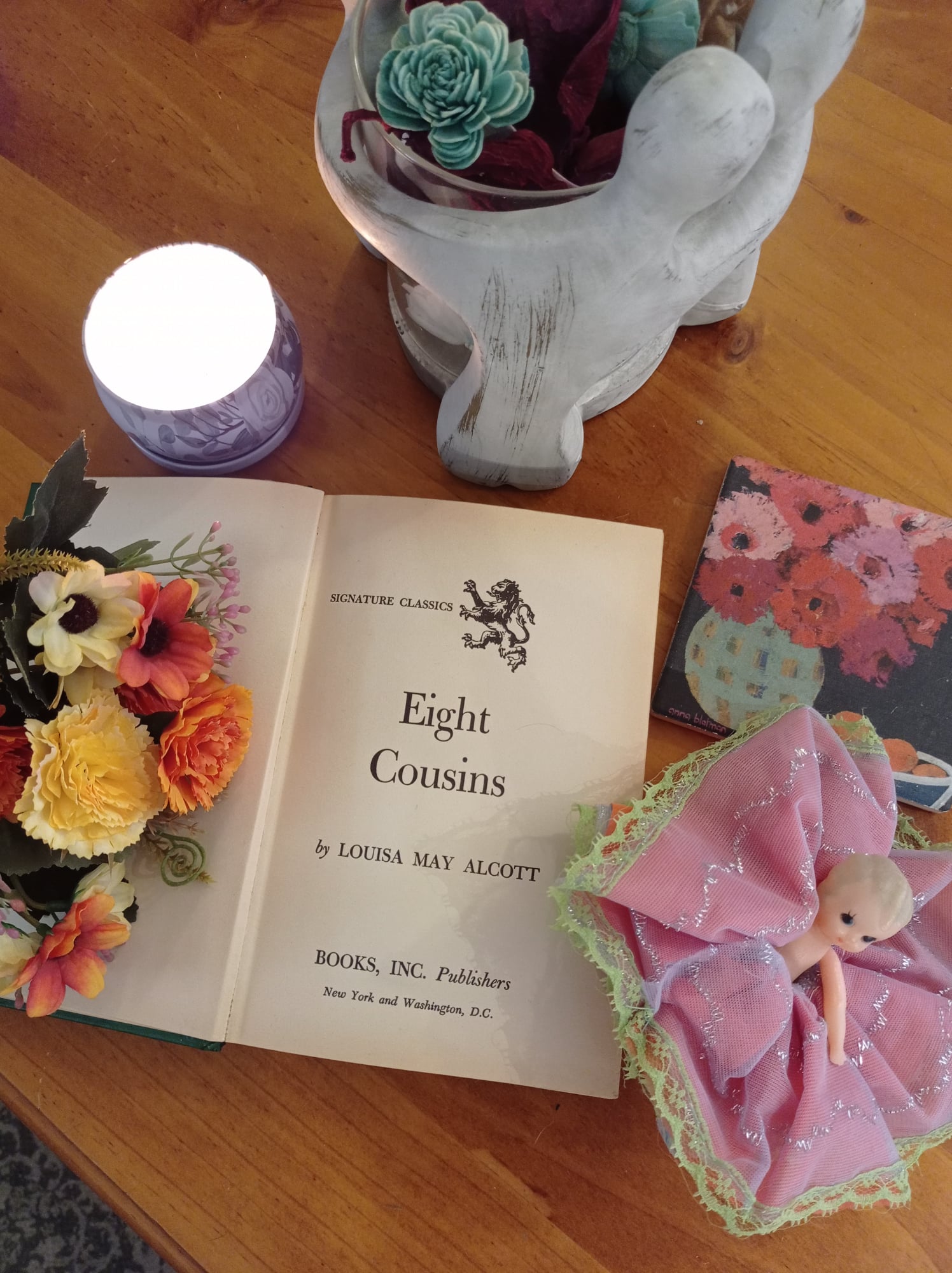
'Eight Cousins' by Louisa May Alcott


When Rose Campbell, a shy orphan, arrives at "The Aunt Hill" to live with her six aunts and seven boisterous male cousins, she is quite overwhelmed. How could such a delicate young lady, used to the quiet hallways of a girls' boarding school, exist in such a spirited home? It is the arrival of Uncle Alec that changes everything. Much to the horror of her aunts, Rose's forward-thinking uncle insists that the child get out of the parlor and into the sunshine. And with a little courage and lots of adventures with her mischievous but loving cousins, Rose begins to bloom.

MY THOUGHTS

This book and its sequel are one of my favourite feel-good duologies. I feel confident enough to promise anyone who loves the Little Women series that you'll get equally invested in the Campbell family. Alcott has a way of making sure we do.

Rose is a lonely orphan who's thrown on the mercy of her father's extended family after his death. There are six overwhelming aunts who all long for custody of her. They agree it would be lovely to be in charge of a girl since they've only managed to produce seven boys between them. But Rose's dad intended for Dr Alec Campbell, the bachelor uncle, to take the reins. And Alec resolves to transform tired, sickly young Rose into a blooming and energetic 13-year-old. He challenges his sisters-in-law to watch him do it over the space of a year, and then dare to dispute the question that he should be the rightful guardian. 

There's some awkward history there, since the two brothers were both in love with the same woman; Rose's mother. Doing right by his niece will be Alec's way of making up for his part in the rift. 

At the same time, Rose is nervous at the prospect of hanging out with her seven male cousins, since she's had nothing to do with boys and finds them intimidating and full-on. Getting to know and love them all is initially easier said than done. There's capable Archie, the eldest and chief; Charlie, the cool, trendy, good-looker; nerdy Mac the bookworm; try-hard young Steve who always has his finger on the fashion pulse; Geordie and Will the 'brats' and little Jamie, the baby of the connection. We no doubt all know 21st century counterparts of each of them.

I'm probably not alone in calling Mac my favourite of the boys. It's surely a split between him and Charlie for most readers, although there's something very likable about dependable Archie too. But as well as being a geek, Mac's an unrefined teenage boy. When he suffers a severe and prolonged trial with his eyesight, Rose glimpses the vulnerability and sensitivity he hides beneath his crude facade, and warms to the cousin she initially finds least attractive. It's quite a delicate touch from Alcott, who tends to lay on moral observations with a shovel. 

Speaking of which, Rose blows up at a couple of the others for smoking. When Charlie argues with her for panning such a harmless, trendy hobby, all Rose has to fall back on is that it's, 'A very bad habit because it wastes money and does you no good.' The fact that it's also a toxic and life-threatening habit hadn't come to light in the 1880s. Even clued-up Dr Alec hadn't latched onto that yet. 

Alec is so smug and opinionated at times, he crosses the line from being a jolly uncle to a know-it-all prat and back again. I'm sure on many occasions, elegant Aunt Clara feels like smacking his face, for she is one of his favourite targets to deflate in public, and then crow over. Interestingly though, some of his attitudes that may sound like common-sense to us were quite radical for his nineteenth century friends and family. 'Nature knows how to mould a woman better than any corset maker!' Or, 'A happy soul in a healthy body makes the best sort of beauty for man or woman.' He believes schools shouldn't try to cram several branches of knowledge into students' heads rather than just the two or three that would most suit each individual. Bravo, the world hasn't really caught up with that one yet, Alec. And he thinks young women who are bent on making themselves into fashion plates compromise their own health with their full-on beauty regimes.  

Eight Cousins ends with the anticipation of interesting developments in the next book. The adults clearly hope for Rose to marry one of the boys, since that was what first cousins did back then to keep big money in the family. Some dynamics will really have to shift to bring this about. Rose's maid-cum-best friend, Phebe with the golden voice, will no doubt be drawn into some romance too, although the Campbell aunts and uncles won't like that so much! They like Phebe as a loyal employee, but no nameless menials for their boys, thank you very much! 

Stay tuned and I'll soon discuss Rose in Bloom. 

🌟🌟🌟🌟

Friday, July 1, 2022

Trixie Belden Series 22 - 24

22) The Mystery on Mead's Mountain

It's time to get into an Alpine mood. The Bob Whites are offered the chance to stay at a breathtaking mountain lodge and learn cross country skiing. Mr Wheeler is thinking of buying the resort and asks the gang for feedback of their impressions. Nobody anticipates the hostile activity of a disgruntled ghost beginning as soon as they arrive. Is there really a human agency behind the nasty attempts to scare them away? And why? What's really going on around here?

* Hooray, it's high time the Bob Whites travel to a new and exciting location. The last six books have been set around home in Sleepyside. I'm well and truly ready for a different setting. But I'm so sad that once again, Dan is unable to go along. Especially when he's right there with them for the first chapter, eagerly asking questions about Mead's Mountain. He can't hide his misery at having to miss out yet again, and that makes us Dan fans upset too. Come on all you Kathryn Kennys, give our boy a break.  

* The Bob Whites discover the down side of owning a car. The overheads are darned expensive. 

* The legend of Thomas Mead's destructive, cantankerous ghost is such a fun premise. He was one of those infamous characters remembered solely for being a cranky old grump to the extent that he was executed for it. (Come to think of it, he sounds a bit like Mr Lytell back in Sleepyside.) Apparently Mead refuses to rest, but is still intent in driving visitors off his precious snowy slopes, even though he's no longer there to enjoy them.  Not that it sounds like he was ever the type of guy who ever actually enjoyed anything, as such, while he was alive.  

* I assumed the Bob Whites were going to be something like Secret Shoppers, only as guests at a ski resort. But it was no secret. Everyone knows upfront this group of teens is the 'investigation team' sent by Matthew Wheeler. In retrospect, things would have been far easier and more hassle free if they'd been able to do their job incognito. And there would have been a whole lot less hostility from people who took umbrage at the fact that they were teenagers. But then, I guess, there would have been no mystery.   

* Honey loses her jolly antique heirloom watch again! It seems she hasn't learned her lesson from The Black Jacket Mystery. Remember when it disappeared while she was wearing it out riding in the game preserve, and Trixie jumped to the conclusion that Dan stole it? Same scenario, different setting. This time it could be anywhere on the ski slopes, and Eric, the lodge's young ski instructor, is Trixie's new scapegoat. For heaven's sake Honey, please lock that watch in a safe!

* Oh wow, a heated swimming pool out by the snow! Yes please!

* The sense of place is superb, as usual. I love this passage when they reach a cliff summit. 'Down in front of them was the chair lift, a mere thread connecting them with the miniature lodge below. They could see the Tan Van, looking more like a toy, and the swimming pool resembling the jeweled setting in a ring. Beyond the lodge was the village of Groverville, pavement ribbons extending from it.' Well done, Kathryn Kenny. With that one paragraph, we're right on the spot without the killer climb.  

* Diana is mustering some sort of enthusiasm for her academic future at last. It's Art. She's the one who instantly recognises the celebrated Carl Stevenson's print in the resort's foyer. And it turns out Art is one of her school subjects, with that friendly Mr Crider from Mystery of Old Telegraph Road as her teacher. Yay, you go, Di.   

* After witnessing some beautiful grazing deer, Di expresses her sorrow at having eaten the roast venison at the Wheelers' before their trip. I tell you, Matt Wheeler has set up Watership Down in his backyard!

* The incident when Mart gets caught in the avalanche is one of those moments of the series that made a long-term impression on me. Sure, we know they'll find him, but how dramatic is savage Mother Nature! And back in my teens, I didn't even fully understand the full risks of suffocation, hypothermia and broken bones. 

* Is it just me, or is Miss Trask a bit breezy and remiss at times? Mart gets spun off his feet in a Mack truck load of sliding snow, is buried for a good 20 or 30 minutes, dug out by a stroke of mere luck, and she doesn't take it upon herself to inform Peter and Helen Belden what happened. Sure he's safe now and there's nothing they can do anyway, but as a parent, it doesn't sit right with me that she doesn't insist on telling them the very same night. Wouldn't you agree, if he was your 15-year-old son? 

* The Bob Whites get to dine at The Purple Turnip, an eclectic vegetarian restaurant. Wow, what goes around comes around. Back in the seventies when this book was written, it was a very popular type of alternative restaurant. And its same vibe would appeal to the hipsters of our new young generation too. There's something about the makeshift tables, mismatched cutlery and vego food that is very contemporary yet again. 

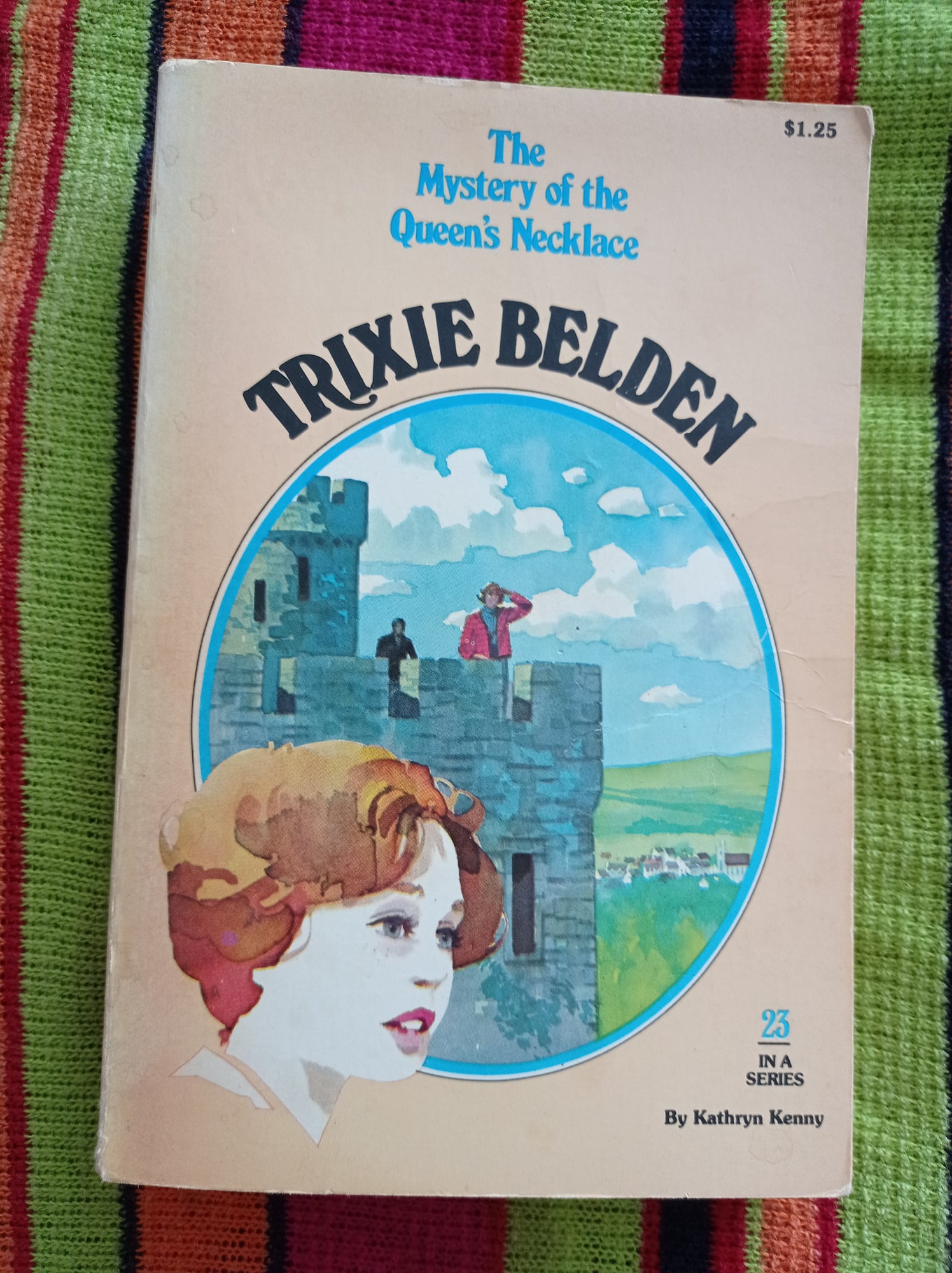
* The picture on my oval cover edition is startling. During the scene it depicts, Jim mentions the guy's 'grotesque' red and green ski mask. I can't help thinking a garish mask is an unwise choice for a crook who turns out to be doing something underhanded that he wants to keep hidden. He should have gone for something neutral and camouflaging.     

 * Brian gets a chance to use his on-the-spot first aid skills not once but twice in this story. First casualty is his brother, of course, after that shocking avalanche. That one's highly emotion charged for Brian. And second is a crusty old man skiing out of control and colliding with a tree. (Better not say too much about him.) Woot woot, go Brian! He makes a vast generalization about sunburn though, commenting that he and Di tan nicely, yet all the blondes and redheads frizzle in the glare of sun off the snow. Nope, not always the case. I'm a brunette who burns like a lobster if not careful.  

* Jim's muscle man moves become necessary in this story too. He's definitely the guy for those fan girls who admire shows of brute strength. I don't think we ever see Dan or the Belden boys put on the spot in this manner even once. I wonder what would happen if they were.

* Hmm, it seems the Bob Whites themselves are crime suspects on another amateur investigator's list, at least for a little while. That's one for the books. They don't think they're remotely suspicious.

* (Aww, how about this exchange.) Di: He certainly is very good looking (talking about Eric). Mart: You would think so. Maybe I should grow wild curls myself. They seem to drive the ladies mad. Di: Don't you dare. We like you just the way you are. You're a real individual, Mart. Mart: Goodbye wild curls - Hello Di! (These two are so cute, but I wish she'd gone ahead and cajoled him to do it. Since he has the potential to grow a careless, tousled mop, it seems such a waste not to, simply out of pride. Ask any guy with thinning hair.)

* I think my quote of the book goes to Carl Stevenson. 'I always found that art understood me a lot better than people did.' I'm always drawn to hermit characters, and he's no exception. They strike me as wise and enlightened, with something elusive that compensates for human society. 

* Okay, this book finishes on New Year's Eve, presumably one exact year after the ending of Mystery in Arizona. The girls were still thirteen then, and now they're fourteen. I scrapped my timeline as far back as Mystery on the Mississippi, yet it's still glaringly evident to any reader who keeps track of dates that this is only a matter of four complete months before Trixie will turn 15 on May 1st. We all know the KK authors don't intend to take her to her next birthday, yet we've only just tipped the halfway point. More precisely, there are 17 books yet to come. That's a lot to squeeze into four months. But bring it on.

23) The Mystery of the Queen's Necklace 


Woo hoo, the Bob Whites go international, or at least four of them do. Trixie and Mart accept an invitation to spend ten days in England along with Honey, Jim and Miss Trask, to research the origin of a stunning necklace Honey has inherited. But not only does the gang feel unwelcome in England, but they become the target of pickpockets. What's more, Miss Trask seems a little too friendly with a smooth talking Scotsman who behaves rather suspiciously. The trip turns into a quest to desperately retain the heirloom necklace, let alone learn about it.  

* Trixie insists on starting this story with a 'Council of War.' She's drawing from the sassy attitude she showed all through Mystery at Bob White Caves and pressuring her parents to cave in to her demands. The Beldens think it's a bit lavish for the Wheelers to give their kids a paid-for international trip. However, I'm with Trixie on this one. Who would willingly let a trip to England slip out of their grasp? But this brief showdown makes me sad that Peter and Helen never get to take a holiday with the Bob Whites themselves throughout the whole series, unlike the Wheelers and Lynches. The all-year-round toil of a small farm must take its toll. Anyway, they agree at last, and Trixie and Mart are off to England! Woo hoo!   

* Oh no, Brian can't go! He has too much work to do at home to spare for 10 days in England. Seriously, we're used to Dan and even Di missing out, but what sort of adventure will it be without Brian? Let's hope nobody needs first aid. 

* Wow, breaking news! Mart is letting his hair grow out for no apparent reason. After all, Diana told him not to do it in Mead's Mountain. But perhaps hearing her consistently go gaga over curly-haired guys has got to him at last. Or maybe he's just growing up and dropping his middle kid statement. It's pure conjecture since he offers no reason for the change. And he still hates being mistaken for Trixie's twin. 

* Talking about hair, Trixie reflects how intimidating Mrs Wheeler can be, since she never appears with one out of place. I think we all know why. She never needs to lift a finger to do a scrap of work. 

* Honey lives everyone's ultimate fantasy. Imagine a wealthy relative you've never heard of passing away and leaving you a priceless treasure in their will. It could only happen to a rich chick like Miss Madeleine Wheeler. The artifact itself is very cool though. It's a necklace dating back to the time of Queen Elizabeth I, but rather than actually being worn by the monarch herself, it's an imitation used by Shakespeare's players as costume jewellery. And Honey can actually trace her genealogy back to Shakespeare's family, through her mother's line.   

* Sadly, the Bob Whites find their general reception in England is not particularly warm. Jim calls it a distinct 'Yankee-Go-Home' feeling. (On a quick personal note, this shocks me since I found quite the opposite vibe as a visiting Aussie.) Anyway, Jim puts it down to lingering resentment after World War Two, when the Brits were still on strict rations and felt the Americans rubbed their faces in it by flashing their dough. Really? Another conjecture is that they find American tourists loud and disruptive. 

* Plainly, it's only Trixie who consistently causes offence. The other three don't get people's backs up. Jim is naturally gallant and gentlemanly, Honey is her usual polite and tactful self, and even Mart seems to have mastered the knack of pausing to reflect how he may come across. But our impatient, impulsive girl detective is a hopeless case. I do feel sorry for her in this book though. She's like an ebullient puppy dog who keeps getting chastised and snubbed. If she had a tail it would be between her legs. It's refreshing to see her like this. 

* Just for the record, her accidental faux pas in getting them all evicted from their first Bed & Breakfast at Stratford could easily have been overlooked in my opinion. It's sad that the wry and droll Brits come across so oversensitive.  

* There are still a couple of lessons Honey should have learned, but apparently hasn't. First is about bestowing trust too readily. And second is not to be careless with her ridiculously expensive jewels. For heavens sake, after losing that antique watch of hers twice, they should all know by now not to let Honey carry the heirloom necklace around in her handbag. Somebody please buy Jim a man bag and let him be the person in charge of it! Especially since they know there are pickpockets around the place.   

* The Bob Whites pass 221B Baker Street while they're in London, and Mart tells the girls, 'that's the famous Victorian flat Sherlock Holmes and Dr Watson are supposed to have rented. Only they didn't, of course, because they're really just fictitious characters.' Hmm, this is where things start getting a bit surreal. Hey Mart, if we're really splitting hairs, what does that make you and your sister and the Wheelers? Since they all seem as real to me as flesh and blood friends, especially while re-reading this series, I won't turn it back on him.  

* Och, they have another delicate problem on their hands. It seems Miss Trask's head is being turned by the bluff Scotsman Mr McDuff, who latches onto them after saving Honey from a spot of bother at Piccadilly Circus. Apart from feeling awkward with the flirty, careless, sometimes touchy behaviour she assumes (and who can blame them!), the Bob Whites struggle with the possibility of losing their beloved chaperone to Scotland. Perhaps they should have been encouraging Mr Lytell's suit all along, haha.     

* Deja-vu from Mystery of the Blinking Eye. In that story, pickpockets were trailing the Bob Whites in New York. Now they're doing the same thing in London and beyond. Same scenario, different artifact. (And different pickpockets, of course.)  

* Now, this just puzzles me. Mart says, 'Surprisingly enough, the stereotyped ideas we have about people of other nations are more often false than true. You know, like I thought the English would have terrible food.' Now, whatever made him think that? He mentions his expectation more than once, and even writes to Di how surprised he is that everything is so delicious. Is this a general misconception that Americans have about British food? And if so, why?  

* You bet they cram some great places into their itinerary, including Madame Tussaud's, Westminster Abbey and the Tower of London. Honey gets a bit squeamish over all the talk about beheadings, but she's come to the wrong place to dodge it. (Honey is a bit of a wuss in this book.) Later they attend live Shakespearean theatre at Stratford twice.  

 * The girls and guys occasionally split up, and I'd prefer to go along with Jim and Mart but of course we readers get dragged along with Trixie and Honey. While the girls do souvenir shopping in Oxford Street, the boys take a cruise up the Thames to the Greenwich Meridian. And in Stratford, the boys tour Shakespeare's house while the girls opt for strolling in the park. If only this particular book had a 'choose your own adventure' component written into it, I know which pair I'd be trailing. 

* Anti-quote of the book comes from Trixie. 'Well I guess there wouldn't be any London if our country hadn't entered the war.' Whoa, wash your mouth out, arrogant miss. I'm glad Miss Trask demurs about that point. 

* Quote of the book comes from Mart, when Trixie strains too far over a cord barrier at Warwick Castle and knocks a suit of mail clattering to the floor. He says, 'Trixie strikes another blow for international relations.' Bahaha. 

24) The Mystery at Saratoga

We get a behind-the-scenes glimpse into the racehorse industry, with its hidden corruption. Part of Regan's past comes to light. When a thoroughbred horse breeder named Mr Worthington comes to visit the Wheelers, Regan gets wind of it and takes off, leaving a cryptic note for Dan. A bit of research reveals that he was implicated in a horse doping scandal as a teenager. Trixie and Honey aren't sure whether Regan disappeared to clear his name or avoid justice, but either way they are determined to track him down. 

* Whoops, one of the things the Bob Whites have dreaded has finally happened. Regan has disappeared, for no apparent reason. It's some mysterious catalyst known only to himself. Trixie's reasons for wanting him to always stick around are not entirely unselfish. Mr Wheeler has hinted that he may sell all the horses if Regan ever gives notice, because he's an employee in a million. What's more, Regan is always willing to babysit Bobby any time. Yet nevertheless, she and the other Bob Whites genuinely value him as the great friend and treasure that he is. 

* Regan leaves Dan a note telling him that he has to take care of unfinished business for an undisclosed length of time. Even Trixie notices that he signs it, 'Your Uncle' instead of 'Love.' It seems Regan and Dan are both adept at dodging talk about their pasts. Although there's genuine commitment on both sides, this uncle and nephew definitely keep each other at arm's length. I'd like to see them grow closer, but wonder if it's possible or likely.  

* Of course, the age gap between them is far less than most uncles and nephews, making things more complex. Figuring that Regan is 24 in this story, and Dan is about 16, it's really only a matter of eight years or so, which makes Regan more of a floundering older brother figure, in my opinion. I guess it's a big ask to expect Regan to supply the secure and grounded adult influence which Dan needs from his only living family member. It's easy to forget just how young Regan really is.

* (Okay, I just had a terribly corny thought. Although Regan may be a 'stable' influence in the horsey sense, he's not necessarily a 'stable' influence in the sense of reliability. If you're groaning, do forgive me.)  

* Trixie blows up at Dan, when he wonders if the ugly rumour about Regan is true. She says, 'He showed a lot more faith in you, and hardly knew you at all.' Although Dan nods and apologises at that point, I beg to disagree. At the time of Dan's arrival in Sleepyside, Regan barely showed any trust in him at all, and basically disowned him, leaving him with Mr Maypenny from the outset. (I discussed this more in my review of The Black Jacket Mystery.)

* Poor Trixie is going through a phase of being gloomy about her looks (although we know she's considered very pretty by many). How about this logic. She pulls a face at her own reflection, then tells Honey, 'See, no wonder how funny I look ordinarily, it's nice to know that I can look even funnier if I really try.' It's extremely sad really, that she deems Honey (and of course Diana, when she's around) closer to society's ideal of beauty than herself, then beats herself up over it. 

* A sneaky, cloak and dagger vibe pervades the racecourse, which the two girls discover is merely part of the industry. Owners and trainers do their best to keep a horse's vital statistics as close to their chests as possible, which takes some trickery and subterfuge, considering everything is ostensibly done in broad daylight. But it's all in a day's work. 

* Mr Worthington is the gregarious owner of Worthington Farms, the prestigious thoroughbred outfit where Regan worked from the age of 16 to 17. Carl Stinson is the taciturn but highly relied-upon head trainer who is foul at Regan, because he believes his most promising young employee did the dirty on him, accepted a bribe and doped the prize horse in the stables. 

* Oh, and although horse-lovers no doubt know this, as Trixie and Honey already did, it was news to me. 'Thoroughbred' is actually a specific breed of horse. Many novices mistake it for 'purebred'. I was one of those naive readers. 

* Ooh la la, Regan's past included budding romance, young as he was. Carl Stinson's daughter Joan, also a teenager at the time, had a major crush on the young redhead. This author (Laura French, I believe) left it way open for other Kathryn Kennys to continue developing Regan's relationship with Joan. Nobody ever does though. I doubt her name is ever mentioned again.  

* The scene when Trixie and Honey eventually find Regan is heartwarming. It shows the fond, easy rapport they all share with him, and is also the one and only scene in which Regan ever falls off a horse with shock. 

* Even though part of Regan's personal history has come to light, it turns out to be just a small chunk of his working life as a teenager. Nothing at all is divulged about his dysfunctional family background, including his relationship with his sister and whatever happened to their parents. Why was a sixteen-year-old lad out by himself, looking for jobs with horses anyway? 

* Hmm, we had Carl Stevenson in Mead's Mountain and now Carl Stinson two books later. Hopefully that's enough Carls for a while, lest we get them mixed up. 

* Yay, although Jim, Brian and Mart aren't in this story for the most part (since they're working as camp counselors), I love their role toward the end.

* Quote of the book comes from Trixie. 'We'll think. Our brothers aren't the only Bob Whites who have mastered that skill, in spite of what they try to tell us.'

Catch up with Series 19 - 21

Next up will be Series 25 - 27

Friday, June 24, 2022

Mini Reviews

Flowers for Mrs Harris by Paul Gallico

This was a quick weekend read in cold weather to indulge myself when I handed up all my assignments and started mid-semester break. My review of Coronation interested a few friends, so I was happy to start another Gallico book. 

I have empathy for Mrs Ada Harris, who should surely pronounce her own name 'Ida' since she says such things as, 'I syved some money to get me passport photo tyken.' Mrs Harris is a 'British char' and I've been an Aussie cleaning lady. She regards her profession as a creative effort in which she takes pride, which is possibly the best way to take domestic cleaning over the long term. (I only did it for a few years. You do get used to it, but it's notorious for repetitive strain injuries such as carpal tunnel syndrome and lower back trouble.)

Anyway, Mrs Harris spots two Christian Dior dresses in the wardrobe of a client and considers them breathtaking and heavenly. They totally slake her thirst for beauty and colour, so she sets a new lifetime goal on the spot. It isn't to stop putting her body under strain cleaning for other people, for Mrs Harris is a realist. It's to own a Dior dress of her own, for she's also a romanticist. Mrs Harris knows there will never be an event to which she can wear it, but the thrilling idea of storing such exquisite perfection in her own wardrobe drives her to scrimp and save until she can afford this sublime but essentially useless item. 

Next she heads across to Paris to choose her dress, where she's totally out of her depth in powerful circles of elegance. Yet this plucky heroine refuses to feel belittled by snobbery and spurs herself on with the reminder, 'Your money is as good an anyone else's.' Her arrival impacts several other people she brushes shoulders with, including Madame Colbert, the manager, who realises that her job with VIPs has blinded her to the reality of wider human needs. There is also Natasha, the most celebrated model and toast of Paris, who knows full well that she's being objectified and treated as a pretty prop to boost other people's public images. Natasha longs to quit her illustrious job and be absorbed back into bourgeois anonymity, but considers the price too high to pay, until honest little Mrs Harris walks through the door.

It's a lovely story all about the high price of being 'somebody' and the inherent dignity of being a 'nobody' and also encourages us to discover our own piece of beauty to boost our spirits in this world of toil. I find reading Paul Gallico's books is a bit like indulging in a super-sweet dessert though. Reading them back to back would be overpowering, but they're great for a quick indulgence here and there. 

And talk about the 1950s vibe! This decade was over long before I was born, yet I can almost smell the Brylcreem, not to mention the heady scent of big money. 

🌟🌟🌟🌟 

Devotion by Hannah Kent


I adored this book because the characters' story is taken straight from my ancestral background on my mother's side. They are devout German and Prussian Lutherans who make the huge sacrifice of migrating to South Australia on a grueling six-month journey by sea, for the freedom of worshiping God in their own way. And they end up in the lush and fertile Adelaide Hills where they build the township of Hahndorf (which is re-named Heiligendorf in this novel, but we all know where it stands for). 

The tale starts back in the Prussian village of Kay, and focuses on two teenage girls who form an extremely close and loving bond. Hanne Nussbaum, who narrates the story, is a gauche and awkward girl who suspects she'll never live up to the expectations of her austere father and tight-lipped, stoic (but ravishingly beautiful) mother. Her new friend, Thea Auchenwald, is the daughter of a pair of broader-minded newcomers who linger on the outer circle of village life. Indeed, Thea's mother, Anna-Maria, is rumoured to be a bit witchy because of her herbal remedies, although desperate people don't mind calling on her for medical emergencies. 

During the debilitating sea passage on board the Kristi, something drastic happens to Hanne that allows her true sprightly and whimsical nature to have free rein. (Major plot spoilers seal my lips.) Suffice to say it changes her whole way of relating to her parents, her good-looking and cheeky twin brother, Matthias, and her fractious baby sister, Hermine. Not to mention Thea, who she comes to realise she loves with all her heart.

Hannah Kent is renowned for her impeccable research, and this is authentic and polished. Perhaps Hanne and Matthias may come across with the mindsets of twenty-first century youths, the way they surreptitiously smirk at their father's radical piety behind his back. If so, I feel Kent couldn't write it any other way. I love those flashes of modern solidarity from the twins. If they shared their father's same soberness and severity, as may well have been the case in real life, it wouldn't be the same book at all. I think historical novels must have their share of up-to-date attitudes to make them palatable.   

There is plenty of wonderful lyrical tribute to their new environment, full as it is with strange, mobile and noisy new flora and fauna. Hanne also contrasts the colour, light and perfume favorably against the dense, dark, forest environment they came from, lovely as it was. Since their story and the setting is my very own (for I lived a five minute drive from Hahndorf for many years) I wonder if I'm biased to appreciate this book as much as I do. It certainly makes me cherish my local environment and spare a thought for the brave and desperate settlers whose blood runs through my veins. 

I can't even give genre heads-ups for other readers, since that in itself may be spoilerish. All I can say is read it, and tell me what you think. It's historical fiction, and that's all we need to know at the start. 

The theme of the novel may be said to be spoken by Thea. 'Owe no-one anything, only love one another, for she who loveth hath fulfilled the covenant.' 

🌟🌟🌟🌟🌟 


Friday, June 17, 2022

'The Railway Children' by E. Nesbit


In this much-loved children's classic first published in 1906, the comfortable lives of three well-mannered siblings are greatly altered when, one evening, two men arrive at the house and take their father away. With the family's fortunes considerably reduced in his absence, the children and their mother are forced to live in a simple country cottage near a railway station. There the young trio—Roberta, Peter, and young Phyllis—befriend the porter and station master.

The youngsters' days are filled with adventure and excitement, including their successful attempt to avert a horrible train disaster; but the mysterious disappearance of their father continues to haunt them.

The solution to that painful puzzle and many other details and events of the children's lives come to vivid life in this perennial favorite, a story that has captivated generations of readers.

MY THOUGHTS:

This was published in 1906, so belongs to the charming kid lit of the short Edwardian era. Three young siblings live a comfy life with their parents in a London townhouse until their father, a government worker, is roughly hauled out of the house one night. The reader gets enough hints early on to surmise that he's been unjustly imprisoned, although this fact is concealed from Bobbie, Peter and Phyllis for a very long time. 

Their mother is forced to remove the family to Three Chimneys, a rough country dwelling, and drastically cuts costs while she tries to support them by writing stories. She's one of those beloved, hero-mums with the weight of the world on her shoulders, and the poems she writes for family and friends during her more leisurely moments are a great embellishment of the book.

Rather than growing miserable because of their new spartan lifestyle, the three kids channel their energy into getting familiar with the local railway and canal systems. The railway is their favourite, because it's the first interest they discover, plus the people who work and commute along it are the most friendly. There were several railway workers back in my own family line, so I really appreciate that. 

On several occasions, at least three of huge significance, the trio happens to be on hand at crucial moments to prevent serious accidents. Yes, it's very convenient plot wise, but also most entertaining to read. Other themes include being bold enough to ask for what they need, since others can't be expected to guess. Their mother and other adults are often horrified when boundaries of pride and privacy are accidentally crossed, but Bobbie, Peter and Phyllis definitely get things done, making us question whether those boundaries should even be there. 

Bobbie, or Roberta, the eldest sister, is a stand-out character to me. For those of us familiar with 21st century terms, it's clear she's an empath, our modern label for a person with a sixth sense when it comes to perceiving the mental or emotional turmoil of others. This is quite fascinating, because Nesbit would never have heard of such a term, writing as far back as 1906, but Bobbie clearly has all the typical traits, including internalising others' emotions, willingness to help out, love of nature, and a certain delicacy of holding back her intuitive knowledge when she thinks it's most tactful. 

The book explains her character as one of 'silent sympathy, which is not as dull as it sounds and not always easy.' In other words, Bobbie won't reveal to people that she's even aware of their suffering, but just makes an extra effort to be nice and lighten the load. It's a rare and excellent talent to have but since it's so internalised it tends to go unnoticed, with no accolades. Because of this, Bobbie never comes across as a goody-two-shoes who's performing to earn brownie points, but rather as the treasure that she is. 

Besides, she gets into too many heated arguments with her brother and sister to be a goody-two-shoes.

Phyllis, or Phil, is just the sort of feisty youngest sister who stands up for herself that I like. And Peter is a great lad, hanging out with his sisters because his options are so limited, while the restless machismo and testosterone drive him to get a bit dissatisfied and impatient. In one cringe-worthy scene, Dr Forrest gives him a totally old-fashioned, condescending and utterly sexist lecture. 'You know, men have to do the work of the world and not be afraid of anything, so they have to be hardy and brave. But women have to take care of their babies and cuddle them and nurse them, and be very patient and gentle... Girls have to be so much softer and weaker than we are, because if they weren't, it wouldn't be nice for the babies.' 

I had to laugh when Peter paraphrases later to Bobbie and Phyllis,' Dr Forrest has been talking scientifically with me. It all comes to you girls being poor, soft, weak frightened things like rabbits, so us men have just got to put up with them.' Haha, we've come a long way. 

Overall, it's a heartwarming blast from the past about kindness, simple pleasures, straightforward honesty and things ending well simply because a few people dare to show a bit of initiative. And I'm sure I won't forget Bobbie's delayed reaction in the wake of a sudden landslide on the tracks.  

🌟🌟🌟🌟    

Friday, June 10, 2022

Trixie Belden series 19 - 21

19) The Secret of the Unseen Treasure

The Bob Whites stumble upon an arsonist preparing to set fire to the flower farm of long term family friend, Ethel Elliot. After some snooping, Trixie is convinced that somebody has been trying to sabotage this harmless widow's business. The question is, who wants her out of the way, and why? As well as trying to discover the answers, the Bob Whites aim to help this struggling pensioner make ends meet. 

* Ethel Elliot was Mrs Belden's babysitter when Helen was a little girl. Ethel married a horticulturalist named Sam who had a teenage son named Max. Now Sam is long dead and Max has grown up.

* Charles (or Charley) Hartman is a retired cop and ex-judo instructor who still has a very sharp edge. With such a combination, he's not a guy to mess around with. I admire his patience and respect for Trixie's work. Other elderly chaps in his position may well be too ageist and too sexist to take her seriously. Go, Charles!

* The cover of my oval edition is a little misleading. It gives the impression that the 'unseen treasure' of the title may lie deep at the bottom of a sea or lake. In actual fact, the Bob Whites' discovery in the Wheelers' lake is a total accident and red herring. It's a very cool and unexpected scene though, so not a bad choice for the cover. Because of the main setting and subject matter though, I might have preferred a riot of colorful cottage flowers. 

* Jim and Brian shoot off for two weeks to work at a boys' camp. Apparently they both shine like the models of young manhood they are. Jim performs a heroic rescue and then Brian delivers some crucial first aid. This is all totally off scene for a chunk of the book, just in case we forget how awesome they both are. They are still in the story though.

* Hmm, I reckon Peter Belden is a bit too chatty with his family regarding privileged information from the bank. Sure, he tells his wife and kids, 'What I say has to stay at this table and go no further,' but it happens more than once. I hope he doesn't start making a habit of these information leaks. At least he just does it in front of Trixie and Mart, and not chatty Bobby. 

* Kathryn Kenny does a brilliant job of describing a dodgy florist shop. There's just something about Manton's that's on the nose. 

* Hey, how about the outcome of the flower photograph contest? Did Mart's photo end up winning the grand prize for Mrs Elliot? Sure, it doesn't really matter anymore, yet it's still a thread that peters out and would have been nice to know. (By the way, this boy turns out to have another talent, along with music, general knowledge, research skills, furniture restoration, agricultural know-how and a super-dooper vocabulary. It turns out he can take terrific photos too.)

* Whoa, a hidden cannabis crop is a controversial discovery. Not to mention awkward when Dan, who wasn't along for the find, assumes the others have all been smoking pot! I mean, what the...? How well does he know his fellow Bob Whites? (Just in case you're wondering, this isn't the 'unseen treasure' of the title either, haha.)

* Dan is a bit sus and touchy in general in this book, because he's spotted Al Finlay, a gang leader he once knew, hanging around Sleepyside. After what happened to Dan in The Uninvited Guest when his old gang members turned up, I guess we can't blame him for being a bit paranoid. His past never seems to stop haunting him.

* I appreciate Trixie and Honey's innocence in being unable to identify the strange leaves. Even Brian, the future doctor who was credited with so much botanical knowledge in The Marshland Mystery isn't sure. Once again it takes Mart, the budding agriculturalist and general trivia buff, to figure out what the girls have stuffed in their pockets. And he ain't impressed.

* I'm not sure I'm a big fan of allowing Mrs Elliot to remain oblivious about the shenanigans going on under her own roof, and on her own property over the years. In her position I'd want to know. It might help her appreciate the true character of her stepson too. 

* But her assessment of him is still good enough to be the quote of the book. 'Max has too much of the city in him. With growing things you have to wait, to be patient.' That's a good life lesson for all of us, and no doubt includes kids, ambitions and dreams.

20) The Mystery off Old Telegraph Road

Trixie discovers that Art students at Sleepyside High are really badly funded, so she and the Bob Whites decide to host a bikeathon to raise money for art supplies. Serious opposition stuns them, especially from talented artist Nick Roberts, one of the very people they're trying to help. Why would he object? Who is behind the anonymous threats for them to stop their plans or else? And what's with the counterfeit German bank note Trixie finds blowing in the breeze? It all comes to a head when the Bob Whites are forced to consider whether persevering with their plan will jeopardize anyone's safety.   

* The notorious Ben Riker is back, staying with his aunt and uncle Maddie and Matt Wheeler. This 'poor little rich kid' was in with a bad crowd at boarding school, and his parents hope his cousins and their friends will rub off on him. Instead, he's fallen in with a new bad group at Sleepyside. Trixie finds him annoying as hell because he's monopolising Honey and Jim. She sure doesn't want to make Ben one of her personal help projects. He's where she draws the line. 

* Just for the record, Ben's uncouth friends are Mike Larson, Jerry Vanderhoef and Bill Wright. We'll know them if they pop up in the halls of Sleepyside High again. 

* Hmm, nothing much has really changed in the decades since this book was written. So often it seems to be the arts that miss out on support or funding. Sports get far more financial backing. That speaks volumes about people's general priorities, then and now. 

* Okay, times have changed dramatically in other ways though. I'm pretty sure it wouldn't be considered ethical in our day and age, for an art student like Nick Roberts to sketch other people's houses and then sell them to the general public at his stall. Yet  in the seventies when this story was written, privacy and permission weren't such hot topics. Trixie and Honey are simply glad to come across his drawings of Crabapple Farm and Manor House before anyone else snaps them up. Come to think of it, does it strike you as slightly creepy to think of anyone else buying them?

* 'Kathryn Kenny' is as interesting and comprehensive as ever, when it comes to educating us readers more about the themes of the book. Nick Roberts gives the girls a good tutorial about pen and ink drawings, and later Mr Crider, the art teacher, does the same regarding silk screen printing. (It's Laura French's first look-in, I believe, who later became quite prolific in the series.)  

* Helen Belden, the one and only Moms, was in a similar position to these struggling Art students. It seems she was an Art major before she married Peter, but her life took a different turn when she had babies and could no longer afford art supplies. A lovely landscape on the wall of Crabapple Farm is her link to the past, painted back in the day. She never shows any signs of regretting the loss of that side of her life. I suppose she hasn't had time for much introspection.

* Ouch, one of Trixie's famous temper flashes puts her briefly into the bad books of her bestie Honey! And Honey goes so far as accusing Trixie of seeking attention! Yep, the same Honey who snaps at anyone else (especially Mart) who ever dares to suggest such a thing. Just for the record, it's clear that Honey was pushed just a bit too far, and was quite justified. Both girls deal well with their difference of opinion, without letting it fester too long.    

* Awww, I love it when Trixie and Mart have an honest heart-to-heart about Trixie's rift with Honey. In fact, Trixie shows up well in this book. I like her best when she's vulnerable and ponders her possible flaws and overbearing approach. 

* Trixie, in her effervescence, simply assumes that others will share her enthusiasm for the bikeathon project and agree to be 'in'. Lucky for her Mrs Vanderpoel and Mr Maypenny are both good sports when she 'volunteers' them for hospitality and food. But Nick Roberts makes it clear that she can't presume too much as far as he's concerned. 

* We get a hilarious Bobby moment, when he locks himself inside the house, then launches into full-on panic mode. Neither his mother's fruitless attempts to soothe him, nor Mart's wordy instructions to solve the problem do the slightest bit of good. It takes the future Dr Brian Belden to cut the Gordian knot. He knows the only solution is to forcibly break the door chain. And the dramatic Bobby thanks him for saving his life!  

* Whoa, Nick's a bit reckless toward the end, for a standoffish, deep thinking art student. But perhaps he was simply pushed too far. 

* Wow, good old Jimbo gets the chance to utilise some impressive strongman tactics again. What a guy! But our Jim is more than just an impressive bicep and six pack. He has a great heart too.  

* Both Ben Riker and Nick Roberts come across as angry young men throughout this book, and both eventually confess that they find the Bob Whites cliquey and feel excluded. What a flashback to Tad Webster in The Mysterious Code. On one hand, those inclusive Bob Whites haven't learned their lesson. But it's interesting because on the surface they're just a small group of out-of-town kids who bond because they feel geographically removed from other Sleepyside High students.  And they're sort of geeky, in their matching red jackets. Yet jocks like Tad and Ben and art nerds like Nick alike seem to feel and envy their mystique. 

* Overall, I wish I could have been at that bikeathon, peddling up Glen Road and through the Wheelers' game preserve, sampling Mrs Vanderpoel's famous cookies and Mr Maypenny's legendary stew. Oh well, bring on more stories instead.  

* Quote of the book. Trixie: I have a bad habit of assuming that other people know all the details of things I'm involved in, just because I spend all my time thinking about them. Mr Crider: That's a fairly common habit with us human beings, Trixie. 

21) The Mystery of the Castaway Children

The Beldens discover a tiny baby, apparently abandoned in Reddy's doghouse. It's a ready-made challenge to trace his family. Since he bears several bruises and scrapes, they must tread with caution rather than reunite him instantly with whoever caused them. Once the baby's identity unfolds, it appears his older brother is still missing and kidnappers are involved. It'll take some delicate probing to return both little boys safely to their parents, but can impulsive Trixie restrain herself? 

* I love the start of this book, with the six Beldens doing their best to cool down on a sultry summer night, culminating in that refreshing thunder storm and shock discovery in Reddy's doghouse. (I'd call it a kennel, but the story consistently says 'doghouse.' International differences.)

* Reddy is a hero. Not all dogs would simply stand back being hospitable, when an interloper has been placed in their domain. 

* It's a dramatic moment when Mart and Trixie discover the baby's bruises and wonder whether he's been battered by someone intentionally. But technically, these two aren't the first to reveal baby Dodgy's tiny torso. Their mother gives him his first bath the previous evening, and surely would have noticed the bruises then.  

* Once again, Brian and Mart have a ginormous responsibility of the running of the farm placed on their young shoulders. As their father heads off to his air-conditioned bank in the heatwave, he casually commands them to irrigate the raspberries. What a long, hot, sweaty and tedious job for two High School lads. They never once complain though. I tend to think Peter and Helen may be in for a rude awakening when their sons leave home. 

* Diana relishes the chance to help care for a three-month-old bub, and is a natural when it comes to hands-on care. Trixie tends to get a bit impatient and snappy with Di, as we've seen before.

* This story serves as a warning that little kids may have under-developed senses of humor, as poor David Dodge finds out. The conversation which young Davy takes at face value is astounding, but not at all implausible for someone his age. We must learn David's lesson and love our young relatives but never assume that they always cotton on to our jokes, haha. 

* We meet Ella Kline again; the wheelchair bound girls who does some sewing for a living and boards at the Glen Road Inn. She's the godsend who helped with Juliana's wedding clothes back in The Uninvited Guest. 

* When the Bob Whites come across Nancy the goat and her teenage owner, Brian confesses he's unable to milk a goat, even though he lives on a farm. Yet he and Mart both milked those Ozark cows in The Mystery at Bob White Cave with no hassles. Come on Brian, how different do you think it could be?

* Elmer Durham the wealthy, sorta-smarmy auctioneer, had teeth so perfect they were bound to be dentures, we're told. Haha, those days are over. Some elderly family members inform me that dentures are now made with intentional flaws to appear natural. 

* This novel is a bit of a tear jerker. I remember sobbing over the big family reunion near the end of the book in my teens. In fact baby Dodgy is a very sweet character, bringing the best out of all the Beldens and their friends. Peter and Helen could so have another one! (I'm pretty sure they'd say I have to be joking.)

* This was written in the 1970s, long before backward facing car capsules for babies were invented. 

* It's incredible that a boy Davy's age could escape attention for so long out on his own with his baby brother. You'd hope that in a similar scenario these days, that work crew would have intervened.  

* The way I see it, Trixie causes as much trouble as she solves. She, Honey and Jim make a rash visit to certain people against Sergeant Molinson's advice. Sure enough, she causes crooks to follow her. It's like stirring up a hornet's nest with a stick. Not only does she endanger the lives of her own loved-ones, but those of the small Dodge brothers too. Then Molinson shakes her hand in the aftermath. Does he not understand what just happened? If ever there was a time to rebuke her it's now. Perhaps he will when he has time to reflect.   

* For quote of the book, I've chosen a line from the narration, instead of a speech from a character. 'Sharing the work was the price each Belden paid for living a quiet, uncluttered life.' (And as I mention above, the two elder boys seem to shoulder a particularly hefty share.) 

Join me next time for Series 22 - 24  

And catch up on Series 16 - 18   

Thursday, June 2, 2022

'Coronation' by Paul Gallico


MY THOUGHTS:

 This was a strong recommendation from a friend who came into the secondhand book shed where I volunteered for a while. She pulled this one off the shelf and told me it's brilliant. Well, serendipitous recommendations are too few and far between for me to miss a single one. I agree it was a highly enjoyable story and I decided to time this review with the queen's Platinum Jubilee celebrations, which begin this week. Now, I'm sure I wasn't the only one who got a bit confused by dates, since the queen was crowned in 1952 but her coronation didn't take place until 1953. A quick bit of research reveals her coronation was delayed for a year, as a mark of respect for her father, King George VI, who had passed away so recently.

Anyway, that big day in London is what this book is all about. It's June 2nd, 1953, and the Clagg family are off to the city to join the celebrations as the new young queen is crowned. Will Clagg, the dad, is a blue-collar steel worker who is delighted to have secured five tickets for a prime viewing spot along the procession route, that includes wonderful refreshments. Their day out will have to take the place of their annual fortnight holiday to the sea, but it's a big sacrifice they all agree on. 

Young Johnny is an imaginative boy who loves to mentally cast himself in a hero's role. He most looks forward to seeing all the fancy royal soldiers and cavalry. His little sister Gwendoline is obsessed with young Queen Elizabeth II because she seems like a fairy tale character in flesh and blood. And Prince Philip is so gallant and handsome. (I remember having similar feelings about Diana is the early eighties when I was quite young.) Granny Bonner, the critical, snappish mother-in-law, can't resist the thought of being present for a significant historical moment. And Violet, the careworn young wife, is just hanging out to try a sip of champagne. 

Well, it turns out crooks and frauds were as busy in 1953 as they've always been. The Claggs' tickets turn out to be absolutely worthless. But what strikes them as a disaster turns out to bring brilliant consolation for each family member as the day unfolds. I can't improve on how the dust jacket blurb puts it. 'Each learned how to relinquish his or her own ends and desires. Yet one and all returned home laden with gifts and riches far beyond their expectations which would remain with them for the rest of their lives.' In short, it turns out not to be a complete waste of a day. 

This story is a convicting example of how poor people may possess a short cut to happiness and contentment which rich people forfeit, because their standards of what should tick our boxes are set incredibly high. The Claggs may be no-names, but without saying so outright, Paul Gallico gives the impression that in the long run, they may well clock up many more moments of contentment and satisfaction throughout their lives than VIPs who are regarded as far more important. Especially if they keep on with the same resilient attitudes.

It's one of those novels that takes place within one single day. Whoa, the overwhelming noise and bustle of that big day in London comes through the pages loud and clear. Through the medium of TV beginning in 1981, I've watched four royal weddings and Prince Philip's funeral. And now, through the medium of this little novel, I feel I've also been at the queen's coronation, although I didn't really catch a glimpse of Liz or Phil in person. And when the Claggs finally get home, I felt my ears were ringing with the sudden silence. I think this might be a nostalgic read for anyone who really was around at the time.  

I'm glad the Claggs were satisfied with how things played out, although I'm not convinced I would have been in their place. Maybe I still have a bit to be desired in the art of letting things roll. 

🌟🌟🌟🌟