Monday, May 17, 2021

'Jane of Lantern Hill' by Lucy Maud Montgomery


For as long as she could remember, Jane Stuart and her mother lived with her grandmother in a dreary mansion in Toronto. Jane always believed her father was dead until she accidentally learned he was alive and well and living on Prince Edward Island. When Jane spends the summer at his cottage on Lantern Hill, doing all the wonderful things Grandmother deems unladylike, she dares to dream that there could be such a house back in Toronto... a house where she, Mother, and Father could live together without Grandmother directing their lives — a house that could be called home.

MY THOUGHTS:

 This story is very dear to my heart, so I've chosen it as the Children's Classic in this year's Back to the Classics Challenge. It's technically kid's lit, but is one of those layered books you can spot extra themes in when re-reading as an adult. It offers deep refreshment to readers of any age in an easy-reading, palatable style, like spiritual medicine between covers. 

It was one of Montgomery last books, published in 1937 while she was living in Toronto. I read that she was spurred by homesickness and nostalgia for Prince Edward Island. Well, this story made me homesick too, and I've never even been there!

11-year-old Jane lives in a grim old Toronto mansion with her mother, aunt and grandmother. Old Mrs Kennedy is a control freak and skillful guilt-tripper, who loves her daughter Robin (Jane's mother) with scary intensity. (LMM has given us this type of character before. Think of Teddy Kent's mum from the Emily series.) And Robin is a doormat who finds it impossible to stand up for herself, especially since her mother has everlasting ammunition to throw back in her face. Robin is separated from her husband; a man who the elderly matriarch never wanted her to marry. Robin lets her mother dress her up like a doll well into her thirties, and attends all sorts of social events to show herself off on her mother's behalf. It appears to be a lovely lifestyle but she never knows a moment of true happiness.

Young Jane lives a stifled lifestyle too. She's a practical soul who longs to be helpful but isn't allowed to do anything. Scoldings and pay-outs from her grandmother have made her super-edgy, frustrated and awkward, which generates more tongue lashings. It's a vicious circle, but still, it's the only existence Jane knows, and she adores her mother, who is afraid to show her any affection in front of the jealous old lady. 

One day a letter arrives from Jane's father, Andrew Stuart, requesting that she visit him on Prince Edward Island over the summer holidays. At first Jane is petrified, since all she's ever heard about Andrew has an evil monster tinge. But the family decide it's best to agree as a one-off capitulation, to appease the beast in his lair so he'll leave them alone in future. Poor Jane is devastated and dreads every minute. 

But when she arrives on the Island and meets her dad, Jane's life changes completely. Remember the old Wizard of Oz film, which switches suddenly from black-and-white Kansas to vivid, full-coloured Oz? It's easy to imagine the same thing happening here. While Jane has wonderful fun, keeping house and cooking, making new friends, and chilling with her delightful and non-conformist dad, her personality has a chance to blossom in unexpected ways without the old restraints.

Forget any feedback you might hear calling this anti-feminist hype which aims to keep girls at home scrubbing floors and washing dishes. On the contrary, it's about liberating girls to be mistresses of their own domains, curating their own environments until they reflect their inner beauty. It's about making the physical aspects of your life a triumphant statement of creativity. Jane knows that a person's home is their palette, and when she's given carte-blanche to do whatever she likes within the little house at Lantern Hill, she takes full advantage of it.  

This book is all about how people, like plants, thrive in the proper soil, and for humans it's when we find our ideal environment, niche and tribe, and are free to work out our deepest purposes. 

So I guess the theme sure isn't, 'Bloom where you're planted,' but there are plenty more which can probably be applied to each character. 

One of Jane's is definitely, 'The thing you're dreading may turn out to be the best blessing ever.' 

Andrew's might be, 'Go out on a limb and see what happens,' or, 'You have nothing to lose.' 

For Robin, 'If life offers a second chance, grab it with both hands.' 

And for Grandmother, 'Hold life loosely, or you may loose what you cling to with that white knuckled grip.'

Perhaps the best lesson of all is that enthusiasm is contagious. It's such a charming father/daughter tale, and the mutual benefits are immense. Jane makes it her mission to provide the warm, homely comforts she believes Andrew lacks in his bachelor lifestyle. In return, through listening to his great takes on geography, history, religious studies and current affairs, she discovers she actually loves the school subjects she'd assumed she hates. 

If you're a sentimental reader like myself, read it if you can. 

🌟🌟🌟🌟🌟 


Tuesday, May 11, 2021

'Prince Caspian' by C. S. Lewis


Or 'The One with the Hard-Done-By Prince'

Some minor spoilers lurk below the summary, so beware. 

I admit I felt resistance coming into this one, after the impact made by The Horse and his Boy. This book generally ranks low when it comes to the Narnia series, and rarely seems to be anyone's top favourite (similar to Harry Potter & the Order of the Phoenix, I guess.) I remember falling asleep during the Prince Caspian movie, because it seemed so drawn out. But to enjoy a book, the first step is to get stuck into it. So here goes. 

The Pevensie kids are all a year older, and waiting on a station platform for their trains to boarding school. Suddenly they're tugged by some invisible magic to the ruins of Cair Paravel. They've returned to their old stamping ground in Narnia, but apparently hundreds of years have lapsed since they reigned there. It's now a derelict castle on an island. It turns out they've been supernaturally summoned to help with a dire situation, like living ghosts. Unfortunately, plenty of readjustment is necessary, since they've arrived not in their regal Narnian forms, but their British school kid states when they're least equipped to be of any help. And we meet Prince Caspian, the boy who is current heir to the throne, but thwarted by his wicked uncle. 

What I appreciated more than before.

1) The different attitudes of Caspian's two dwarf supporters. Honest Trumpkin is very much the skeptic, who  refuses to consider there may be a grain of truth to stories of Narnia's golden past. In his view, we can only trust what we can detect with our own five senses; a limited perspective indeed. And zealous Nikabrik is prepared to give his allegiance to absolutely anybody willing to drive out Miraz, their bitter enemy, whether it's Aslan or the White Witch. This makes Nikabrik a dangerous ally. Yet as the others realize, it's his desperate circumstances that bring out the worst in him. If not for the looming threat of civil war, Nikabrik may have remained a harmless, occasionally grouchy guy. Those of us living in western, modern times might do well to reflect that perhaps our shadow sides have simply remained dormant. An easy, peaceful era is no excuse for complacency.

2) We get one of the greatest Edmund moments! He decides to suppport Lucy this time, when she claims to have seen Aslan, even though all evidence indicates she's delusional. But he has learned his lesson from his treatment of her in the past. In this case it means going out on a limb, since he can see nothing at first and must rely completely on her call. Hooray, you go, boy! 

3) It's fascinating to consider why only Lucy can see Aslan at this point, and none of the others. One possibility is that Aslan chooses Lucy alone to reveal himself to, but the progression of the story indicates this isn't the right answer. It appears the spiritually receptive, humble and pure of heart simply have the most sensitive antennae. Aslan is there the whole time. The self-professed smart folk, over-thinkers and worldly among us just need to tune in. 

4) We meet the brave Reepicheep and his army of fellow mice, who steal the show. Especially when poor Reepicheep loses his tail, and all the others would choose to sacrifice their own pride and honour rather than have their captain go without. In Aslan's opinion, their affection and loyalty trump Reepicheep's showy vainglory, and gets his request granted.        

5) The fact that such a vast underground world of good talking animals and magical beings exists in hiding from the tyrant Miraz, including a giant or two, is a comforting notion. Even Caspian has no idea until he makes the first step to cut his family ties. 

6) Lewis' description of the living trees, who seem to move fluidly between their woodsy and human states, is wonderful! He really gets that subtle magic on the page, and it extends to what they eat. 

What I wasn't a fan of this time round. 

1) The pace is slower at times than the other books, and I think this may be because it's a bridging book, between two very different time periods. It's interesting in it's own right, but a fair chunk of backstory must be told, which puts the brakes on the action. Even though the chapters recounting Caspian's childhood revelations are told with immediacy, they are still backstory to the Pevensies, and I think it shows. 

2) Maybe Nikabrik actually had a point. If you're in Caspian's position and blow the magical horn out of sheer desperation, don't assume help will arrive promptly. There's lots of bungling, guessing, second guessing, arguing and time-wasting before the help actually arrives. (I'm aware that some readers may consider this a story strength, rather than a weakness. But it had me rolling my eyes.) 

3) Aslan tells Peter and Susan this will be their last visit to Narnia because they're getting too old. I'm not sure I like this spin from Lewis, considering the rock solid spiritual reality on which their life in Narnia is based. It suggests it's all an ephemeral, Puff the Magic Dragon type of make-believe which they're nearly grown out of, and totally undermines the allegorical fantasy world he's taken such care to set up. It also contradicts what Aslan tells Lucy, that whenever she encounters him, she'll find him bigger rather than smaller, because she's growing into a more deep and mature awareness. 

Some great quotes.  

Lucy: I do wish now that we're not thirsty we could keep on feeling as not hungry as we did when we were thirsty.

Edmund: Oh, don't take any notice of her. She's always a wet blanket. (Talking about Susan.)

Aslan: To know what would have happened, child? Nobody is ever told that. But anyone can find out what will happen.

Aslan (to Lucy): Go and wake the others and tell them to follow. If they will not, then you at least, must follow me alone. 

Aslan (to Susan): You have listened to fears, child. Come, let me breathe on you. Forget them. Are you brave again? 

Aslan (to Prince Caspian): You come of the Lord Adam and the Lady Eve. And that is both honour enough to erect the head of the poorest beggar, and shame enough to bow the shoulders of the greatest emperor on earth. Be content.

Stay tuned, because next up will be The Voyage of the Dawn Treader.

Monday, May 3, 2021

Wonderful Doppelganger Stories (Literary Look-Alikes)


What a recipe for mayhem and confusion. Legend tells us that many people have a double somewhere, but because the world is such a large place, they rarely cross paths. Doppelgangers, of course, are total strangers who share no genetic make-up but for some freakish reason, look exactly alike. As you may imagine, authors and storytellers have had a field day with this premise. Here are some great examples I can think of. 

Tom Canty and Prince Edward

 The social chasm between these boys could not be wider. One is a slum kid and the other is the only son of King Henry VIII and heir to the throne of England. Both 10-year-olds think it would be a fun gag to swap clothes for a day, but their prank backfires big time when all the adults assume they've turned crazy and refuse take them back where they belong. It's pure entertainment from Mark Twain, but he does get us pondering the way in which people are socially conditioned to live up or down to expectations. (See my review of The Prince & the Pauper.)

Shasta and Prince Corin of Archenland

Technically, these two shouldn't really count as they turn out to be identical twin brothers and not true doppelgangers at all. Yet they've been separated since babyhood, and as far as they are concerned, they are total strangers who are mixed up by some very important people. Shasta, a humble runaway, overhears some royal intrigue that would never have reached his ears if King Edmund and Queen Susan of Narnia hadn't insisted on mistaking him for their young friend Corin from a neighbouring kingdom. In this case, being identical has some crucial repercussions for entire nations. (See my write-up of The Horse & his Boy.) 

John the Historian and Jean de' Gue

After a chance meeting in a public place, Frenchman Jean entices British John into getting drunk, so he can swap their clothes and tick off across the Channel with John's ID. John has to face the mess Jean left behind him at home in his own chateau. For various reasons, going along with the masquerade for the sake of Jean's family seems the correct and moral thing for John to do. The question is, does he simply imagine lovable traits in Jean's family members just because he's not so close to some flammable situations which have been brewing for decades? Or are they really there? Some chilling suspense from Daphne du Maurier. (My review of The Scapegoat is coming soon. )

Charles Darnay and Sydney Carton

If I had to make a choice, these two are my favourite doppelgangers. Charles is the nephew of a corrupt French nobleman, and Sydney is an unfettered and depressed English lawyer. Both are in love with beautiful Lucie Manette, but she loves just one of them. Sydney, the rejected suitor, resolves to stay devoted to Lucie all his life, for he can't stop loving her. But when the crunch comes, can he orchestrate a total swap with Charles at a crucial moment, making the ultimate sacrifice to benefit Lucie and her family? It all hinges on their physical resemblance. This is one of the most breathtaking and romantic French Revolution tales. (See my review of A Tale of Two Cities.) 

Yakov Golyadkin and Golyadkin Junior

This one is a creepy tale from Fyodor Dostoevsky. Golyadkin is an anxious and inept bureaucrat who bumps into his double one night, on the way home from an awkward party. The other guy, who chooses to be called Golyadkin Junior, has all the charm and polish which the original lacks. They start a warm relationship as friends who believe they can mutually benefit each other. But all too soon it dawns on the first Golyadkin that his sinister doppelganger is steadily hijacking his life. This tale has an interesting psychological twist, as readers are challenged to decide whether there was ever really a dopperganger at all, or if one pathetic man was simply having a mental breakdown. (My review of The Double coming soon.)

John Harmon and George Radfoot

It's another Dickens example, and I'll take care to tread carefully and give away no crucial plot points. It's enough to say that one of these two is honourable while the other is open to bribes and corruption. One is a man of the sea while the other prefers solid land. Most importantly, one lies drowned at the bottom of the Thames and the other does not. But even so, they keep getting mistaken one for the other. (See my review of Our Mutual Friend.)  

George and Dick Moore

These cousins from Four Winds Harbour have a history of using their strong physical resemblance to pull practical jokes. But one day a serious case of mistaken identity backfires on one of them and keeps him in an undesirable situation for years, if only he knew the full extent of it. And it's not only him, but other innocent people who are victims of the honest mistake. (See my review of Anne's House of Dreams.)

Not only are doppelganger stories great fun to read, but they also have potential for some excellent one liners such as the following. 

1) I make it a rule never to be surprised by anything in life; there is no reason to make an exception now. What will you drink? (Jean to John)

2) I would ask that I might be regarded as a useless (and I would add, if it were not for the resemblance I detected between you and me), an un-ornamental piece of furniture. (Sydney to Charles)

3) Why are you in such a hurry? I say: we ought to be able to get some fun out of this being mistaken for one another. (Corin to Shasta) 

How would you handle it if you met yours? I've certainly spotted doppelgangers of friends and family members walking around in the big wide world, but never my own. I'm sure I'd find it a bit creepy, but as a kid, I always thought the novelty would be overwhelming, and I'd want to play tricks, like Tom, Edward, Shasta and Corin. And all these decades later, I think my reaction would still be the same. Just imagine the fun! Which are your favourites? 


Tuesday, April 27, 2021

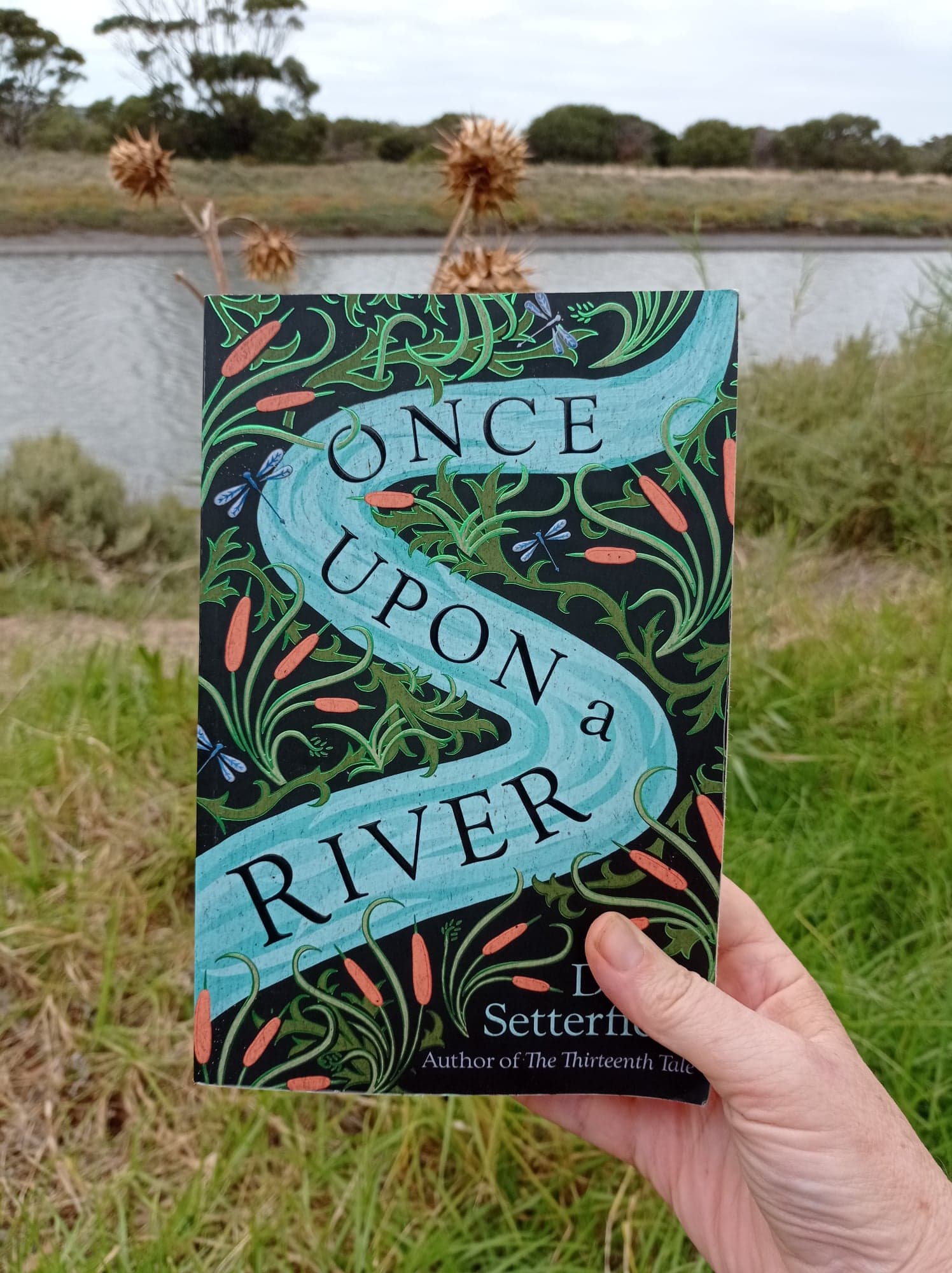
'Once Upon a River' by Diane Setterfield


On a dark midwinter’s night in an ancient inn on the river Thames, an extraordinary event takes place. The regulars are telling stories to while away the dark hours, when the door bursts open on a grievously wounded stranger. In his arms is the lifeless body of a small child. Hours later, the girl stirs, takes a breath and returns to life. Is it a miracle? Is it magic? Or can science provide an explanation? These questions have many answers, some of them quite dark indeed.

MY THOUGHTS:

 'Just because a thing is impossible, doesn't mean it can't happen.' 

This novel is bewitching. It's set along a stretch of the rural Thames in the late 1800s, where people were so steeped in stories, folklore and legend that when something startling really bursts into their lives, they can't figure out whether or not they've been sucked into a story themselves. And even we readers start to wonder when the edges begin to blur. 

On winter solstice evening, a battered stranger carries the body of small girl over the threshold of the Swan Inn just before he passes out. Both are soaking wet, apparently having just emerged from the river. The little girl appears to be clearly dead, but then she stirs back to life. She cannot speak a word, but her little frame seems so perfect as to be untouched by any wear and tear of life. And she has an endearing, seductive way of making whoever encounters her long to keep her. 

Two strong contenders come forward to claim her. Helena and Anthony Vaughan are a young couple whose toddler was kidnapped two years earlier, and it appears their Amelia has been suddenly and miraculously restored to them. But down the river a little way, Bess and Robert Armstrong suspect the child could be their granddaughter Alice, who they've only just found out about. Circumstances align to make them think she could well be the daughter of their rebel son Robin (who I have to say is a proper little turd). And complicating the issue is the parson's housekeeper Lily White, who's convinced the child must be her long-lost sister Ann. 

Elsewhere we have Rita Sunday, the nurse who was called to attend the casualties on the night of their arrival, trying to fit pieces together that refuse to click. And Henry Daunt, the girl's unconscious rescuer, comes to with no idea how he found himself in that situation. 

I loved every second of this story, partly for the characters and their impossibly helpless situations, but also for Diane Setterfield's magnificent prose. For example, she describes the plight of the bereft Vaughans this way. 'With their words they were trying to bail themselves out, but their words were eggcups and what they were describing was an ocean of absence too vast to be contained in such modest vessels.' 

 There's a lot about the power of words, sentences, and eventually the skill of full-blown stories. On one hand, the publican's husband Joe is able to maximise even his facial expressions to make him master of the spoken word. Yet on the other, his teenage son Jonathan cannot master the knack of storytelling, for however hard he tries, he's sure to muddle something. And in the middle are try-hards like Newman the gardener, who discovers that even one misplaced word ruins the whole effect. (For no, you can't hare up the river.) The audience is putty in the hands of a good storyteller, and I know full well Diane is playing us that exact same way.  

At the end, she sort of releases us back to our normal lives. 'And now dear reader, the story is over. It is time for you to cross the bridge once more and return to the world you came from. This river, which is and is not the Thames, must continue flowing without you. You have haunted here long enough, and besides, surely you have rivers of your own to attend to.' 

The thing is, we've been so immersed I'm not sure I want to go back yet. I can still smell the murky river bank, and feel the spray on my face. 

🌟🌟🌟🌟🌟


Tuesday, April 20, 2021

'Work' by Louisa May Alcott


In this story of a woman's search for a meaningful life, Alcott moves outside the family setting of her best known works. Originally published in 1872, Work is both an exploration of Alcott's personal conflicts and a social critique, examining women's independence, the moral significance of labor, and the goals to which a woman can aspire. Influenced by Transcendentalism and by the women's rights movement, it affirms the possibility of a feminized utopian society.

MY THOUGHTS:

I'd never heard of this book until I bought it at a second hand shop recently. That's why I'm choosing it as a book by a favourite author I've never read in this year's Back to the Classics Challenge. It seems that in a sober mood, Louisa May Alcott decided to write this story for adult readers rather than children and youth, which I took as a clue that I should prepare myself for plenty of frank, reflective passages.

Basically, we get a glimpse into the job seeking maze of the nineteenth century. 

It's about a young woman named Christie Devon, who was an orphan living with her mother's brother. She suspects that Uncle Enos isn't thrilled about having her there and decides to strike out on her own to find work. Christie feels sensitive about wearing out her welcome and also sees only 'bad marriage, sour spinsterhood or suicide' before her if she stays. That's a pretty bleak attitude for a 21-year-old, but gives her a sort of gloomy optimism that however she fares in the wider world could be no worse than staying. This poor girl is knocked around by the world at large, but something about her quiet, steady and modest soul reminds me of Jane Eyre

The first several chapters are named after different occupations, as Christie tries her hand at each of them and feels compelled to move on, for a series of legitimate reasons. (Servant, Actress, Governess, Companion, Seamstress, and so on.) The format reminds me a bit of those feel-good tales where young heroes try many alternatives before returning to where they started, convinced now it was the best. However, this is anything but that! Retreating home is not an option here, as Christie has burnt her bridges where Uncle Enos is concerned. She'll never go back. 

There is a romantic thread, in the form of two contenders for her heart. First is Philip Fletcher, the brother of one of her employers, whose sole aim is to be a dilettante and kill time. That is, until he's inspired by Christie's fine nature. The second is David Sterling, the son of another employer, who is nursing some mysterious heartache of his own and devotes himself to his floristry business and a quiet life. (This guy may or may not have similarities to Alcott's family friend, Henry David Thoreau, but maybe it's just the name.) 

This tale has a desperate, raw quality which never makes it into Alcott's juvenile fiction. Christie's world sometimes seems shrouded in darkness and the heavens seem like iron. 'What have I ever done to be so desolate and miserable, never to find any happiness however hard I try to do what seems my duty?' She even contemplates suicide and has to be drawn back from the brink. The old-timers from the nineteenth century surely knew about hardship, struggle and grief, so I read it with a sense that it behooves us to listen to them. There's always a feeling that when Alcott writes Christie back to mental and physical health, we'd do well to latch onto any solution she suggests.

And there are plenty to choose from. I found myself copying several quotes, but for the sake of staying fairly brief, I'll just give one of my favourites. It's this exchange between Christie and David.

Christie: You said you'd learned to feign happiness. I wish you would tell me how you do it, for it is such an excellent imitation, I shall be quite content with it til I can learn the genuine thing.

David: I did not love my work, but it was good for me and helped cure my sick soul. I never guessed why I felt better but dug on with indifference at first, then felt pride in my garden, then interest in the plants I tended, and by and by I saw what they had done for me and loved them like true friends. If I keep tugging, I may yet be the cheerful, contented man I seem. 

Yeah, I dig that. David Sterling predates the maxim, 'Fake it til you make it,' but he sure enters into the spirit of it.  

It's a very simple, yet profound story that stays in your mind. Sometimes it's pretty shocking, such as when the Civil War rocks the nation, and Christie's pious mentor Mrs Wilkins pays out her poor husband for hesitating to enlist and put himself in the firing line. She tells their 10-year-old son, 'I wish I could add ten years to your age and send you off to fight for your country like a man!' and then nags the dad until he caves in. I have to assume this sort of blind, fanatical fervour is Louisa's own, and it leaves a sour taste in my mouth. But she was an author who sure could pick up a pen for a cause. 

I'll finish with another convicting speech, this time from Christie's friend Rachel, an ex-prostitute who faces a group of judgmental fellow seamstresses, who used to be her friends and now wish to fling her out on her ear.

'It's no use for such as me to try. Better go back to the old life, for there are kinder hearts among the sinners than the saints and no one can live without a bit of love. Your piety isn't worth much, for though you read in your Bible how the Lord treated a poor soul like me, yet when I stretch out my hand to you for help, not one of all you virtuous Christian women dare take it and keep me from a life that's worse than hell.' 

Bravo! On the whole, this book is definitely no barrel of fun. But it's one I'll still recommend. And might even dip into again down the track. 

🌟🌟🌟½     

Monday, April 12, 2021

Do you review books with your head or your heart?


I once shared this post about the star ranking system.

I realised that I award stars based on pure engagement. In other words, I'm sure I lead with my heart. If I love the characters, jot down plenty of inspiring quotes, feel wiser or happier for having read a book, or can't wait to incorporate the story into my imaginary thought life, then it gets five stars. Does that sound like a tall order though? Let me assure you that since I like to be swept away to another world, I'm willing to potentially award five stars whenever I pick up a new book. I want to distribute as many fives as possible, and no book has to be perfect to tick those boxes. 

Some other reviewers lead with their heads, and I'm sure getting five stars from these folk is a taller order than getting them from me. They tick off technicalities such as structure, grammar, story arc, showing without telling, tightness of diction and presence of symbolism. They want themes to be full of beauty without being in our faces. Some even go full-on Joseph Campbell and insist the hero's journey must be evident each step of the way. Dialogue must come across natural without being inflated with unnecessary words (which really are, in fact, natural). And a book has to stand the test of political correctness too, which means that the fives of one era might become the ones of another. These head-led reviewers are the people you might hear saying, 'I very rarely give fives.' Based on their criteria, this makes perfect sense. From such a reviewer, a four-star ranking is cause of great celebration. 

I'm actually pleased to consider myself a heart-reviewer. This way you get to be generous and give top marks even when the editing isn't flawless or the literary excellence leaves a bit to be desired. But there is a flip side. It follows that heart-reviewers might feel inclined to dole out ones or twos based purely on emotional responses too. Any given book may flow with technical perfection, read like a work of fine art and be top of the charts for years, yet if the characters annoy us with dumb decisions and stinking attitudes, or the plots make us fume, we'll be the dark horses who give unexpectedly tough feedback. 

In an ideal world, I believe there should always be a written review to support exactly why a reader fixed on a specific number of stars. Do you know what presses my buttons? Readers who merrily leave a wake of one or two star rankings on Goodreads without bothering to leave a single word as to why. Explaining your decision can be a lot of fun. I love describing why a five-star book has touched me deeply. And I equally enjoy the challenge of justifying a two-star ranking in such a way that I'm not being super-mean but still making a fair point. 

As for one-star rankings, I rarely give them. For me, it means, 'Pity a poor tree had to die for this,' which is a pretty blunt assessment of some writer's hard work. I'm a DNF-er these days, so if some book is shaping up to be a one-star story, I'll be more likely to leave it unfinished. But once again, it all comes back to the heart. If it strikes me that an author's dodgy values, disrespect for others, questionable philosophy, narrow-mindedness or tacky flippancy are obnoxious enough to deserve it, I just might give one star.

 Occasionally there is the type of material that doesn't deserve to be politely ignored.

Do you review with your head or with your heart?        

Monday, April 5, 2021

'The Horse and his Boy' by C. S. Lewis

Or 'The One with the Great Journey.' 

There are a few spoilers in my discussions below the line, so beware.

I'm chalking this one up for both my Narnia Business and also my choice for Travel or Adventure Classic in this year's Back to the Classics Challenge. Reading it reminds me that this may well be my favourite of the whole Narnia series. It's a tale within a tale, occurring some time during the long and successful reign of the Pevensie kids in Narnia.

Shasta is a fisherman's son who suddenly discovers he's not a fisherman's son after all. On the verge of being sold to a tyrannical master by the man he believed to be his father, he escapes with the man's horse, Bree, who happens to be a talking Narnian steed. They intend to make a dash for freedom from harsh Calormen in the south to glorious Narnia in the north, and Bree has been a prisoner for so long, he barely remembers his roots. On their way they join forces with another pair heading in the same direction. Aravis is a girl of noble birth trying to dodge an appalling arranged marriage, and her gentle mare, Hwin, is another talking horse from Narnia. 

Before they make it, there are many dangers to dodge and unexpected evil plots to unmask. Rather than the personal quest it started as, the whole journey turns into a desperate rush to save a country.  

Things I appreciated more than before

1) Shasta and his pity-party. This boy gets me nodding with complete sympathy and understanding when he's carried away on tidal waves of self-pity while he convinces himself he's an underdog and victim, born under an unlucky star. When we start thinking in this manner, more reasons to reinforce our outlook keep coming thick and fast. Don't we all know it? But I love how Aslan tears apart Shasta's morbid reasoning with tremendous love and kindness, and without adding fuel to the fire by false sympathy.  

2) Bree and his pride. This horse's life experiences make him extremely smug, and being taken down a peg or two is a great turn of events for us readers, though very confronting for him. Through Bree we see that taking a good, hard look at ourselves with honest appraisal is healthy for our self-esteem, instead of detrimental as some modern pop psychology might have us believe. We're all the heroes of our own stories and it's easy to delude ourselves that we're pretty perfect, so I think Bree learns one of the best lessons of the entire series.

3) Aravis and her lion attack. Wow, what an eye-opener for this princess! I'm glad she found out why it had to happen, because I was wondering too. Sometimes our lessons really hurt. 

4) Hwin and her unassuming modesty. The gentle mare is a great example for any readers who find ourselves easily cowed by stronger personalities. I notice she's not told to stand up for herself in future, because it's just not in some natures to be confrontational. But I think she's armed with tools to help her not back down in her own mind. 

5) The middle-eastern description of the great Calormen capital city of Tashbaan. It reminds me of ancient Babylon, or somewhere from The Arabian Nights. 

6) Shasta's creepy experience alone at the Tombs of the Kings, near the start of the desert. Especially the appearance of the comforting cat who helped him fall asleep. 

7) Aslan's revelations to the little company of travellers. By the time he finishes with the horses and children, they've learned that great strokes of blessing or destiny may be disguised as hard luck. It's not entirely a provable analogy for real life, but surely enough people have indicated by hindsight that it can be true. Not to mention Aslan's insistence that nobody should be nosy about anyone else's story but their own.

What I wasn't a fan of this time round. 

1) The archaic and rigid rules of succession in Archenland. Something as arbitrary as birth order determines every significant decision for a nation, including who should inherit the right to rule the land. Sure, the characters believe this isn't capricious at all but predetermined by destiny. But from our vantage point, it appears that a physically adventurous and thoroughly capable lad who's been groomed from infancy to take his royal place must step aside for a green newcomer who knows absolutely nothing and is loath to take on the responsibility anyway. That's crazy in anyone's books.

Conveniently, Lewis wrote the story in such a way that Prince Corin is delighted not to have kingship looming over his future. But had it been otherwise, he could have made Shasta's life very unpleasant. And having been relegated to second place because he followed his brother into the world a mere twenty minutes later, I think Corin would have had a strong case for being annoyed.

Some Great Quotes

Bree: Now we've got to have reins for the look of the thing, but you won't be using them.

Narrator: In Calormen, storytelling is a thing you're taught, just as English boys and girls are taught essay-writing. The difference is that people want to hear the stories, whereas I never heard of anyone who wanted to read the essays. 

Lasaraleen (Aravis' friend): Anyone I catch talking about this young lady will first be beaten to death and then burned alive, and after that be kept on bread and water for six weeks. There. 

Narrator: One of the drawbacks about adventures is that when you come to the most beautiful places, you are often too anxious and hurried to appreciate them. 

Narrator: Both horses were doing if not all they could, at least all they thought they could, which is not quite the same thing. 

Hermit of the Southern March (to Bree): You are not quite the great horse you had come to think, from living among poor, dumb horses. Of course you were braver and cleverer than them. You could hardly help being that. It doesn't follow that you'll be anyone very special in Narnia. But as long as you know you're nobody very special, you'll be a very decent sort of Horse, on the whole.

Bree: Aslan, I'm afraid I must be rather a fool.

Aslan: Happy the horse who knows that while he is still young. Or the human either. 


Stick around, because next up will be Prince Caspian