Monday, February 23, 2015

'The Settling Earth' by Rebecca Burns

23725275

2015 Reading Challenge Week 8 - A book set in a different country.
The country I've chosen is fairly close to me, just slightly to the east, but I still have never managed to visit yet. 

 Marriage transplants Sarah thousands of miles from home; a failed love affair forces Phoebe to make drastic choices in a new environment; a sudden, shocking discovery brings Mrs Ellis to reconsider her life as an emigrant — The Settling Earth is a collection of ten, interlinked stories, focusing on the British settler experience in colonial New Zealand, and the settlers’ attempts to make sense of life in a strange new land.

Sacrifices, conflict, a growing love for the landscape, a recognition of the succour offered by New Zealand to Maori and settler communities — these are themes explored in the book. The final story in the collection, written by Shelly Davies of the Ngātiwai tribe, adds a Maori perspective to the experience of British settlement in their land.


MY THOUGHTS:

This is a book of compelling short stories set in colonial New Zealand. They focus on a number of women who find themselves trying to eke out a living with their families.

At first, I thought the stories seem to follow on from each other like a set of dominoes. In each one, a reference is made to someone else, who then becomes the focal point of the next story. The domino arrangement is circular, as some of the characters we met at the start re-appear toward the end.

Though each of the stories can stand alone, having a book written in this unusual way of interlinked stories highlights something significant. There's a vicious circle which people don't even realise they are part of. In the harsh new southern land, settlers tend to build walls of detachment and aloofness to protect themselves by keeping despair at arm's length. Yet the detachment and aloofness keeps the cycle going. These women are living desperate and lonesome lives separately, yet right beside each other. I can easily imagine that I would have been just the same in their place.

The writing is vivid enough to draw us right into the picture and recreate these rough times as if we're watching them unfold. Even though the tone is fairly bleak and sober, some rays of hope are left in threads which aren't tied up (and I guess they don't have to be, since these are short stories). For me, they come through the younger characters. There's a robust little baby named Dottie, who is still too little to know about the hard world she's entered, and a creative teen named Laura, whose secret art helps her to retreat for a time, and be outside of things.

I wasn't impressed with the men who appear within these pages. It seemed that being male automatically meant being written as an inferior character; controlling, repugnant and nasty. It hardly seemed Miss Swainson, the local madam, needed to warn her girls to leave all their romantic notions at the door with a crowd like that. I'm glad there were passing references to a few good men, although they seemed to have either moved on or passed away. The men who were fixtures in this book all seemed to be the harsh, bestial type for the most part, who would take what they wanted with no compassion. Yet it seemed to be written this way for a purpose. In the last chapter, written by guest author Shelly Davies, the Maori character Haimona sums up the situation with his opinion about the problem with white settlers, of which this inequality between the genders is a feature. I'll leave you to get to that part.

Thanks to the author and Net Galley for providing me with a review copy.

4.5 stars

Saturday, February 21, 2015

'Prayers for People who say they Can't Pray' by Donna Schaper

22267089

Sometimes the time you most need to pray is when you are least able to--these are the prayers you offer.

MY THOUGHTS:

This book was written to help people who struggle with the notion of prayer, for whatever reason. Some may feel thrown in the deep end. They may have recently become Christians and are told, 'Now you have to go and pray,' after never having done such a thing before. Others are what she calls 'Cradle Christians' with a solid grasp of basics and traditions from the very outset, along with a feeling of boredom and dryness.

Schaper aims to show that although prayer needn't be formulaic, if written guides appeal to something in our hearts, we might as well go for it. Some of the prayers in her books are crafted for individuals and others for groups. Some end with the traditional 'Amen' and others don't. Her chapters cover all sorts of situations in which we might find the need for a bit of prayer help. In other words, whether we prefer off-the-cuff spontaneity or some written form to refer to, it's all good, as it is not our methods but God's working which is responsible for the results of prayer.

The author introduces each chapter with a thought-provoking section detailing exactly what she's talking about, which I'm sure many readers will appreciate. It's good to have a book like this, reminding us that God doesn't treat prayers like exam conditions. Although I'm not sure I agree with every point made within the pages, it's good to have some sort of guide like this, rather than just shoving people off to their own devices with no experience or ideas.

In the last section, she puts forward some interesting ideas and tips about writing our own prayers, including where we focus our attention and how we may choose to go about editing. I like how she suggests that not everyone can pray briefly, and brevity is actually an art. I've had several brushes with people who seem to believe the opposite. And she's quite right when she gets us reflecting that prayer is a different sort of discipline than most others, since we're not even supposed to aim to become 'experts' or achieve a platform to show off. She finishes off by suggesting that if we have trouble praying, we may, in fact, be perfectionists, as prayer is a perfect practice for imperfectionists. Hmm, that's worth considering.

Thanks to Abingdon Press and Net Galley for my review copy.

3.5 stars

Thursday, February 19, 2015

'Face to Face' by Monte Kline

 19840761

 Meeting God in the Quiet Places
Has God Spoken to You Lately?
Imagine a whole new way of meeting with God that would transform your Christian life. What if you could create special times alone with God for illumination, direction on decisions, and just the sheer enjoyment of being in His presence like nothing you've ever experienced before? What if you could come face to face with God? Following the pattern of Abraham, Elijah, Paul, and other biblical characters, Face to Face shows the way to create those life-changing encounters. Today we must rediscover the secret and power of meeting God in the quiet places.
You will discover:
-A way to meet with God and hear his voice
-Keys to escaping the noise and busyness of life
-An alternative to Christmas list praying
-How to capture your spiritual transformation
-How to encounter God through Personal Retreats


MY THOUGHTS:

This is a very handy and easy-to-read guide for anybody who wants to plan a personal retreat with God. I'm happy to be able to recommend it to anybody who never knew there was such a book, but could benefit from the advice about tailor designing one to suit our needs.

In the first part, the author looks at histories of Biblical folk who took time to make personal retreats. There are many more than we may think. He suggests tips for us to get to know the real Person of God, instead of getting away and trying to worship someone we've made up in our own heads. He also gives tips at the outset about how we can increase our thirst for God, if we find it lacking. This includes the way we may prioritise 'urgent' demands and our true attitude toward mundane, routine tasks. There's also a good, comprehensive section about fasting, if we should choose to include this component in our retreats. As I've often found instructions about fasting a bit waffly and unclear in other books, I appreciated this one.

So that was all interesting, clear reading, but my favourite section is the one which sets out recommendations about setting up our own retreats. I love the idea that rather than regretting the fact that we can't take many long retreats in a year, it's possible to take several one day, closer to home ones for the same benefit. I like even more that this book stresses the value of doing just that, to take away the guilt some of us may feel for putting aside the time. (I'm imagining my family saying, 'Mum's taking one of her retreats' and being fine with it.)

Toward the end, Kline even includes an excerpt from a journal he kept on one of his own retreats, to give us a springboard to help plan our own. I'll definitely keep it on hand to refer to when I need it.

Thanks to the author for providing me with a review copy.

4.5 stars 

Monday, February 16, 2015

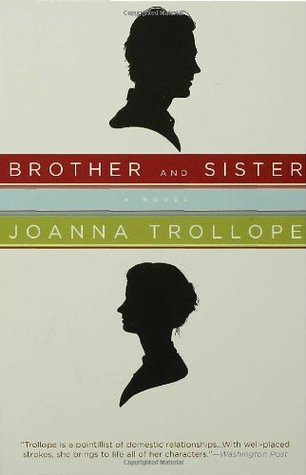
'Brother and Sister' by Joanna Trollope

 201231
2015 Reading Challenge Week 7 - A Book you own but have never read.

I bought this novel from a second shop quite a long time ago and it's been sitting on my shelf. Since I've enjoyed another novel by Joanna Trollope, I thought it's time to take it down for a read, to fit this category of the challenge. 

 Brought up by the same parents, but born to two different mothers, Nathalie and David have grown up as brother and sister, and share a fierce loyalty. Their decision as adults to try to find their birth mothers is no straightforward matter. It affects, acutely and often painfully, their spouses and children, the people they work with, and, most poignantly, the two women who gave them up for adoption all those years ago. Exploring her subject with inimitable imagination and humanity, the celebrated author of Marrying the Mistress and The Rector's Wife once again works her magic.

MY THOUGHTS:

Nathalie and David are the adopted children of Ralph and Lynne Dexter. Now in their 30s with families of their own, they decide to search for their birth mothers. It's easy to see why Joanna Trollope is such a well-known writer of domestic dramas. I feel if she were to discover the secret feelings of any of our families and households, she could probably spin a pretty interesting yarn, with the blends of personalities to be found beneath one roof.

I think another of Trollope's trademarks is giving every character a chance to have a scene written from their point of view, including not only Nathalie's five-year-Polly but David's two-year-old Petey. I was once told that authors should limit point of view characters to six at the most. This is definitely not a rule Trollope adheres to. I tried to think of a character in this novel who didn't get a point of view scene, and there were very few. For her, having so many works well. I think this is partly because it shows how our own lives may be impacted by the decisions of people who remain total strangers to us. To give just one example, David's antagonistic half-brother, Martin, never meets Nathalie, but unbeknown to him, it was Nathalie's idea and pressure which brought David into his life. There are many more such as these. It's interesting to think that ripple effects are often taking place in our lives.

It's interesting to see the number of people affected by the decisions of two people to delve into their pasts. The adopted siblings believe it has nothing to do with anyone but them, yet not only their birth families are affected, but their own spouses, children and adopted parents. Their partners, Steve and Marnie, take Nathalie and David by surprise with their reactions. And although it's never stated outright, it seems that neither of them ever forget that Nathalie and David are not really blood siblings at all. There's always an undercurrent of jealousy.

The other thing I noticed is that it's easy to fool ourselves into thinking something we really don't. Nathalie always convinced herself that she found being adopted liberating because she could forge her own path and wasn't bound by expectations based on her bloodline. However, it comes out that she really feels the lack of knowing her background and the hurt from wondering why her birth mother felt the need to give her away.

I was quite satisfied with the conclusions each of the siblings came to when they finally met their biological mothers.

4 stars

Wednesday, February 11, 2015

'Tied in Pink' by Mirren Hogan et al


23514002
2015 Reading Challenge Week 6 - A book of short stories.
 As three friends of mine have contributed stories to this collection, I was happy to choose this one for this category. 


Fourteen authors from across the globe have joined forces to help raise funds and awareness for breast cancer research with this anthology of romance short stories. Every fictional story is unique and ranges from romance to romantic suspense and fantasy. Within these pages you will find stories of love, loss and determination. Each contains a pink ribbon – the international symbol for breast cancer awareness.

All proceeds of the sale of this anthology will be going towards the Victorian Cancer council’s research into breast cancer.

Inspired by those we love, those who fight, and those who we have lost; this is our gift to cancer sufferers and survivors, and their families, who have inspired and continue to inspire us.


MY THOUGHTS:

This is an anthology of romantic short stories by Aussie authors from various walks of life. Some of the stories are fantasies, some are contemporary and some have historical elements. Some are quite steamy while others are more subtle or sweet. One thing they have in common is a united desire to earn money for breast cancer research, so I hope they sell like hot cakes. The price is very reasonable.


Some of the stories deal with breast cancer patients and survivors as main characters. Even the ones that don't directly deal with breast cancer have little hidden motifs. I found myself beginning to look out for references to pink ribbons - a bit like a 'Where's Wally' book for an excellent cause, so good on them.

I liked some of the stories better than others, which I guess is bound to be the case when so many different authors are involved. Most readers will probably say the same, and prefer different selections. I've heard it said that a book of short stories is a bit like a box of chocolates. Every reader will find something that suits them.

3.5 stars


Thursday, February 5, 2015

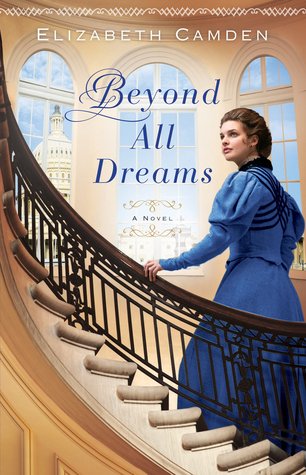
'Beyond All Dreams' by Elizabeth Camden

22504481
Sweeping and Romantic Historical Drama from an Award-Winning Author
Anna O'Brien leads a predictable and quiet life as a map librarian at the illustrious Library of Congress until she stumbles across a baffling mystery of a ship disappeared at sea. She is thwarted in her attempts to uncover information, but her determination outweighs her shyness and she turns to a dashing congressman for help.
Luke Callahan was one of the nation's most powerful congressmen until his promising career became shadowed in scandal. Eager to share in a new cause and intrigued by the winsome librarian, he joins forces with Anna to solve the mystery of the lost ship.


MY THOUGHTS:

This is another well-researched novel by Elizabeth Camden, set around the turn of the twentieth century. It's fun to see a library setting for a budding romance.

Anna O'Brien is a map librarian who discovers some inconsistencies in a report about the sinking of the Culpeper; the ship on which her father supposedly drowned. Not expecting to ticked off for meddling when she makes a report, she wonders whether something unsavoury is being hushed up. Luke Callahan is her likeable, impulsive congressman admirer, who decides to look into the fate of the Culpeper to please her. He has no idea about the tinderbox it will turn out to be.

Anna and Luke seem to be total opposites on the surface, but share traumatic childhood memories, a love of books and a passion for possessing knowledge. Luke once aspired to be a great poet, but realised he wasn't very good at it. I like his advice to his nephew, Philip, that if you don't reach your dream, you can channel the passion and energy into something equally worthy. I also like Luke's funny intolerance to modern contraptions, which now themselves seem very outdated and old-fashioned to us.

His family are interesting secondary characters, all full of enthusiasm and bluster. His brother Gabe's 'infamous stairway to nowhere' is such a good analogy for the way they choose to live.

As for Anna, I'm glad she's able to stick to her desire to live a quiet life. This isn't one of those novels about a shy girl who who finds the courage to step out of her comfort zone for the long term and live happily ever after, as if the limelight is better than behind the scenes. The author understands that introverts can't change their colours, and that they wouldn't even want to. The author bio tells us that Elizabeth Camden is a research librarian herself, so I can see why Anna's voice rings so true (although thankfully they are permitted to marry in the 21st century without being expected to resign).

Perhaps Luke's quote to Anna is a good take-away from this book. 'The world can be a tough and gritty place. We need to seize beauty wherever we find it.'

Thanks to NetGalley and Bethany House for my review copy.

4 stars

Monday, February 2, 2015

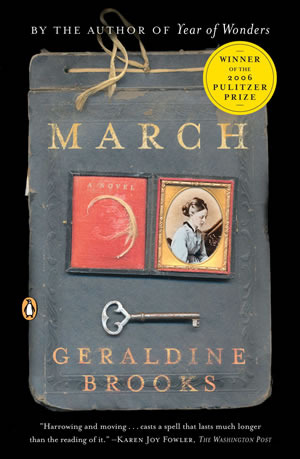
'March' by Geraldine Brooks

 13529
2015 Reading Challenge Week 5 - A Pulitzer Prize Winner

 Some time ago, a friend recommended 'March' and the following day, I was browsing the bookshelves of a second hand shop when it tumbled down and fell at my feet. I felt I had to buy it, although I never got around to reading it until now. When this option for this year's challenge came up, I decided it would be the one. This novel was the 2006 Pulitzer Prize winner.

Winner of the 2006 Pulitzer Prize For Fiction. From the author of the acclaimed YEAR OF WONDERS, an historical novel and love story set during a time of catastrophe, on the front lines of the American Civil War. Acclaimed author Geraldine Brooks gives us the story of the absent father from Louisa May Alcott's Little Women - and conjures a world of brutality, stubborn courage and transcendent love. An idealistic abolitionist, March has gone as chaplain to serve the Union cause. But the war tests his faith not only in the Union - which is also capable of barbarism and racism - but in himself. As he recovers from a near-fatal illness, March must reassemble and reconnect with his family, who have no idea of what he has endured. A love story set in a time of catastrophe, March explores the passions between a man and a woman, the tenderness of parent and child, and the life-changing power of an ardently held belief.

MY THOUGHTS:
Remember the first chapter of 'Little Women' when Meg says, 'I think it was so splendid of father to go as chaplain, when he was too old to be drafted and not strong enough for a soldier'? This is his story, told in first person about his experiences in the Civil War, and also includes flashbacks of his youth and life with his wife and daughters.

His story is based on research Geraldine Brooks did into the life of Bronson Alcott, Louisa May Alcott's father. March (for his Christian name is never divulged) was a peddler in his late teens when he first experienced the southern way of life. Prosperous in his twenties, he lost his fortune investing in John Brown's underground railway. It's interesting seeing local historical figures such as Brown, Ralph Waldo Emerson and Henry David Thoreau appear in the story. Concord, Massachusetts, had its fair share of celebrities back in the mid 1800s, and probably hasn't had many since. 

March comes across as an idealistic thinker. His planned Utopian community, where men and women could live with nature but without its exploitation, sounds like a forerunner of similar twentieth century attempts. Perhaps this goes with his vegetarianism, a principle he stuck to all his life. He always put himself in the place of humans and animals alike, making me applaud his empathy. March brought to mind the quote I once read that a man's character is measured by the way he treats those who can do nothing for him. Regardless of the opinions displayed by those around him, he found the ex-slaves in this novel to be 'God's image cut in ebony.'

It's easy to recognise members of the 'Little Women' family, making this book quite clever. It contains an earlier version of Marmee, while she still hadn't controlled the fiery temper she mentions to Jo in the classic. But I definitely wouldn't consider this novel to be a prequel, sequel or companion volume. The genre is way too different, with its in-your-face horror stories of war. I feel sorry for any young girls who may like the blurb and decide to read it, based on their fondness of 'Little Women', with its warm, cosy, wholesome themes. 'March' is way different.

Even though the book was published in the twenty-first century, Brooks keeps the lofty style of voice used by the father in 'Little Women', and somehow the preachy, outdated nineteenth century tone comes across OK. She plants lots of thought-provoking quotes in his mouth.

On education and his passion for teaching - 'My objective was to awaken their hearts to the ideas dormant there, rather than to implant facts in their memory.'

On courage - 'Who is the brave man, he who knows no fear? If so, then bravery is but a polite term for a mind devoid of rationality or imagination.'

On poverty - 'I was glad to give up the garments on the peg rail that spoke to me of slave labor, worm slaughter and sheep theft, for is not the fleece the rightful property of the sheep? And why should the humble silkworm be sentenced to death for our finery?'

As for ranking this book, I usually love to escape with uplifting stories that end happily for the good characters. This is full of tragedy, made even more heartbreaking by Geraldine Brooks' descriptive writing which leaves nothing to the imagination. It's not my favourite type of book, yet I can see why it's very good. Although some books are great for escapism, others are written from a sense of responsibility that we should understand our world history, and the sacrifices some made for others. This is one of those types of books.

The best quote by March to end with might be this one. 'How could one turn the other cheek to this evil when the cheek being turned was not one's own, but that of innocents?'

3.5 stars.