Tuesday, August 30, 2016
Reading with Depression
I've had encounters with the black dog at different stages of my life, which I'm sure many of us have. I've only come across one doctor who ever prescribed medication. I ended up not taking it, because when I sought the opinions of others, they thought she might have been a bit too quick. They suggested a good rest, plenty of fresh air and my favourite pastime, reading, first. It's worked for me. In return, I've often suggested reading a good book to friends or family members with depression, but it hasn't seemed to be the right thing to do. Here is the sort of response I've received.
'Sorry, I can't read books at the moment. My concentration is shot to pieces. I can't hold onto the thread of a plot.'
'I can't read until I'm feeling better. All my energy is focused on looking after myself.'
'I've got enough guilt and 'shoulds' on my mind already, so please don't add another one by suggesting that I read a book.'
It got me wondering whether recommending books to depressed people is a bit of a social faux pas which I'd violated. For my attacks of the blues, reading therapy is the one thing I can depend on to pull me out of it quickest. But maybe I'd never experienced such severe, crashing, clinical depression as they have, so I had to take their word for it. Then I came across a little book entitled, "Reasons to Stay Alive" by Matt Haig, who had been grappling serious depression for years, and came through the other side. He concurred with me. He believes his black dog had almost killed him, and books were his saviour.
Haig says that depression changed him from a person who simply liked books to a person who needed them. And his reasons turned out to be similar to mine.
He gave a builder analogy. Parts of his mind were broken, and the words of other people within the pages of books became his bricks and mortar, helping him to patch it back together again. Then he gave a potter analogy. He considered his mind to be a hopeless mass of mess and chaos, and the words and sentiments within books helped him to mold it back to the shape he wanted it to be.
Haig especially valued books by authors whose minds were clearly in a state of more peace, contentment and faith than he was experiencing. This is also what I've found most helpful about mood lifting books. What we find within their pages, whether fictional stories or gentle, non-fiction encouragement, is like medicine for our thoughts. In my own experience, depression almost always has some bad thought catalyst behind it. If I try hard enough, I can usually track one down. That's why the alternative ways of thinking presented within books has always done me good. It re-aligns my thoughts, getting to the origin of my depression and giving me an alternative way to think.
Some of my favourite fictional characters are those whose personalities help to restore what I might be lacking for the time being. If I'm feeling a bit jaded and glum, the cheerful enthusiasm of someone like Anne Shirley will rub off on me. Or maybe if I feel insulted or put down, re-reading the humorous way Lizzy Bennett reacted to Mr Darcy's mean comment will help. And if I need a boost to get back to some work I've been putting off, taking a break to read about the Hogwarts students buckling down to their Potions and Transfiguration homework may do the trick.
Similarly, Matt Haig imagined books to be like a treasure map, trying to direct him back to his true self, which he felt was buried somewhere beneath all the muck and mire of his depression. They were like clues along the way, and the more he read, the closer he felt he got. He imagined himself stuck in a sludge of quicksand, and books provided the leverage to pull himself out, because they were full of thoughts he wouldn't have been capable of coming up with on his own. They were like a rescuer's rope.
Some of the reading choices he mentioned took me off guard. They weren't the sorts of books I'd necessarily think of recommending to a depressed person, being quite heavy and tragic, but they seemed to work for him. Would you choose 'The Diary of Samuel Pepys' to help pull you out of a mental slump? Me either. But here's what Haig says. 'There was something about the way Pepys jollied on through the apocalyptic events of seventeenth century life that was very therapeutic to read about.' Okay, I guess I can understand that. It just goes to show that anything may help.
As for my own choices, just about anything I've recommended on this blog with four or five stars will fit the bill. Maybe even the ones to threes work too, once I've reviewed them, because the very action of finding words to explain my impressions is often enough to help me feel less depressed, regardless of a book's quality.
But to finish off with, here are some specific books written by people who have successfully fought their own way out of the murky trap of depression, giving their happier survival stories about where they've been.
1) Reasons to Stay Alive by Matt Haig. It seems only fair to start with the book I've drawn from so much for this blog post. He also mentions other things apart from reading which helped him through several years of deep depression.
2) You can't afford the luxury of a Negative Thought by Peter and John Roger McWilliams. These two brothers have put together a thick book combining quotes from all sorts of historical figures, laugh out loud humour, and sound wisdom to convince us to brighten up our minds.
3) Wobbly by Vikki Roubin. This book was written by an Aussie lady, and I found her personal story and tips for dealing with depression and panic attacks very helpful. It's great because I met Vikki at a writers' conference in Brisbane way back in 2007, and later when I contacted her to say how much I enjoyed her book, she replied that part of her impetus in buckling down to write a book was from attending a workshop I'd presented, in which I discussed just going for it.
4) Stepping out of Darkness by Lisa Limbrick. The author is another Australian friend of mine, who it's been a joy to meet in person. She draws from her own background of psychological knowledge to describe how actually owning her depression has been the first step in developing tools to deal with it.
So whatever else anybody may be doing or taking to combat depression, whether medication, therapy, counseling or long sabbaticals, I think books would have to help too, if you feel you could manage.
If you enjoyed this post, you might also like this related one about melancholia, the happy side of sadness.
Thursday, August 25, 2016
'The Secret Garden' by Frances Hodgson Burnett

When orphaned Mary Lennox comes to live at her uncle's great house on the Yorkshire Moors, she finds it full of secrets. The mansion has nearly one hundred rooms, and her uncle keeps himself locked up. And at night, she hears the sound of crying down one of the long corridors.
The gardens surrounding the large property are Mary's only escape. Then, Mary discovers a secret garden, surrounded by walls and locked with a missing key. One day, with the help of two unexpected companions, she discovers a way in. Is everything in the garden dead, or can Mary bring it back to life?
* * *
Genre: Children's classics. My younger son and I visited Adelaide's Carrick Hill not long ago, and stumbled upon a display of The Secret Garden's many editions which have been published over the years. It's partly what inspired me to dig out the one in my own book shelf, to re-read for my classics challenge. Whoa, all I can say is that I didn't expect the reactions which came as I read.
MY THOUGHTS:
First off, when I checked this book's stats out on Goodreads, I saw a long line of 5 star rankings from friends of mine. They are all really good friends, whose reviews I love. I was amazed that my opinion about this little book differed so much, and a bit nervous that I might tread on a few toes because it seems to be such a sentimental favourite. Then I remembered that when I first read it many years ago, I might have ranked it higher too, so maybe they're cruising on memory to some extent (sorry if that's you).
The story begins so grim, there's got to be a HEA (happily ever after) implied, because it can't get any worse. So far so good. I don't mind the direction from horrible to good. It's the opposite movement which gets rough, especially for kids' books. It begins in India, where everyone dies a horrible, painful death of cholera, except for Mary Lennox, the neglected little girl who was ignored by her parents and basically brought up by slaves. She's found days later in the aftermath, and sent off to England to live under the roof of a cranky uncle, Mr Archibald Craven.
From a modern perspective, there is lots of pious author intrusion. Burnett never missed the opportunity to drop in moralistic comments, such as 'Mary really was a disagreeable, self-centered and imperial child'. Yeah thanks, I think we get that idea without being told, but that was how some authors did things back then. You whack readers over their heads with your theme, just to be certain they don't miss it.
Young Colin's plight is seriously disturbing. A boy who has basically nothing wrong with him is left lying in bed for his first ten years, conditioned into hypochondria and believing he's going to die, because that's the line he's always taken on board from the adults. In all that time, he's never even attempted to walk because he believes there's no point. He rarely, if ever, leaves his bedroom. And he's never been outside in his life. Yet they just mumble insulting things about him beneath their breath (which he overhears) and kowtow to his face because he's the master's son, and they have to observe their ridiculous social pecking order.
Burnett kept calling Mary a hard, unloving little girl, and Colin a cantankerous, sickly boy who believed he was going to die, as if this was all their own fault. Come on, they were ten-year-old kids, and the incompetent adults shaped them this way, by the way they treated them. Mary wasn't given an ounce of love by her parents in India, yet she's expected to show love and be a normal cheesy child in her new home. Where do they expect her to pull that from? And Colin is always told, 'Lie down and take it easy, my boy,' and never, 'Why don't you lean on my arm and come to the window seat for some sunshine?' Then they have the nerve to complain about him throwing the occasional tantrum.
When Mary and Colin end up proving that neither of them are really the monsters the adults turned them into, nobody thinks to say, 'Whoops, our bad.' I never expected to feel so angry reading this for the second time. Talk about indulging in forms of child abuse, then blaming the children for their own perceived shortcomings. It's a horror story, in a way.
Good on Mary and Colin, for taking matters into their own hands. I've come across people who have criticized kids' books for what they call 'glorifying disobedience', even when the young heroes end up saving the day (take Harry Potter stories, and other more modern ones). The same thing happens in The Secret Garden, from the moment Mary decides to investigate the strange sound of crying for herself. The adults deserved to have their authority flouted, because they consistently made the dumbest decisions. Why keep Mary and Colin apart from each other in the first place? And why the heck didn't anyone ever think to introduce Colin and boy wonder Dickon to each other earlier, since they lived in the same vicinity? The adults are the baddies here, and there's no two ways about it.
Another thing I must have overlooked during my first read through as a kid was Frances Hodgson Burnett's strong metaphysical agenda in the writing of the story. She has Colin deciding to chant, 'Magic is in me, magic is making me well.' When the children discuss this together, he says, 'Perhaps the beginning is just to say nice things are going to happen until you make them happen.' And there are several similar quotes, particularly thick toward the end. Some readers might throw around terms like white magic, spells, incantations, self-reliance and sorcery. Whether or not you buy into all that, it comes across as if she's elevating the human mind and giving kids the message that they're totally in control of their destiny. If they only think enough good thoughts, these will transform their life circumstances and make things wonderful. That's a bit dodgy and limited however you want to look at it.
There are a few nice, heartwarming parts about enjoying the garden, but not enough to make up for all that I just ranted about. The crocuses, snowdrops, lilies, jonquils, narcissus, jasmine and daffodils (or daffydowndillies) get good mentions. My favourite part is when Ben Weatherstaff, the gruff old gardener, chokes up with emotion when his friend, the robin (the real hero of the story in my opinion) decides to honour him by landing on the handle of his shovel. It's nice to see unlikely friendships, including a crusty old guy and a bright little bird.
So yeah, that's it overall, and I have to wonder whether my list of friends who have given the book 5 stars have rated that on a long forgotten, nostalgic read in their youth, rather than the sort of recent, no-frills read I just had.
2.5 stars
Monday, August 22, 2016
'The Name I call Myself' by Beth Moran

All Faith Harp wants is a quiet life--to take care of her troubled brother, Sam, earn enough money to stop the poverty wolves snapping at her heels, and to keep her past buried as deep as possible. And after years of upheaval, she might have just about managed it: Sam's latest treatment seems to actually be working, Faith is holding down a job, and she's engaged to the gorgeous and successful Perry. But, for Faith, things never seem to stay simple for long. Her domineering mother-in-law-to-be is planning a nightmare wedding, including the wedding dress from hell. And the man who killed her mother is released from prison, sending her brother tumbling back into mental illness.
When secretly planning the wedding she really wants, Faith stumbles across a church choir that challenges far more than her ability to hold a tune. She ends up joining the choir, led by the fierce choir-mistress Hester, who is determined to do whatever it takes to turn the group of ragtag women into something spectacular. She also meets Dylan, the church's vicar, who is different than any man she has ever met before . . .
Genre: Contemporary drama/romance, chick lit (sort of), suitable for both Christian and secular market.
MY THOUGHTS:
My biggest take-away from this novel is that our experiences are grained into the fabric of our personalities. Even with a wealthy fiance, new car and the offer of limitless financial support, Faith still thinks with the battler's perspective and insists on working hard to look after herself. It's easy to understand, when you consider the gradual revelation of all she's been through. It's quite fascinating. She's planning to marry a millionaire, but still has a broke person's mindset. Overall, Faith comes across with a strong sense of her own personhood, which she never compromises or allows to be violated. It makes her an admirable main character.
Beth Moran's writing style is fantastic. She knows how to play with a reader's emotions using a good blend of humour and pathos. She also has a way of making every character well-rounded and three-dimensional, including those with cameo roles. Each of the ladies in the choir stands out as individuals.
The heart and wisdom of Hester the choir director, is one of the good parts of the story. She wants the ladies to develop such a loving bond that they support each other like a single organism, and convinces them that they must believe the best of themselves before they can expect their singing performance or lives to get any better. I liked her creative schemes to get them out of their comfort zones. Bonding happened, as Hester hoped, but on a few occasions some serious accidents were narrowly avoided. At those times, she came across a bit like an unqualified, self-appointed counselor who took huge decisions on herself. She was lucky they didn't turn out any worse.
The progression of Faith's romantic dilemma was interesting. Although it's pretty clear from the start that Dylan, the rugged pastor, is marked to be the hero, it was looking like she could've easily gone with Perry. He wasn't an anti-hero. In fact, I think it's to his credit that he turned out as nice a guy as he was, having been brought up by his snobby, overbearing mother. Perry was a product of his upbringing and circumstances, just as Faith and Sam were of theirs. Parts of the story seemed a bit rough on him, but I think he had a narrow escape too, since he could have ended up with a woman who wasn't in love with him and could never share his view of the world. He should have got out earlier, since there were many alarm bells. For example, she never said, 'I love you.' They probably could never have really been a good match, since their world outlooks were poles apart from childhood.
I think many readers who enjoy the 'One true love and you'll know when it hits you,' ideal will enjoy this book. It shows even big girls aren't too old for fairy tales, which sometimes do come true. Hey, I'm not sure if it's ever fully revealed why Dylan was still single. He said he'd explain one day, but did he ever?
I'll try not to drop plot spoilers, but I decided to take one star off because although the writing is top-notch, some of the events of the plot left me horrified. I found one part of the story to be the emotional equivalent of a whack in the guts. It's most disturbing because the characters concerned are forewarned in plenty of time and do all they can to take precautions, calling on people who ought to be equipped to help, yet the situation still turns out just as they'd feared. That creeps me out. It was like a nightmare, which doesn't say much for the help we can expect from our society (or God, some readers may add).
Sure, plenty of novels reflect the devastating turns life may take, but I thought it a bit unfair to the reader that this turns out to be one of them, because we were lulled into a sense of security. The cheery front cover design and some of the hilarious happenings early on lead me to expect for certain that this particular plot thread would be cleared up okay. Especially since the characters were doing all the right things. When I got to that stage, all I could do was gulp and say, 'I really didn't think she'd take it there.' It's just one of the hazards of the adventure of reading, I guess.
Thanks to Lion Hudson and NetGalley for my review copy
4 stars
Thursday, August 18, 2016
The Sad Scarcity of good Bromances
This blog post was prompted because of the popularity of the new release, 'Harry Potter and the Cursed Child.' A big focus in this play is the heartwarming friendship between the sons of two traditional enemies, Harry Potter's son Albus, and Draco Malfoy's son Scorpius.
Several fan groups across the internet believe that the boys' friendship is rich with gay subtext. They've expressed crushing disappointment that JKR and her fellow authors decided not to take Albus and Scorpius that way. A couple of crushes on females have been included for each of them, but several people call this a cop-out. Fan art and fiction to change this is no doubt being produced as we speak. This is just what I've noticed rife on the internet at the moment.
I can't help wondering if it highlights a bit of a problem in our culture. Why are so many people trying to read romance into Albus and Scorpius' friendship, just because of of its depth and sensitivity? Can't a pair of teenage boys enjoy a strong, affectionate friendship without being gay? Could it be because we see so few intense male friendships of this nature presented in literature and the media that so many people instantly assume what was never intended to be there? Even when I searched through images of friends for this blog post, I found an abundance of close girl friendships (hugging, arms around each other, foreheads together, smiling etc) but barely any for males. I'm thinking it must be high time to resurrect the 'bromance', which is defined as a close, non-sexual relationship between guys.
These thoughts prompted me to start searching through my mind for good examples of literary bromances. Although I came up with quite a few, I felt as if I was scraping the barrel. Some of them aren't quite perfect, and others are really, really old. But here they are.
1) Albus and ScorpiusIt seems right to begin with the hot-off-the-press bromance that prompted this post. These two boys are a perfect friendship match on many different levels. First, they turn established patterns on their heads. A dark, resentful Potter hits it off with a sunny, optimistic Malfoy. Their fathers' history of mutual antagonism means nothing to them, because they take people on face value. They discuss sensitive, emotional issues with honesty and are both willing to admit that their life at Hogwarts would be unbearable without each other. When forced apart they are entirely miserable, and aren't afraid to acknowledge that they intend to always be there for each other.
This bromance even helps their families bridge their gap after more than twenty years. Imagine Harry and Draco having a polite discussion about mutual parenting challenges, and Draco offering Harry a piece of sound parenting advice which he decides to accept. This comes across realistically all because of their sons' bromance.
2) Harry and Ron
You can't start with Scorpius and Albus without mentioning the Hogwarts generation that came before. Although they were often part of a trio rather than a pair, Harry and Ron shared a close, best friend relationship. They had their ups and downs, but proved many times over that their manly affection for each other extended to death if necessary. A lovable duo.
3) R2D2 and C3PO
It's pretty sad when you have to rely on droids to provide a decent bromance. But these two are firm friends who travel together, look out for each other, translate for each other, understand each other and hate the thought of being separated.
4) Tom Sawyer and Huckleberry FinnI admit I've never read these American classics. Being an Aussie, they weren't set on our school curriculum. But from reports I've heard all my life, I assume these two lads are inseparable friends on the same wavelength.
5) Frodo and SamI wasn't sure whether to include this one, wondering if their relationship is on quite the right footing to be considered a bromance. There is always a bit of servitude in Sam's attitude toward his beloved Master Frodo, but hey, I wanted to grab something.
6) Holmes and Watson
They are both intelligent, professional gentlemen who at least give lip service to a relationship of equality. Watson is always keen to tag along on Holmes' detective escapades to see what his friend will come up with next, and so he can say, 'You're incredible, Holmes!' And he never seems to find that smug, 'Elementary, my dear Watson,' at all condescending. Maybe not a perfect bromance either, but once again, I grab them where I find them.
7) Darcy and Bingley These two seemed to be unlikely friends because of their different temperaments, but I guess they tick the bromance boxes. They enjoy hanging out with each other, they travel together and make sure to synchronise the plans in their calendars. And they've been friends for long enough that they make allowances for each others' foibles in a good-natured, eye rolling sort of way.
8) Hamlet and Horatio
The moody Prince of Denmark always had his best buddy to try to make things easier for him. Sadly Horatio's best efforts didn't make a whole lot of difference in the end, but at least he was always there for his friend, and Hamlet appreciated him.

9) Pip and Herbert
These two are getting closer to my bromance ideal, yet Charles Dickens lived long before the term was ever conceived. These young men became best friends and housemates with mutual concern for each other. They looked out for each others' interests, and were totally trustworthy and comfortable together. But do we really have to go back to Victorian England to find a good bromance? A bit sad if that's the case.
10) Michael and JeromeI'm referring to one of my own published novels here, A Design of Gold. I worked really hard on this bromance between two young men who had nothing in common on the surface, yet felt thrown together in several different ways, until they realised they were more alike than either of them would have imagined. And it takes a life or death sort of situation for them to come to this point.
11) David and Jonathan
I think the ancient biblical bromance nails it, and sets the bar high for all future bromances. These two were devoted to each other to such an extent that David declared Jonathan's love superior to that of a woman, and we all know David was definitely a red-hot male who loved his women. Jonathan's actions proved that David's opinion was justified. He was the Crown Prince at the time of the friendship. Even though David's rising popularity jeopardised his own chances of someday becoming King of Israel, that didn't matter to Jonathan. He remained devoted to David and his cause all his life.
If you can think of any more good bromances, please let me know. It's high time boys were free to celebrate their BFFs, as girls do. My son has a number of fairly close male friendships, so they are out there in reality. We just need to see them reflected in stories and art. Please bring them back into our stories and folklore.
To read my review of 'The Cursed Child', click here.
Monday, August 15, 2016
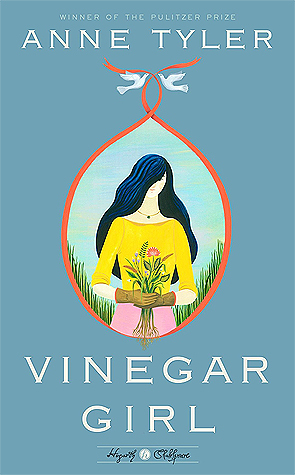
'Vinegar Girl' by Anne Tyler

Kate Battista feels stuck. How did she end up running house and home for her eccentric scientist father and uppity, pretty younger sister Bunny? Plus, she’s always in trouble at work – her pre-school charges adore her, but their parents don’t always appreciate her unusual opinions and forthright manner.
Dr. Battista has other problems. After years out in the academic wilderness, he is on the verge of a breakthrough. His research could help millions. There’s only one problem: his brilliant young lab assistant, Pyotr, is about to be deported. And without Pyotr, all would be lost.
When Dr. Battista cooks up an outrageous plan that will enable Pyotr to stay in the country, he’s relying – as usual – on Kate to help him. Kate is furious: this time he’s really asking too much. But will she be able to resist the two men’s touchingly ludicrous campaign to bring her around?
Genre: General, contemporary, women's fiction. Shakespeare knock-offs.
MY THOUGHTS:
I just found about the Hogarth Shakespeare project when I started this book. It seems Crown Publishing is on a mission to have some of Shakespeare's works re-told by well-known novelists of today, and this contribution by Anne Tyler is based on 'The Taming of the Shrew.' That was a pretty sexist text. Even the title can come across as offensive in our times, whether or not you're a feminist. The male lead character, Petruchio, sets out to make the opinionated Katherina into a more compliant and obedient bride. It's not something I can imagine (or would want) translated into the twenty-first century. I was curious to see how Anne Tyler would handle it.
In this story, Kate Battista (the Katherina character) is the elder daughter of Louis Battista, an intense scientist. She works as an assistant at a childcare centre, because she's run afoul of her supervisors at Uni and feels this is all she can get. Kate's younger sister Bunny (the Bianca character) is the traditional bimbo who aims to attract boys with her prettiness and frivolity. Their father has a young international research assistant named Pyotr Shcherbakov (the Petruchio character) whose visa is about to expire. Since he's the best assistant Louis ever had, the old man cooks up a plan to talk his daughter Kate into marrying him, just so he can keep his protege in the country.
Pyotr is one of the best and most interesting characters in the story, but I was disappointed that Tyler never took him as far as she could have. He's introduced as an orphan, and from time to time he drops brief stories and hints about his lonely, alienated childhood and youth in a country far removed from theirs, This is what begins to warm Kate toward him. But it's never quite enough! I kept expecting more unfolding revelations, helping our own affection for him to grow. I got to the last couple of pages and realised that what we had was all we were getting. It was a bit disappointing, since the potential was there to add so much more.
I found Kate's work and social dilemmas more interesting than her romantic one. She's a direct and honest person who calls things as she sees them. That sounds like a positive trait, right? Well, in this story, people with power endlessly try to force her to modify her behaviour. Mrs Darling, the pre-school director, threatens to fire Kate unless she develops more 'tact and diplomacy' when dealing with parents and pupils. Kate realises that she's really being ordered to skirt around doling out pleasant sounding half-truths and outright lies, as everyone else does. So the story gets us wondering whether people who say they value honestly really mean it.
In Shakespeare's play, the other characters believe Katherina is someone who genuinely needs to be tamed. In 'Vinegar Girl', we get to question whether Kate's version of 'shrewishness' is a bad thing. She's witty, observant and free-speaking at the start, and I was pleased to find that she was still a witty, observant and free-speaking woman in the epilogue. In Anne Tyler's version, being 'tamed' turns out to be gaining a more understanding point of view toward others, particularly her new husband and other men in his position. This turns out not to be a bad thing.
I found the story a bit too heavy with annoying and difficult relatives. Toward the end I was getting really sick of the silly extended family. They took valuable word space from the main part of the story, which should have been Kate's budding relationship with Pyotr. What was there between the two of them was fun, but it wasn't half enough. As it was, he managed to get her to warm to him with more ease than I think he should have.
However, it was a quick, fairly enjoyable read, with a simple and fun message not to dismiss romance, no matter how contrived the circumstance seems to be. Someone recommended this as a light, holiday beach read, which I'd agree with.
Thanks to Crown Publishing and Blogging for Books for giving me a copy through Net Galley.
3.5 stars
Friday, August 12, 2016
'Heart of the Mountain' by Jeanette O'Hagan
Twins Delvina and Retza’s greatest desire is to be accepted as prentices by their parents’ old crew when they stumble across the strange abovegrounder. Trapped under the mountain, young Zadeki’s only thought is to escape and find his kin. Will the three youngsters pull apart or work together to save the underground realm?
YA fantasy adventure in the lost realm deep under the mountain.
Genre: Fantasy, YA novella
MY THOUGHTS:
I offered some feedback on earlier versions of this story along the way, and it's been good and interesting to see how it's evolved.
It's a pleasure to come across stories which are short enough to prove that a lot of skillful world building and characterisation can take place without needing heaps of space or wordiness. This is a quick read (just a 45 page e-book) and yet the racial differences between the mountain people and the abovegrounders comes through strong, along with all the attitudes of prejudice and suspicion. The descriptions are finely honed so it's easy to picture the scenery and characters in just a few well-crafted sentences.
The young twins have a mission to prove themselves and aim to earn their places in their tribe. Stumbling across an injured stranger in need of help was never part of their agenda, but they try to figure out how they can use his presence to their advantage.
Lonesome newcomer Zadeki considers himself in the deepest possible fix. The limitations of his captors gradually dawn on him, so he's able to step up when necessary in the perfect timing, and in a way that only he can do. I like stories in which the supposed underdog turns out to be the only one far enough removed from a bad situation to clearly discern problems which others are blind to.
The story is also about the running and mismanagement of kingdoms. It prompts us to consider how easy it is to accept what we've always known, and to take the questionable words of leaders on board with blind acceptance, because that's how we've always behaved. It's about skirting around problems until you can no longer miss them, and also how corruption can breed on itself.
Altogether, engrossing and thought-provoking. As I said, I've had the opportunity for a thorough read of this story along earlier stages, which makes it more difficult to rank, but I'd expect most new readers to want to give it a 4 or 5.
Click here for an interview with the author, Jeanette O'Hagan, back in 2014.
Wednesday, August 10, 2016
Kids living with Writers
Three-year-old Blake loved the book bear at a conference where I had a stall.
I recently shared a post about writers living with kids.
During their growing years, I wrote and published nine novels. After discussing it over with them, I'm going to talk about the subject from their point of view.
Here's a sample of the events which might be taken as typical occurrences during their homeschooling years.
1) Their father would say, 'One of you come here and act through this fighting scene with me, to show Mum why it wouldn't work the way she's written it. Be careful not to knock anything off the shelf, though.'
2) Family outings could double up as research trips. I might say, 'Let me take a photo of that old cottage. It looks like a place in my novel.' Once we were hiking through a conservation park and discussing whether or not it would be a suitable spot to dump off a body (when I was writing 'Best Forgotten'). My husband said, 'I think it could be perfect. There are plenty of walkers on these paths, but nobody bothers to climb all the way up that steep cliff next to the main road, which is where you'd dump him in the long overgrowth. He could be there for years before anyone finds him.' And Logan suddenly thought to turn around, and said, 'Dad, there are people right behind us. You'd better keep your voice down. What might they think if they overheard this conversation?'
3) Sometimes the kids tried designing covers, and choosing who they thought might be the right people to resemble characters in my novels. We'd have chats about the quality of other writers' covers, taking in font, layout, colours and title. The same applied to analysing other author's plots.
4) They read through the novels or manuscripts of friends or acquaintances of mine. Once, I was helping judge some entries for an unpublished manuscript competition, and offered to get my teenage son to add his opinion to a very up-to-date YA novel set in the world of computer gamers. He came up with a few technical issues to run past the author. She made the changes he suggested, and was kind enough to thank him in her acknowledgements.
This was a cake my daughter baked and designed to match my 'Best Forgotten' book cover, for a launch. She was thirteen at the time.
I didn't twig that my kids' viewpoints might differ from others, until the day I sent Logan off to a one-day session at the library on creative writing for young teens. He came home shaking his head and said, 'I can't believe the hyped-up opinions everyone else around the table had about authors. They think they're really special or something!'
I told him, 'I thought so too, at your age.That's partly what inspired me to want to write novels in the first place. They do create worlds for others to get immersed in, and characters to love, from their own imaginations. That is pretty cool, isn't it?'
He just laughed and said, 'I don't think about them that way at all.'
That's when it hit me that he thinks differently because he's lived with somebody who has kept on writing for as long as he could remember.
And there was the time when Emma told us about a young acquaintance of hers who wrote a great spiel on social media about how she couldn't think of anything more inspiring and heroic than being a fiction author, sitting in coffee shops with your lap top, receiving fan mail and royalties in the post, changing lives with the words from your own pen. My daughter hummed and hawed, but decided to tell this friend, 'My parents are a writer and a musician, and I was the poorest of all my friends. When I was growing up I remember thinking that I wish they had other jobs because we could never afford things that my friends' families could.'
I've asked them, and on the whole, Logan, Emma and Blake are all unanimous about the following. When they've told anyone, 'My mother has written some novels,' they've come to expect responses like these.
'Wow, you're kidding, right? Has she really? That's fantastic!' (To which they would nod politely and think how they wished that 'Wow' would match their financial experiences)
Or, 'You must be really proud of her.' (To which they'd smile and agree because it was the polite thing to do.)
Or, 'Your mum must be really clever.' (To which they tell me they just grin and keep their mouths shut thinking, Little do you know!)
Subscribe to:
Posts (Atom)