Friday, March 25, 2022

'A Wrinkle in Time' by Madeleine L'Engle

It was a dark and stormy night.

Out of this wild night, a strange visitor comes to the Murry house and beckons Meg, her brother Charles Wallace, and their friend Calvin O'Keefe on a most dangerous and extraordinary adventure—one that will threaten their lives and our universe.

Winner of the 1963 Newbery Medal, A Wrinkle in Time is the first book in Madeleine L'Engle's classic Time Quintet.

MY THOUGHTS:

Wow, this book is off this planet in more ways than one! L'Engle has incorporated science, philosophy and theology  in thisYA fantasy novel which was initially rejected by several publishers who thought that complex content and kid characters were too big a clash. But she persevered and it became a Newbery medalist and famous classic. She even borrowed, 'It was a dark and stormy night' as her opening line, which turned out to be an excellent move. Although Madeleine L'Engle didn't make up that line, it wouldn't surprise me if several readers throughout the years assume she did. 

So here's how it all goes down. 

Meg Murry feels like a loser in every way. She's unpopular at school, considers herself plain looking, relies on glasses for her near-sightedness, and struggles in several subjects. She is actually quite a brilliant maths nerd, yet because she's so awkward, the teachers seem to have overlooked this. Her beloved little brother is being picked on, and her father is missing. Mr Murry is a physicist doing top secret government work, but nobody has heard from him for several years. 

A weird trio of ladies squatting in a local derelict house seem to know what's going on with the children's dad. Chatty Mrs Whatsit is a shapeshifter with weird dress sense; bespectacled Mrs Who speaks in famous quotes because she finds it way easier than coming up with her own words to use; and Mrs Which, the most ancient of all, is hazy and ethereal. 

It turns out Mr Murry is stranded on a planet named Camozotz, where he's been helping fight an evil black shadowy force which is also closing in on earth. Meg, along with two boys are enlisted to help rescue him, without getting themselves embroiled in inescapable danger in the process.  

One of the boys is her precocious 5-year-old brother, Charles Wallace. He's rumoured to be slow on the uptake but knows full well he's a genius with an uncanny knack for intuition. Charles Wallace's intellect is probably way too vast for such a young head, which is his biggest weakness. How can a pre-schooler arm himself against a superiority complex when he understands stuff like quantum physics?

 The other boy is 14-year-old Calvin O'Keefe, who knows he's admired at school for the most unimportant reasons, such as athletic prowess and good grades. But Calvin's home life is a train wreck, which keeps him wistful and envious of those with solid, loving families. When Meg and Calvin realise their home and school personas are complete reversals of each other, it gives them a sort of bonding of opposites.

The sci/fi nature of the story begins when they travel via tesseract. If you compress a long piece of paper to look like a folded fan and then leap across the creases, that's similar to what our little gang do through space and time. There's no actual time travel though. I think the book is more of a 'space' story than a 'time' story, despite what the title may suggest.  

Meg begins the adventures very skittish and easily frightened. I stopped counting the number of times she needs to clutch another person's hand for security, but I honestly find this a refreshing blast from the past in our modern era of brave and bold heroines whose authors fear backlash from our reactive feminist culture if they give them a moment of weakness. With female main characters now being typecast as consistently kickass, timid readers have fewer literary counterparts to draw from.  That's truly sad, and I find Meg Murry's cowardice under the circumstances completely understandable. I'm sure if I were in her shoes, I'd be clutching Calvin's hand until it turned to pulp. 

Her faint-heartedness early on makes her later courage more impressive, especially when she reaches for Calvin's hand for about the hundredth time, then decides she needs to stop relying on others to help her through. Her final big challenge will have to be done alone. (I'm sure many girls hope that any future hand holding with Calvin will be for an entirely different reason.)  

Camazotz turns out to have a brainwashed population who are totally conformed by the ruling power (IT) to be completely uniform. Readers of the sixties assumed that was L'Engle's dig at Communism, but her intent is also to help Meg embrace her own differences rather than wishing to be like others. I've been reading a few books about the drawbacks of our western individualistic culture, so coming on the heels of them, this story is a reminder not to swing too far the other way. 

Okay, I can't deny Madeleine L'Engle's themes are unsubtle and her heavy-handedness sometimes becomes almost cartoonish. Take for example the adventurers' quick mishap on the 2D dimensions plus their interactions with the 'Happy Medium' who is just as she's described. Yet I still have a compulsion to keep reading on despite these corny moments. I think it's because the unlikely main trio are all interesting enough to keep their interactions fun. (I'm talking about the three kids, and not the Mrs Ws.)

I want to keep on reading more of L'Engle's time series, but I've heard they're not easy to find, so it will depend on whether or not I can get my hands on them. Now that it comes down to it, I hope I can. 

🌟🌟🌟🌟  


Friday, March 18, 2022

Trixie Belden Series 7 - 9


7) The Mysterious Code

Oh oh, the future of the Bob White appears to be in jeopardy. There has been a spate of minor vandalism and burglaries, and the school board wants to stamp out clubs for fear of gang like behaviour. Principal Stratton says they'll really have to prove their worth if they're allowed to continue out in the open. Trixie has the grand idea of setting up an antique show to raise money for UNICEF, but it soon becomes clear that serious crooks are after their exhibits. And some of the valuables are only on loan from generous townsfolk. Can the Bob Whites protect the precious loot, save their own reputations and put on a breathtaking show?   

* This is the first of the many 'Kathryn Kenny' titles written by ghost authors, so I was alert for changeover glitches. The start feels a bit awkward. This author opts to 'show' story background through conversation rather than 'tell' it in information dumps. That sounds great in theory, but doesn't work brilliantly when we have the teenagers referring among themselves to, 'your chauffeur Tom' or 'our gamekeeper Mr Maypenny.' They all know very well who everyone is by now! Once those hurdles are clear, we're off.  

* I got tired of Trixie consistently calling Bobby, 'Lamb.' She never has before, and I hope she stops in future books. 

* The previous book ends at Christmas time, and this one takes us in to the new year, culminating around mid-February, as Di Lynch decides to throw a casual Valentine's Day party at her house, probably to atone for that dismal, formal Halloween gig the October before with her fake Uncle Monty.

* We find out about the challenging family dynamics of Spider Webster, the young Sleepyside cop. His parents are both dead and he's the sole guardian of his 14-year-old brother Tad, who tends to be a bit of a handful. 

* We also meet a couple of charming elderly Dutch neighbours; Mrs Vanderpoel and her whiskered friend Brom. Recurring character alert.

* The author clearly had great fun describing the wonderful antiques, some dating back to the Civil War era and some exported from overseas. It was enough to make me wish I could step into the pages and visit their antique fair myself. 

* There is some slight inconsistency with the recovery of an old music box that previously belonged to the Frayne family. Apparently Jim's bad stepfather, Jonesy, was falsely accused of stealing it. Yet the scenario is set up in such a manner that the box disappeared several years before Jonesy ever entered the scene. This incident doesn't matter really, since it's not integral to the plot. I guess the author just wanted to highlight Jim's generosity in wishing he could tell Jonesy that he's off the hook.  

* I really applaud Mr and Mrs Belden for being such fun, hands-on parents. Chapter 15, in which they both take part in the fun and games night with all the kids, is excellent. In fact, I should call them Peter and Helen from now on, since they are such well-rounded characters, and not the bland, faceless suits and house dresses often found in juvenile literature from this era. They are a wholesome family too, as Peter gets all the kids and their guests to bow their heads for grace. 

* Helen Belden is a fantastic example of a happy, fulfilled stay-at-home mum. Bobby and the male Lynch twins are unanimous in agreeing that her homemade hamburgers are superior to those at Wimpy's. She even describes her methods for any eager beavers willing to put them to the test. And she adds marshmallows to her Waldorf salad with the apples and celery. I've never heard that idea before, but I like it. There really should be a series cookbook.

* Great news for romance fans, this first Kathryn Kenny author seems super keen to promote the Jim/Trixie attraction angle. She's practically shoving the baton into the hands of writers to come, but from my memory, I don't think they all run with quite the same speed. Perhaps she was warned to slow down and remember this is first and foremost a mystery-adventure series for young teens. 

* There are a few lovely little nuggets for Mart/Diana shippers to jump on too, such as that cute, nervous public kiss. However any Honey/Brian threads are virtually non-existent thus far.

* At one stage, Helen Belden gets exasperated and snaps at Bobby to give her a break. I'd come across one reviewer who remarked that the little imp doesn't get so much as a scolding throughout the entire series. Well, that's not quite true. He might be a trifle spoiled but she is only human herself.

* Trixie's bossiness is as plain as ever, but she gets called up on it from surprise sources a few times. As long as the authors are all aware that she tends to be dominating at times, it's all good. What's more, all the Bob Whites get a wake-up call for being a bit inclusive and giving Tad Webster the cold shoulder treatment. That's interesting, since I was going along with their point of view from the start, and considering him a pain in the neck. But there are always two sides. The fairness factor is what makes these books a great read. I notice they haven't invited Tad to join the Bob Whites though. Perhaps he still thinks they're a bit corny.

* It's lucky that Jim aims to open a school for boys rather than working with Trixie and Honey's detective agency. When it comes to picking up on a desperate clue, he's absolutely terrible! It would take a brick to drop on his head.

* I'll award the quote of the book to Mrs Belden. 'I don't want you to grow up too soon but I would like to be able to tell the difference between you and your brothers without straining my sight.'  

8) The Black Jacket Mystery


The Bob Whites are organising an ice carnival to help raise funds for a Mexican village struck by an earthquake. Meanwhile, Regan is concealing a ponderous secret that appears to make him very anxious and grumpy. And a sulky boy named Dan Mangan who has had brushes with the law is now living with Mr Maypenny. Is Dan Mr Maypenny's grandson? And is he behind some thefts and break-ins that have been happening? 

* Trixie and Honey have acquired Mexican penpals, Dolores and Lupe, whose school library was decimated by an earthquake. Donations of new books is what the Bob Whites' ice carnival is all in aid of. No sooner have they finished the antique fair from the last book when they're pumped again, working on a new project. These guys don't let grass grow under their feet, but to squeeze all the coming adventures within one year, the stories will need to be back to back like this. 

* Mart is apparently a very speedy skater. I wonder if he surpasses Brian and Jim, but get the feeling he never manages to trump the Mr Perfect duo as often as he'd like to.

* I don't remember if the Beldens' elusive Aunt Alicia ever makes an actual appearance, but her gifts to her nephews and niece tend to bite the dust. In this book, a spotted china cat is smashed and a chunky woolly sweater is unravelled. 

* It seems the Beldens are a family of faith after all, for it appears Mart has recently outgrown his Sunday suit and needs a new one. Perhaps Trixie goes to pick up the newspapers from Lytell's General Store (See Book 1) after they get home from church. 

* I wonder if Bobby ends up getting the kitten that many people promise him. I don't remember, but I feel sorry for it if he does, having to live with both Bobby and Reddy.

* Regan somehow manages to come up with a decrepit old horse named Spartan from the Wheelers' stable for the use of Dan Mangan. How come we've never heard of Spartan before? He's a handy plot device horse if ever there was one.

* (Sigh) it had to happen some time, I guess. The awesome Regan goes down a notch or two in my estimation. His attitude toward Dan stinks. Basically, Regan places job security way above his family duties. He's so scared that acknowledging his delinquent nephew will tick off his rich employers that he prefers to keep it hushed up. He'll hide Dan with Mr Maypenny rather than admit that he even has a nephew. What sort of message is that supposed to give poor Dan?  

* The whole secret experiment thread is abysmally handled by the adults. For a start, it encourages others to imagine things are worse than they actually are. Trixie wonders if Regan himself has committed a crime, such as a hit-and-run. Little does she know he's just too churlish to own his own flesh and blood. 

* Trixie's antagonistic reaction to Dan from the moment she sets eyes on him is nothing to be proud of. She sums him up as a troublemaker the second he steps on the bus, and treats him accordingly. Snap judgement might be natural, but that doesn't make it right. Then when Mart points out that Trixie has had it in for Dan since Day One, she flounces off in a huff, although every word is true. 

* This is probably the point where readers with opinions about Trixie's romantic life may begin to diverge. Until now, Jim has monopolised the floor, but from here on he may have competition, if not in Trixie's eyes, in the readers' at least. The canon undoubtedly points toward Jim, but there is something sort of cool in Trixie's progression from haughtily putting Dan in his place to humbly requesting, 'Please don't go, I'm scared.' So is it Team Jim or Team Dan, girls?

* Haha, now for the inconsistencies! Sorry to be a spoilsport but being pedantic can be fun. Firstly, let's talk about Tom and Celia wanting to buy the Robin; the red trailer formerly from the Lynches which they're living in on the Wheelers' property. The implication is that Tom dreams of paying Mr Lynch the $5000 for it. But hey, hang on, doesn't that trailer now belong to Trixie and Mart?! Mr Lynch gifted it to the young brother/sister duo for their valiant success at stopping the fake Uncle Monty in his tracks. This new anonymous author needs to go back and read The Mysterious Visitor. Trixie and Mart should be the ones rolling in dough, with $2500 apiece if the sale ever comes off! 

* Secondly, how did the Bob White clubhouse even get broken into at this stage? In the previous book, The Mysterious Code, a burglar alarm was connected to the clubhouse which Regan would instantly hear from the stables and his apartment up at the Manor House. Surely this wouldn't be inactivated so soon. It's only a matter of a few weeks since they needed it for the antique show. 

* Finally, this author contradicts herself within this one book. At one point we're told that Regan has been sending money to his only sister, (Dan's mother) to help her make ends meet. Then a little later the story changes. Mr Maypenny informs Trixie that Regan totally lost track of his sister until he recently heard that she was dead. Come on author, get your facts straight. Proofreader, you should have been onto that one too. 

* If I'm to award a quote of the book, it'll have to go to Dan. 'But you know all the answers, don't you, Freckles.' 

* Hooray, now our seven Bob Whites are complete, so bring on more.   

9) The Happy Valley Mystery  


The Bob Whites are off to spend a week at a sheep farm in Iowa owned by the Beldens' Uncle Andrew. While he's away in Scotland, he asks his managers, Hank and Mary Gorman, to give the teenagers some hands-on experience and a good time. Yet there is some funny business going on in the background. Andrew Belden's sheep are steadily disappearing without a trace. It's surely the work of some elusive sheep thieves, and the cops and sheriff have no leads. Trixie makes up her mind that before they depart she will solve the mystery for Uncle Andrew as her way of thanking him for having them there.   

* This book doesn't divulge whether the bachelor uncle Andrew Belden is older or younger than his brother Peter, but my guess is older. Those two have sure diverged in different directions. Being a sheep farmer is a far cry from working in a bank. 

* On the flight across, Honey remarks that she's not even sure she'd know a sheep if she saw one. Then a bit later, Di asks whether huge jackrabbits are just grown-up cottontails. Yikes, as the Bob Whites themselves might say! We seem to be living in the time period when dumb speeches were consistently put in the mouths of girls. At least some should be given to the boys if we need any at all. But our Bob White boys are consistently portrayed as quite brainy.

* Poor Dan misses out on the trip, which we soon see becomes a recurring pattern. In this case, he wants to study hard to stay in Jim and Brian's class. This suggests that he's closer to their age than Mart's, but I have a feeling this fluctuates. The Black Jacket Mystery seems to suggest somewhere in between, but since Jim has skipped a year, Dan would have to be extra-academic, which we know he's not. Hmmm. 

* The Trixie Belden series is quite educational as well as fun. We learn a lot about sheep farming, meet several different breeds, discover why shearers have soft hands, and see that well known proverbs about dumb sheep were thought of for a very good reason. There are some lovely descriptive passages and a good sense of place. 

* Trixie gets a bit nettled and snaps at Diana, 'I like Jim of course! Just the way you like Mart and Honey likes Brian.' Whoa okay, I thought these were subtleties for readers to pick up over time, but this author has chosen to lay all the cards right out on the table already. 

* The three Sleepyside boys blitz the basketball court! You show 'em, boys! I wish there was a way to spell a wolf whistle! 

* Di reveals that her parents knew they were going to marry each other since they were ten years old. Trixie often gets impatient with Diana and calls her a baby to her face, but has to admit that Di has a social poise and grace around boys that she lacks. 

* But Trixie learns some feminine wiles from observing Diana and Honey in action. The other two make no attempt to buzz off the swarming guys who are trying to help them tie their skates. The helpless act is part of their arsenal. Thanks heavens times have changed. 

* Trixie gets jealous when Jim's attention is monopolised by a gorgeous blond girl, Dot Murray, and she's not above flirting with Ned Schulz to get back at him. It sort of backfires since Ned is a straightforward sort of guy who likes girls to be natural and unadorned. Yay, at least someone has some sense. I doubt Jim would expect such behavior from Trixie anyhow. 

* Trixie's aptitude for her ambition shines through in this book. She truly has the grit to be a detective. She's a very driven person, considering time wasted unless she's on the case. She's forced to put up with lots of flak and teasing from adults, and loss of face after false leads. But nothing deters her for long. Perhaps my favourite quote of the book comes from Ned. 'Trixie, you knock me dead. You make up your mind to something and nothing can change it. Right?' 

* No, I think my ultimate favourite is this exchange between the almost-twins. Trixie: 'I just can't remember what our lives were like without Jim.' Mart: 'Your life especially.' 

Please catch my last thoughts on Books 4 - 6

And stay in touch for next up will be Books 10 - 12.  


Friday, March 11, 2022

Guys with crazy, genetic diseases involving time


Time is perhaps the most fascinating and relentless force of all. It steadily changes each of us and eventually removes us from the picture entirely. Nobody can speed it up or slow it down. The most we can do is create the illusion that we can, with skin products, hair dye, cosmetic surgery and so-called super foods. But it ticks steadily away, eroding us into faded, frail images of our former selves. Maybe that's why speculative stories about fellows like these intrigue us, because they encourage us to ask, 'What if time behaved differently for us? What would be the ramifications of that?' It's interesting and fun that several authors have grappled with the same questions, and the conditions they inflict on their poor heroes could be likened to medical prognoses, enabling us to ponder some possible answers. Here goes. 

Tom Hazard (from How to Stop Time)
How to Stop TimeHe has a condition that causes him to age incredibly slowly, at the rate of one year for every 15. He's seen a lot of history in his life, meeting celebrities such as Shakespeare, Captain Cook and F. Scott Fitzgerald. This gives him plenty of insight for his current job as a High School History teacher, but Tom finds it hard to deal with the downside, which is outliving everyone he grows to care about. (My review is here.)

Benjamin Button (from The Curious Case of Benjamin Button)
I love the concept of poor Benjamin's tale. His life trajectory is the opposite to other people's. He's born as a haggard, grey-haired man and ages backward until his death from old age, as a new born baby. The image of how he and the love of his life face their final moments together is haunting; an elderly woman holding a helpless infant. I believe the movie starring Brad Pitt surpassed the novella by F. Scott Fitzgerald, on which it was based. 

Henry de Tamble (from The Time Traveler's Wife)
The Time Traveler's WifeHis condition once saved his life as a 5-year-old, but he senses it will also be the death of him. Henry zips back and forth to different stages of his own future and past, with the inability to control when it will happen. His genetic clock randomly resets itself, often at extremely awkward moments. He always vanishes without a trace, leaving a pile of clothes behind on the floor, to appear entirely naked in another time frame. But he has the consolation of some interesting conversations with himself at different ages. To a certain extent, this gives him comforting insight into what lies ahead for him, but how terrifying for Henry when his future self no longer visits. What is that supposed to signify? (My review is here.)


Dorian Gray (from The Picture of Dorian Gray)
The Picture of Dorian GrayYou could say that his time condition didn't develop until his late teens or early twenties. This young man longed to trade places with his own portrait, because it would be so wonderful to stay gorgeous and young. Suddenly that's just what happens. The canvas bears the brunt of his hard living and bad choices, so Dorian hides it away in his attic. Meanwhile, everyone wonders how he manages to stay so ravishingly attractive. It's bound to catch up with him some time though, because that's the nature of time, and we know it'll hit hard when it does. (Here is my review.)

Tuck EverlastingJesse Tuck (from Tuck Everlasting) 
This teenager and his whole family could be said to have caught their condition from contaminated water. There was evidently some sort of supernatural bug in the stream they drank from, which preserved them from the ravages of aging from then on. Furthermore, it fortified each of them so they were impossible to kill. So when Jesse visits the grave of his childhood sweetheart Winnie long after she's grown old and passed away, he's still the same handsome young man he was in the 1920s. Only his fashion sense has changed. His is perhaps the most tragic tale of all. For who would really choose that sort of indestructible immortality?

What a wild ride it would be to get hold of all these stories and read them back to back. If you're like me, they might help reconcile you with your rapidly aging self. Perhaps ours is the best case scenario after all, because these guys' lives were fraught with too much difficulty and heartache. Would you trade places with any one of them? Perhaps I'll finish off with the legendary figure who represents the condition each of us must bear.

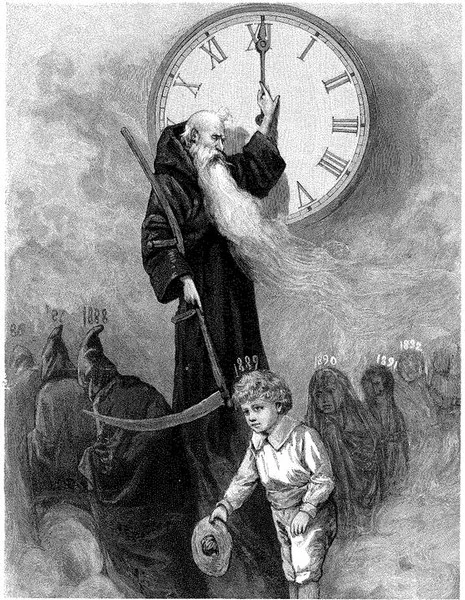
Father Time
Image result for father timeHe's not actually a mortal, but a personified picture of the passage of time in our lives. He's elderly and bearded because he's been around literally forever. His scythe and hour glass represent the one-way movement we all must cope with. The young will grow old, but the old cannot rejuvenate themselves to start over again. Presenting him in a human form like the rest of us is apt, because it could be argued we all have a genetic condition regarding time, the same as the guys on my list. It starts ticking away the moment we're born. We know it's chronic and will turn out to be terminal, but compared to them, we wouldn't have it any other way.


You might enjoy my related list of Evergreen Children, those storybook kids who never grow up. It turns out there's a lot they can teach us.

There's also this reflection on the passage of time, featuring a wise and happy bunch named The Graveyard School. 

Friday, March 4, 2022

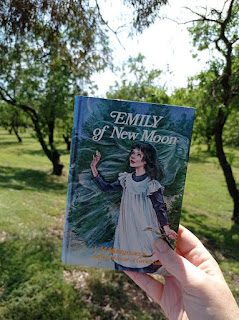
'Emily of New Moon' by Lucy Maud Montgomery


Emily Starr never knew what it was to be lonely—until her beloved father died. Now Emily's an orphan, and her mother's snobbish relatives are taking her to live with them at New Moon Farm. She's sure she won't be happy. Emily deals with stiff, stern Aunt Elizabeth and her malicious classmates by holding her head high and using her quick wit. Things begin to change when she makes friends: with Teddy, who does marvelous drawings; with Perry, who's sailed all over the world with his father yet has never been to school; and above all, with Ilse, a tomboy with a blazing temper. Amazingly, Emily finds New Moon beautiful and fascinating. With new friends and adventures, Emily might someday think of herself as Emily of New Moon.

MY THOUGHTS:

This is the first book in a trilogy Lucy Maud Montgomery was anxious to start work on, partly so she could move on from the Anne series she felt herself cornered in for so long. Her new heroine is Emily Byrd Starr, whose beloved father dies of consumption early on, leaving her at the mercy of intimidating relatives from her mother's side of the family. The proud and haughty Murray aunts and uncles disowned their younger sister (Emily's mother), when she eloped with a penniless guy they spurned (Emily's father). They all baulk at the thought of taking on Emily now, and decide to settle the matter by drawing lots. Poor Emily herself is the person forced to draw the slip of paper! 

She ends up heading off to New Moon Farm, the ancestral family hub, with spinster aunts Elizabeth and Laura, and disarming cousin Jimmy, who's said to be intellectually compromised after a childhood accident, although we readers are left wondering whether he simply thinks fresher, more original thoughts than the average person. (More about Jimmy here.) Laura is sweet and easy-going but Elizabeth, who rules the roost, is grim and set in her ways, making her one of Emily's biggest trials. 

There are strong similarities to the relationship between Anne and Marilla in Anne of Green Gables, yet it's really quite the opposite. While Anne and Marilla come to terms with each other being so essentially different, Emily and Aunt Elizabeth lock horns because they're so similar! They are both stubborn, single-minded, strong-willed individuals who are perceived by others as sharing the same fierce family pride and carrying themselves with the same haughty carriage. In both cases, their eventual warming to each other is very touching.  

Emily's main tool to help her cope with change is a rich inner life that atones for the loss of many other things. Her 'flash' is a fascinating phenomenon. It's her name for those sensual moments that provide sudden glimpses of a wider, more wonderful spiritual plane far beyond our own. Her history of everyday triggers is one we can all practice taking on board. It includes 'a high, wild note of wind, a grey bird lighting on her window sill, the singing of "Holy, holy, holy" in church' and her first sudden glimpse of a dormer window in the early evening sky at New Moon. That sort of rich and simple pleasure is available for us all.

Montgomery endows Emily, more than any other heroine, with her own passion for writing. For both Maud and Emily, the sheer necessity of getting things on paper puts it beyond the scope of hobby to an outright calling. Emily needs to empty her soul with her pen so all the emotional dross can be cleared. The solace she gets from reading and writing keeps her on an even keel. Aunt Elizabeth has an old-fashioned suspicion of fiction and wants Emily to stop, but Emily knows she can't possibly obey. Writing is as necessary to her as breathing. It's elemental and cathartic to her soul. I tend to think if Aunt Elizabeth managed to prevail, Emily would be far harder to live with. 

Emily's three closest friends provide excellent subplots, because their equally colourful backstories enrich the whole text. (Funnily, they're all only children brought up by single parents, or in Perry's case, it's a great aunt, after his seafaring father passes away.)

First is Emily's BFF, the vibrant and choleric Ilse Burnley whose dad, the local doctor, neglects and resents her for a mysterious reason that's concealed from kids but tacitly understood by all adults. When we finally discover what it's all about, Dr Burnley emerges from the secret looking like a rat in my opinion, although peers from his own era seem to understand where the guy was coming from. I'll say no more and leave you to form your own opinions about him.  

Both Burnleys are renowned for their tantrum throwing! It's great fun to read, especially Ilse's colourful insults, but could anyone really get away with such full-on hissy fits without alienating their friends? In the case of Allan and Ilse, people just seem to accept that they're born that way. It seems to me at the very least, both father and daughter are headed for blood pressure and cardio problems if they don't tone it down. Lots of good property is broken or otherwise damaged by being kicked, smashed or pitched out of windows. I do love Ilse though, for her honesty and energy.  

Next is the budding artist Teddy Kent, whose intensely brooding and neurotic mother has her apron strings tied so tightly around him, the poor boy can barely breathe. Even though Teddy is loyal enough to say that she's awesome when they're alone, she's a menacing force capable of doing his psyche great harm. Everything she thinks he's too fond of gets destroyed, whether it's pets being drowned or artwork being burned. Because she must have all his love for herself! Seriously, this lady needs help. 

And finally, Perry Miller, the hired boy who helps Cousin Jimmy around New Moon! What a lad! He's quick-witted and penetrating with abundant confidence to make up for being born on the wrong side of the tracks. This boy hails from Stovepipe Town, the nearby slum, but has no doubt he could become premier of Canada if he tries hard enough. He's a fabulous example of rising from putdowns. I remember as a kid thinking Perry would be a great match for Emily, but can now see he's far too pragmatic. Emily needs a much artier, head-in-the-clouds type of guy, if you get my drift. (I once wrote a blog post explaining why this boy is one of my favourite LMM heroes. You can find it here.)

I read a suggestion somewhere that Montgomery might have based Emily and her three best friends on the four basic temperaments. Emily is Melancholic, Ilse is Choleric, Teddy is Phlegmatic and Perry is Sanguine. Even though each of them, like most of us, is really more of a mixture, I like this generalisation, although I'm not sure it was intentional on Montgomery's part. 

Montgomery's knack for writing elderly ladies shines in this book. Aunt Nancy Priest, her companion Caroline, and Perry's Aunt Tom are all other-worldly wrinklies beyond caring about making good impressions at their stage of life. Old ladies get plenty of awesome lines reflecting the wisdom of having seen the gamut of human nature in their time. 

But practically every character is well drawn. Miss Brownell gets my prize for nastiest teacher, Lofty John for meanest practical joke and Dean Priest for creepiest romantic intentions. One of the final impressions we're left with is this thirty-something guy who's biding his time, waiting for a twelve-year-old girl to grow up so he can woo her properly. Yep, Montgomery's setting him up to become one of Emily's serious suitors, and Dean's occasional passion charged comments suggest that he can hardly wait.    

But I started with Emily and will finish with her too. Believe me, we have no sunny-hearted, carroty haired Anne here. Emily is a little Gothic chick from her black hair and pallid skin right through to the bone! She has a prickly, cheeky streak a mile wide, and backchat flows so naturally to her tongue that half the time she doesn't even realise. Simply stating that Emily lacks Anne's essential sweetness is an understatement. Sure, Anne blows up at Mrs Lynde and Gilbert for outright insults, but can you imagine her delivering a line such as this one from Emily to Great Aunt Nancy? 'If I was Salome I'd ask for your head on a charger.' In all honesty, I can see why some people, (both inside the story and out), consider Emily a piece of work.

She even lives in a darker, grimmer version of Prince Edward Island than Anne's, to match her Gothic persona. Emily's world is peopled by control freaks like Mrs Kent, perpetual sulkers like Dr Burnley and cynical brooders like Dean Priest. It contains eerie guestrooms with spine-chilling portraits and terrifying four-poster beds. Gruesome things happen to innocent people, like Ilse's mother.

 But Emily's flash, devotion to writing, love of cats and openness to being wowed humanises her, and makes me keen to keep re-reading her adventures. Most of all, I admire her self-containment. When her blunt old former housekeeper, Ellen Green, warns her not to cause ripples because she's of no importance, Emily responds, 'I'm important to myself!' Yay, a girl like this will survive the dark, Halloween-y twists her life sometimes takes. 

Bring on Emily Climbs!

🌟🌟🌟🌟🌟 

Friday, February 25, 2022

Trixie Belden series 4 - 6

4) The Mysterious Visitor

Honey and Trixie are concerned about their classmate, Diana Lynch, who's grappling with an awkward problem. Di's parents have recently made a fortune, and her long-lost Uncle Monty has shown up on their doorstep from out of the blue. Now he's a permanent house guest, and an overbearing, controlling nuisance, which compounds the angst Di has been dealing with, coming to terms with her family's sudden wealth. Suspicious circumstances lead Trixie and the Bob Whites to wonder whether Uncle Monty is on the level. If he's not who he claims to be, what are his reasons for sweeping into the Lynch family? And how can they unmask him? 

* I sense Diana is more prone to melancholia and blues than Trixie and Honey. She's a non-academic, pretty girl, but she's no fool. Di recognises physical beauty for the transient asset it is. Some of her remarks and her general attitude indicates low self-worth and social anxiety. Sometimes she just feels bewildered, as the fringe-dweller who doesn't get the 'in' jokes yet. She craves acceptance and belonging, which she's beginning to get with the Bob Whites.

* Jim thinks that Diana has a phobia about being rich. I guess it takes one to know one, since Jim tends to be a bit sensitive about his own reversal of fortune, especially when he's nettled.

* Di is simply disillusioned by the pomp and pretentiousness of the new lifestyle that's been thrust upon her. She was never born to it like Honey, so all the showy bull dust is a source of grief and great loss to her. Especially now that all of her old school acquaintances (including Trixie until now) have shunned her because of the gaping difference. Although Trixie rebukes her for being depressed that she's rich, it's far more complex than simply getting over it. But Trixie doesn't really understand all the identity angst and bereavement involved. It's short-sighted of her to tell Diana how she should feel, however well intended. Trixie can be such a know-it-all at times.

* Trixie and Diana both have good reason to envy each other. Each of them has all sorts of things which the other wishes they had. It adds unspoken tension, even though they are genuinely good friends.  

* Regan is a legend! I wondered why the kids get so anxious he'll resign as Wheeler's groom, just because some opinionated stranger breezes in to give his opinion. But I think I get it. They suppose that Uncle Monty is a horse expert, and fear Regan will quit out of pessimism and insecurity if his methods are questioned. Naw, he's made of far cooler stuff than that. 

* Trixie is her over-confident, know-it-all self. Tom Delanoy warns her not to go exploring a seamy section of Sleepyside unless her brothers accompany her. So what does Trixie do? She heads straight to dodgy Hawthorne Street alone. What an eye roll. 

* As far as I see it, Trixie owes Mart big time. He saves her life! (He surely has issues of his own, feeling unconsciously lower in the Bob White hierarchy than Brian and Jim. That's probably one motivation behind his large vocabulary. It's attention seeking behaviour. And in the same vein, wearing his hair in a crew cut rather than letting it curl like Trixie's and Bobby's is all a grasp for individuality.) 

* Some of the recurring cop characters are introduced for the first time. We get Spider Webster, the popular guy, and Sergeant Molinson, who seems to be just a regular officer at this stage. Spider's crucial role in this story dates the series a bit. It was written back in the time when policemen still stood at intersections, directing traffic on foot. 

* Wow, Tom and Celia are jolly lucky to be given a free trailer! What an over-sized reward for a very small tip-off. Surely it should be more of a permanent loan than an outright gift. In my opinion, Tom should gradually pay off its new owners. (Can't identify who they are without being too big a plot spoiler.) 

* We are told the Lynches fire Harrison the butler toward the end of the book. I'm guessing that must change before long, because I clearly remember his presence in later books in this series. But seriously, do they really need a butler?

* There is perhaps a slight continuity glitch, but nothing major. The story has skipped to late October, yet there's still a feeling the Bob Whites have only just returned to school. The last book ends in late August, when they were discussing their imminent return. Now, this story clearly needs to be late October, to include the infamous Halloween party, but I think it might have worked better without the inclusion of the school assignment about how they spent their holidays. 

* Bring on more! You can surely see I'm loving all the implicit psychological subtleties motivating the Bob Whites. Who even needs to discuss the actual mysteries. 

5) The Mystery off Glen Road


Fierce gale winds destroy the roof of the Bob Whites' clubhouse in the week leading up to Thanksgiving. Only Brian has saved enough money to pay for necessary repairs, but everyone knows he'd intended to purchase a secondhand car from Mr Lytell - a once-in-a-lifetime sort of bargain. Trixie thinks hard to come up with a solution enabling them to fix their roof without Brian's sacrifice. It partly involves some gamekeeping work on Mr Wheeler's estate, since the current gamekeeper has quit in a huff. Trixie and Honey stumble across evidence that a sneaky poacher may be at work. What's more, he seems to be a weird, elusive character who rides a unicycle. How will they pin him down?

* The car that Brian plans to buy from Mr Lytell is a jalopy, a term I was unfamiliar with. It turns out it's simply what I know as an old bomb. 

* I don't really like the idea of Mr Wheeler setting up a huge game reserve where lots of lovely animals can be fed and feel at home just so he can blast through and shoot them when he feels like it. The whole set-up strikes me as very Watership Down, and this guy has more of a British Squire vibe the more I hear about him.

* Trixie's plan to win back Brian's car involves some hilarious, fake romantic play-acting on her part. Chapter 6 in particular is laugh-out-loud funny, and I actually did laugh out loud. 

* We are introduced to a new recurring character, Mr Maypenny, a senior gentleman who lives a semi-reclusive lifestyle on a small patch of land surrounded by the Wheelers' game reserve which his own family has actually owned for generations. 

* Honey's cousin, Ben Riker appears again. Although most people get browned off with his practical jokes, he's really not a bad guy, and seems to get saddled with way more than his fair share of looking after Bobby Belden, as far as I see it.   

* Oh oh, Trixie and Honey are already at it. That is they make occasional condescending remarks about Di Lynch, along the lines of, 'Oh, she's not good enough to come with us, so let's think of something else for her to do, to make her feel important.' (Not in those words of course, but that's the gist of it.) Sometimes their treatment of Di is no different from the way they'd fob off Bobby. And then, they assign her a few arduous jobs to take the pressure off themselves! (Entertain Ben and babysit Bobby.) If that's their tactful way of making Diana feel valued, it serves a double purpose. In effect, they're using her and telling each other they're doing her a favour.

* Mr Lytell has the hots for Miss Trask. I don't think that one's going to launch. 

* For quote of the book, I choose the moment when Brian discovers his sister's schemes on his behalf and says, 'Of course I'm mad, you lame-brained idiot. Mad with joy.' 

* It's a satisfying ending all round, but did this mystery itself manage to launch? Or did it fizzle out? I can't quite decide. Anyway, it doesn't matter, because I thoroughly enjoyed it.  

6) The Mystery in Arizona

It's almost Christmas time and Diana's REAL Uncle Monty makes good on his promise to host the Bob Whites on his Dude Ranch in Arizona. But they arrive to discover that the majority of his staff has just disappeared without notice. It was one family unit he hired as a whole, and now they've taken off. The Bob Whites offer to pick up the slack with cleaning, cooking and waiting on tables. The place isn't short of mysteries to solve. Is the resident cowboy a phony? Is there something suspicious about Rosita, the young Indian housemaid who has just acquired a job? And how about three very problematic guests who are reluctant to leave their rooms? Most of all, why the heck did the Orlando family shoot through like that? Trixie overhears suggestions that they were threatened.

* I had to google the term 'Dude Ranch.' Turns out it's a ranch that's oriented toward paying guests, and therefore part of the tourism industry. What a great place to visit. 

* The tension of the subplot can be cut with a knife. Trixie is struggling with a couple of school subjects, and Brian and Jim have volunteered to spend time tutoring her so she won't have to miss the trip to Arizona. Friction escalates, because Trixie thinks they're too demanding and they're convinced she's slacking off. This really garners reader sympathy for Trixie, who sheds some frustrated tears over the boys. Her insecure schoolgirl persona is refreshing. 

* Aha, put your money where your mouth is, Honey! She insists that she won't go riding in the Arizona desert herself if her best friend Trixie has to miss out and swot. But when the moment really comes... it's a whole different story. 

* There is now some cohesive inner structure within the Bob Whites. Jim and Trixie are co-presidents, Honey is vice president and Mart is secretary and treasurer. But what's Brian's role? (And Diana's, for that matter?) 

* I first read this book as a young teenager in the mid 1980s. Since then, my corner of the world must have grown far more international. Back then, I had no idea what tortillas, guacamole and pinatas were, and this story probably enlightened me. Now I wonder how I could possibly have been ignorant! They're now quite common sights on menus and at parties. 

* Avocadoes are called 'alligator pears' for obvious reasons. I like it a lot! 

* At this stage, Di is certain she wants to become an air stewardess like Babs, who they befriend on their flight west. (And Trixie suggests that she's not smart enough! Di cops a lot of straight talk from Trixie.) 

* I like all three challenging guests; rich, bossy Mrs Sherman, lonely, sullen Miss Jane Brown and wistful, sad Mr Wellington. Jane Brown discovers that reality may not live up to rosy expectations, but decides that you have to work at having fun, along with everything else. Fun doesn't necessarily just fall in your lap. Who says you can't learn good life lessons from books such as the Trixie Belden series? 

* We learn lots of other interesting trivia too, such as the many uses of a cowboy's bandanna.

* Jim always laughs and pretends to be meek when he's actually fuming. The others have grown to recognise danger signs that he's getting hot under the collar. He always cools down quickly, but Jim can be an angry young man. His moods are very entertaining.

* Are we getting an early sign when it comes to choosing square dance partners, of how these kids may pair themselves off in the future? 'Jim grabbed Trixie's hand, Brian crooked his arm at Honey, and Mart bowed low in front of Di.' 

* As for my quote of the book, I love it when Mart challenges the girls to come up with the correct answer to the 'Peter Piper picked a peck of pickled peppers,' tongue twister, and Di responds that Peter Piper couldn't have done it anyway, because, 'peppers don't grow pickled, they're pickled after they're picked.' Brilliant, yet this girl considers herself to be dumb. 

* The festive season is described beautifully, Julie Campbell, the initial creator, wraps up her input in the series. She's set up strong characters, taken them through six months, from June to late December, and now she's passing the baton on. From now on, the pseudonym 'Kathryn Kenny' will comprise several ghost authors willing to have a shot at writing a Trixie Belden mystery or two. Bravo, Julie Campbell! I noticed no continuity issues as a kid, but that was a long time ago, and I'll soon find out how smooth the transition really is. 

Catch my thoughts from last month on books 1 to 3. 

And please join me next time for books 7 - 9 in the series.  


Monday, February 21, 2022

Minimalism for Pleasure

The academic year is about to begin, and three of our household will be studying full time. My younger son is off to start his Bachelor of Languages, my husband will be studying a Master of Teaching and I'll be commencing a Master in Creative Writing and Communication. Our new Covid culture is behind my husband's change of direction. He had built up his own business as an entertainer of elderly citizens at nursing homes but because of all the new restrictions, appointments have declined to the point where we can't make ends meet. This coming year will be characterised by tight purse strings, but as our daughter remarked, that's what we've always been used to. Having too much month left at the end of the money has long been a way of life since our three kids were small. 

 Practising a sort of grudging minimalism has been necessary since the nineties. 'Come on kids, we can't afford that. It's not that I don't want to get it for you. We just don't have the money!' There were always snazzy items on our want lists, and loads of household improvement ideas being permanently postponed. It's easy for frustration, anxiety and even envy and bitterness to take root, even though we know that compared to many others in the world, we have nothing to complain about!  

But there's a deeply ingrained drive in the western world to keep buying things. Apparently a chap named Edward Bernays, now long gone, helped start our ball of restless consumerism rolling, and it hasn't stopped since. He worked on propaganda campaigns during World War One, and had a light bulb revelation that the minds of millions can be easily manipulated through advertising. He gave his concept the positive sounding name of 'aspirational marketing' in the 1920s. Essentially, his big epiphany was that possession gives us a sense of identity and worth. Now one hundred years further on, the digital era makes it easier still to play on that collective uneasiness that we must own X, Y and Z if we aren't to lose face. Millions of people work full time just to ensure that people who can't really afford it keep opening their wallets whenever possible. How unsustainable and potentially crushing for those who really can't afford it. Yet the machine grinds on.      

I'm delighted that in more recent years, I've come across a more joyful, voluntary minimalism in the pages of books, which has impressed me a lot. The authors have proven to their own satisfaction that keeping their purse strings tight, even when they don't have to, has tremendous payoffs that lighten their hearts. They can't possibly be considered miserly, for it's all in line with the principles that give their lives great meaning. 

In her book, 'This One Wild and Precious Life', Aussie author and entrepreneur Sarah Wilson describes her conviction to keep her lifestyle as spartan and clean as possible. She feels certain consumerism is one of the beastly, insidious ideologies behind all that's wrong with the world, leading to planet crises of all sorts. Since change begins with the individual, she has set herself a series of challenges to buy nothing but staple groceries for as long as possible. Pulling it off even when she doesn't expect to gives her a real buzz. 

She says: 'Let's say I get the urge to buy a new pair of undies. It's time. I'm down to three pairs, all jowly in the gusset. New knickers would be nice. I map out a day to head to the shops. But then I get a bit lazy. I can't be stuffed doing the schlep. At this point I game-ify. I put off going to the shops a week, then another week. It becomes fun to see how long I can delay the gratification of shiny new knickers.'

Next she mentions how the stoics used to do the very same as a form of character training, (not necessarily in regard to knickers but hey, maybe). They would eke out the days in which they'd be content with the cheapest and scantiest of fare for as long as possible. And Wilson finds that like these illustrious philosophers, she relishes the freedom which results from jumping off the 'more, more, more' treadmill. Playing frugality is a game for now, but she'll take it in her stride should it ever become a necessity. 

The 'Frugal Hedonists', married couple Annie Raser-Rowland and Adam Grubb, also chime in with the fun of taking on this lifestyle. I love these two for their candid admission that since life is short, they aim to fill theirs with gratifying activities such as reading, hammock swinging, leisurely walks and peaceful siestas. For this reason, they're each satisfied with part time jobs that pay miniscule salaries, and pack their whole book, The Art of Frugal Hedonism, with hacks for making it work. 

Here's an excerpt from an occasion when Annie actually went out to buy a few things on a shopping list she'd written, including a slotted spoon and a metal ladle. 'Approaching the cash register, Annie felt an odd aversion to buying the two utensils. A little voice in her head was saying, "Life has actually been great without those things in it for years now, so why get them? Sure, you put them on a list because there were a couple of times where you thought, 'What we need right now is a slotted spoon.' But you got around it just fine on those occasions.' She returned the utensils to the shelf and left the shop empty-handed, which felt surprisingly nice. The two utensils would have cost a grand total of $1.98, so it definitely wasn't price that prevented her from buying them. It was the pleasant lightness that came with recognising her true lack of need for them.' 

Wow, a low-maintenance, well-ordered household in which you can place your hand on exactly what you need when you think of it must be a huge benefit indeed, to neutralise sacrifices such as this. Surely tidying time must be cut in half, shortage of storage space must be far less of an issue, and mental clarity must be crystal clear. After our most recent house move, which was almost four years ago, I was determined not to gradually accumulate a small glut of possessions yet again, for it doesn't take long for clutter to make me overwhelmed. But retail therapy does make creeping inroads over time. Bargains from second hand shops are hard to resist, especially if they're lovely, cute or flattering, as the case may be. 

Happiness coach Domonique Bertolucci adds a bit of advice, in her succinct manner, to prevent impulse buying. She says: 'Don't confuse the pleasure of looking at beautiful things with the desire to acquire them. You don't need to buy something to enjoy a shopping trip. Think of it as visiting a gallery or museum. You can have a lot of fun window shopping, enjoying all the visual delights of your favourite stores, and come back home with your money still safe in your wallet.'  

Cool, then perhaps I did the right thing when I didn't splash out on a beautiful terrarium shaped like a turtle, with the glass dome for his shell. I thought how great it would look on the coffee table in our single loungeroom, but decided it doesn't get enough natural light for any little plants to benefit there 24/7. 

The spirit of Bertolucci's brief paragraph is compressed into a pithy, single line from John Ortberg, and I think it was in his book entitled 'Soul Keeping.' He said, 'You can admire without having to acquire.' 

I won't ever become a full-on Wilson, Raser-Rowland, Bertolucci or Ortberg, but the fact that people are keeping their purses closed because it gives them a buzz gives me a buzz. And I'm aiming to start the new year with a little bit of their zeal. Have you ever been impacted by sensible wisdom such as this too?


Monday, February 14, 2022

Austen Characters Whose Marriages I Hope Will Last


For this Valentine's Day, I decided to think beyond the famous Jane Austen couples we know and love so well. She also devised several marriages which we suspect might crash and burn. Some are potentially big mistakes. Others are jaw-dropping surprises, some of which were entered into with murky motives on at least one side. Here is my list of newlywed couples whose marriages I sincerely hope can go the distance, although other readers may have their doubts. But I wish happily ever afters for each of the following pairs. 

Robert Ferrars and Lucy Steele

This pair of impulsive pains in the neck stun everyone with their sudden nuptials. Vulgar Lucy is the girl who threw a wrench in poor Elinor Dashwood's hopes and dreams. She'd formed a childhood pact with Edward Ferrars, the love of Elinor's life, and clung to it like a barnacle, knowing full well he'd outgrown it, and that she herself didn't really care for him as she should. But until a better offer comes along, she refuses to release him. Robert is Edward's smug younger brother and their mother's pet. He knows Edward was disowned for his engagement to Lucy, but is confident enough in their mother's favouritism to trust that he won't suffer the same fate, or at least not for long. Even though Austen hints that they're already beginning to tire of each other by the end of Sense and Sensibility, I hope they'll muddle through somehow, for everyone else's sake. For as long as they're tied up annoying each other, they'll annoy nobody else.  

William Walter Elliot and Mrs Penelope Clay

Sure, Mr Elliot is an unscrupulous opportunist whose heart has been said to be as black as the night. But for Mrs Clay's sake, I hope he'll settle down to make a reasonably sound husband. She never comes across to me as the bad person Anne and Lady Russell make her out to be. Sure, she's a social climber and sycophant who hoped to worm her way into Sir Walter Elliot's affections, but when we consider the callous era in which she lived, can we really blame her? Plain, friendless widows such as Mrs Clay found themselves starving on the streets unless they could find others willing to look after them. Anne's harsh attitude toward Mrs Clay always disappointed me, for it's none of her business who her father re-marries, and at his age, surely he has the right to please himself anyway! I like to imagine this marriage of convenience between the younger Mr Elliot and Mrs Clay softening into a friendship. It would surely temper Mr Elliot's hypocrisy should that happen, which would benefit everyone he knows.

Louisa Musgrove and Captain James Benwick

This relationship is a true attraction of opposites. Before her accident on the shore of Lyme Regis, Louisa was a brash, energetic and extroverted young woman. Captain Benwick is a sensitive and emotional introvert struggling to recover from the death of his former sweetheart. Their surprise attraction also releases both Anne Elliot and Captain Wentworth from the unwanted attention of either one of them. It's highly desirable all round, and I would have loved to see Louisa and Benwick together in the story. It's lovely to think that Benwick's poetic influence is already bringing a more thoughtful and reflective side out of Louisa, and I'm sure her sunny nature will also temper his melancholic side. Go Louisa and Benwick! 

Charlotte Lucas and Mr William Collins

Poor pragmatic Charlotte goes into this farce of a marriage with her eyes open. She thinks her husband-to-be is pompous and tiresome (which he is)! But she's weighed the pros and cons and decided that a rare opportunity for financial security, motherhood and social approval will be worth putting up with him for. She's already in her late twenties with no interest from other men, so the only alternative is being a lifelong drain on her parents and brothers. Mr Collins considers himself a great catch, but he'll soon be disillusioned, for she can't maintain her brave act forever. Already she's arranging their household to keep him far from her sight. Call me sentimental, but this is the sort of arrangement I like to see change for the better. The remainder of their lives is a long time, and it would be a relief for these two to warm to each other with the passing years. (In Janice Hadlow's book The Other Bennet Sister, this is just what happens.) If Charlotte can help make her husband even a smidgen less ridiculous to the world at large, many people will thank her.  

Harriet Smith and Robert Martin 

The meddlesome Emma Woodhouse tries her best to deflect young Harriet's attention away from the humble farmer who loves her dearly, and Harriet is so pliable that she almost succeeds. Not only is Emma's choice for Harriet, Mr Elton, a deplorable idea, but it seems Harriet has burned her bridges when she refuses Robert's proposal. Accepting the second marriage proposal from this cool and modest young farmer off her own bat is the first decisive move this girl ever makes. It's also the first time she doesn't consult anyone else. Hopefully it marks the start of a long and happy relationship. I always suspected Harriet's wishy-washy temperament might stem from her long history of living in institutions. You don't get to be pin-up girl at a school like Mrs Goddard's by expressing a mind of your own. I get cross when Mr Knightley says that a blank slate like Harriet needs a good man like Robert to help shape her opinions. No, what she needs is encouragement to think for herself. From the little we see of Robert, I think he'll be the sort of guy to encourage her to excavate her own opinions. 

Frank Churchill and Jane Fairfax

I know many readers consider this match to be a total train wreck, for how can such a sensible, down-to-earth, hard-working young woman possibly fall for such a shallow, flippant, immature fop? Doesn't she deserve far better? Emma Woodhouse is speaking truth when she says, 'The fortune is all on his side and the virtue is all on hers.' Still, I can't help hoping Frank and Jane will suit each other excellently in the long run. Frank's toughest critics tend to overlook the fact that he's been pampered by wealthy guardians from boyhood, he's chafing because his autocratic aunt has been so demanding, and he's still in his early twenties; young enough not to be set in his ways. Who better to teach him sensitivity toward those less fortunate than a wife who has endured hard times herself? In return, his cheerful, jocular disposition is already adding an overdue dash of lightheartedness to her days. And marriage to him will enable her to support her dependent elderly relatives without having to eke out a pittance ever again. Sounds like a fair enough trade-off to me.

Lydia Bennet and George Wickham

Whoa, these two may be the ultimate troublemakers, and readers far and wide probably regard their marriage as a ticking time bomb. They go their own merry way, causing friends and relatives huge embarrassment and financial distress. This quality of selfishness and indiscretion isn't the type renowned for sticking together through thick and thin. But, I hope Lydia and Wickham do stick it out, just to prove to their critics that they can! If Darcy shakes his head, thinking he's poured money into a lost cause, I hope Wickham will give him a pleasant surprise. And when the elder Bennet sisters roll their eyes and mumble about that willful, naughty Lydia, I hope she'll prove to them that her marriage will be as happy as theirs. For if there's one thing I love, it's naysayers being proven wrong. I doubt Lydia's and Wickham's will ever be a marriage marked with deep and meaningful conversation, but that doesn't mean they can't be happy in their own way, painting the town together. 

So there we have it. Are there any couples on this list who have your best wishes too? Also, if you can think of any others, please mention them in the comments.  

And happy Valentine's Day!