Friday, December 30, 2022

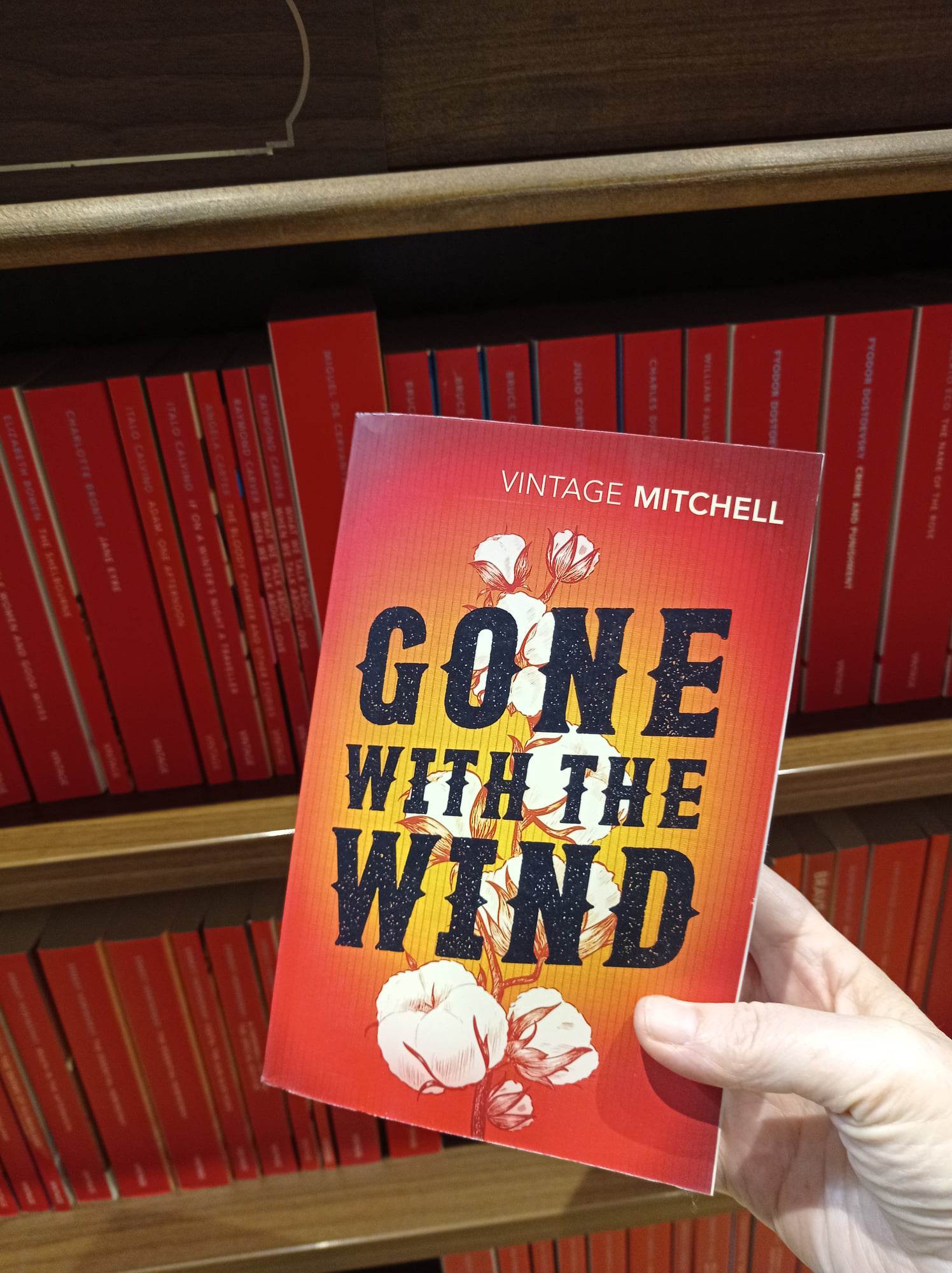
'Gone with the Wind' by Margaret Mitchell (Chapters 31 - 47)


Note: I'm well into the story now so beware of spoilers. This will be the third of four parts. 

This section deals with the mop-up these Southerners face after losing the war, and different people's adaptability. It begins with the threat of Tara being sold off beneath the O'Hara family's noses because they can't afford the sky high taxes; and the drastic action Scarlett is determined to take to secure her plantation home, whatever the cost to herself may be. Meanwhile, the Confederates' whipped dog status is taking its toll on everyone. 

We get more of the pitiful inner workings of Ashley Wilkes than ever before. He professes how cowardly he feels, and ill-equipped to adapt to the harsh new reality. His personality was a perfect fit for the old world, when he would float around his father's plantation, looking handsome and thinking bookish, philosophical, cultural thoughts. But now that Twelve Oaks is burned and folk everywhere must turn their hands to new, formerly demeaning occupations, his whole life appears redundant. Ashley fails to fit the new brief, whether it's working the ground at Tara or managing a mill in Atlanta. Rhett rubs it in by calling Ashley the sort of guy who was only ever fit to be an ornament at the best of times. 

But who does Ashley really love; Scarlett or Melanie? I picture him as a 'devil on one shoulder and angel on the other' sort of guy. He seems to ruminate on depressing, non-productive thoughts, and could maybe benefit from some of Scarlett's, 'I won't think about that now,' approach. Margaret Mitchell has presented Ashley as a dreamer in the most negative sense of the word. Yet it's still easy to feel sorry for this fish out of water. He needs a stable, 21st century academic job, that's what Ashley needs.  

Meanwhile, Scarlett adopts a polar opposite approach to the man she professes to love so devotedly. After her resolution to never go hungry again, she will do whatever it takes to be a money magnet, whether it's offering herself to be Rhett's mistress for a loan, stealing Frank Kennedy from her sister Suellen, or becoming a cheating, unscrupulous business woman once she gets her sawmills operating. She taps into entrepreneurial brilliance she'd never have needed if not for the War and its aftermath. 'I've found out that money is the most important thing in the world and I'll never be without it again.' 

Scarlett still carries devotion to her mother's gracious memory, but decides to defer being kind and gentle until she's rolling in greenbacks. Woven through the text is a thorny question. Is being successful in the business world incompatible with being a decent, principled person in the traditional sense? Because as Rhett points out, the 'nice' people are currently living in dire poverty. And Scarlett carries proof that her store and sawmills would never thrive without some ruthless or dodgy moves on her part to maintain momentum. The narrator comments that she was 'undimmed by any realisation that she has no desire to be sweet or kind now.' And as Rhett points out, her kindness muscles have probably jumped overboard and suffered a sea change. Dollar signs and sweetness are so often mutually exclusive.

 Scarlett is a female Ebenezer Scrooge, relegating her nearest relatives to second place. A new baby, Ella Lorena Kennedy, is the price she pays for marrying Frank, but Scarlett is clear that the mills are far more important to her than her children could ever hope to be. The ultimate losers are Wade and Ella, born out of Scarlett's spite and necessity respectively. But even though they're shoved to her periphery, at least now they'll never go hungry. 

We're invited to ponder whether or not choosing the guiding star of money means maternal love must inevitably suffer. I remember a meme that popped up on my news feed once. 'Women are expected to work as if we have no children, and raise children as if we had no work.' Perhaps Scarlett, the only business woman in town, is discovering this impossible conundrum for herself. And she makes her choice clear.

Scarlett is never handicapped by Ashley's style of grief for the loss of art, literature or music, for she doesn't care for any of that sappy stuff. The guys in her life know it. Rhett sometimes shakes his head over her ignorance, Ashley admires her practical 'lack of imagination', and her brother-in-law Will knows she was 'never interested in what was in folks' heads.' It's just part and parcel of who Scarlett is.  

Most of the action of this section takes place in Atlanta rather than Tara, but the bits we do get are intriguing, including the Will and Suellen thread. Without giving too much away, Suellen makes an audacious move to try and attain $150 000 from the Yankees, which backfires and sets the neighbours against her. Will tactfully defuses the murderous tension at Gerald's funeral and proposes to Suellen in the bargain. It's a match with clear benefits for both, but I wonder if they'll grow to love each other. 

This section delivers some disgusting and scary Ku Klux Klan incidents indulged in by 'good' guys. Tony Fontaine kills two men on the basis of frenzied, racist hatred, yet Scarlett questions, 'What can we do with devils who'd hang a nice boy like Tony just for killing a drunken buck and scoundrel scallawag to protect his womenfolk?' The evil KKK is presented as a necessity dreamed up by chivalrous chaps whose sole aim is to be knights in shining armour. The mindsets behind history are nowhere as strong as in novels, so I appreciate Gone with the Wind for attempting to help us grasp the unthinkable. (It's quite hilarious when the men are delivered from arrest by Rhett's quick thinking, but must pretend they were customers at Belle Watling's brothel. That bit does make me laugh.)   

Finally, a couple of ladies make amusing analogies. Grandma Fontaine likens Ashley to a turtle lying on his back. Later, Mammy tells Scarlett that she and Rhett are just like mules dressed up as thoroughbred horses. And Scarlett herself shows a flash of insight when she compares Frank to a timid old brown field rabbit. Perhaps these cool metaphors add to the compelling nature of a book which I still have no idea why I'm enjoying so much. Scarlett and Rhett both make me groan, but I must plow on to find out what will happen now that she's all set to become Mrs Butler. It should be smooth sailing for both reckless opportunists, but we all know his infamous closing line. Stay tuned for my last installment, which will take us to the end of the behemoth er, novel, when I will discuss Chapters 48 - 63.

Friday, December 23, 2022

'In the High Valley' by Susan Coolidge


Lionel Young and his sister, Imogen, set out for the picturesque but remote High Valley in Colorado, leaving their hometown in Devonshire, England behind. Lionel wants to take the share in Geoffrey Templestowe’s cattle business. Imogen, owing to her prejudices against America and the American way of life, finds it hard to adjust to life over there.

Clover Templestowe, now happily married and living in the High Valley, at first finds it very trying to get on with Imogen.
A lot of events ensure in the course of which we meet again with Rose Red, get news from Cousin Helen and of course meet Katy again…

MY THOUGHTS: 

Warning: This is the last book in Susan Coolidge's 'What Katy Did' series. Plot spoilers of events that happened in or directly after the former stories are inevitable, because of where this one picks up from. 

Oh gosh, this is as cheesy a story as you could stumble across, yet a must-read for anyone who has finished the rest of Susan Coolidge's Katy Chronicles, because it provides some lovely closure for the rest of the Carr siblings, wrapping things up nicely for Clover, Elsie, Dorry, Johnnie and Phil. 

First off, I'm a great fan of the Elsie/Clarence match which we're simply dropped into. I'd been a little disappointed when Clover didn't choose him, but this is so much better! I'm certain these two former misunderstood and overlooked kids must have bonded over shared stories about the woes of being younger siblings. That's my guess, but all we're really told is that he swept her off her feet and now they have a baby daughter. Whoa, talk about tantalizing major story gaps. I liked both Elsie and Clarence a lot, even though they each had their difficult moments, as the little we got of them was always larger than life. 

So Geoff and Clarence are still ranch partners in the High Valley, while Clover and Elsie are equally busy on the home front, keeping their communal house beautiful and popping out offspring for the boys. It's quite restful reading about their pastoral lifestyle, sixteen miles from civilization, beneath all those mountains, and among all those fragrant flowers. 

Their nearest neighbours are a young brother and sister duo named Lionel and Imogen Young, who have come all the way from Devonshire. They were neighbours of Geoff Templestowe's family. Lionel has worked as a sort of teenage apprentice with Geoff and Clarence before, and now he's all set to buy into a share of the ranch himself, while Imogen is going to keep house for him. According to the narrator, many sisters make this sacrifice for their brothers, but I can't imagine myself being one of them. 

Imogen is homesick for the British coast and predisposed to look down her nose at all things American. We're also told she's sort of frumpy, a little jealous of Clover, and would have preferred moving to somewhere such as Canada or Australia, for colonial reasons we assume. A bit slow on the uptake, Imogen lets out a lot of unintentional racial gaffes which mildly shock her nineteenth century neighbours and probably appall many of her twenty-first century readers. Put it this way, Susan Coolidge would never get this story past a sensitivity editor in its current state. 

There are visits from several old faces from earlier books, including the awesome (Rose Red), the annoying (Mrs Watson), and the closest family members (Dorry and Johnnie, and later Katy and Papa). Hold onto your hats for the romantic roller coaster at the end. Coolidge justifies all that happens by saying, 'In a retired place like the High Valley, intimacies flourish with wonderful facility and quickness.' I'll say they do, to such an extent that the boys ought to consider setting up their ranch as some sort of love shack on the side, for a secondary income.

It's all good fun, and reminds me a bit of The Enchanted April in some ways. It's probably a two star read, but I'll add another one because of Elsie and Clarence.

🌟🌟🌟 

Friday, December 16, 2022

'Gone with the Wind' by Margaret Mitchell (Chapters 17 - 30)


Note: Since I'll be discussing my thoughts of the book in sections, there will be some spoilers, but I'll still attempt to hedge around crucial points carefully. However, as I've said before, I do consider old classics are fair game. 

MY THOUGHTS: 

The historical drama escalates to a high pitch.

 At the start of this section, it becomes evident the Yankee invasion of Atlanta is inevitable and indeed the Union Troops are moving steadily closer. Scarlett continues to despise Melanie, who is now pregnant. Yet she feels bound by her promise to Ashley to care for his wife. Melanie still has no idea of Scarlett's true feelings toward her. In fact she'd prefer Scarlett to adopt her baby if anything goes wrong, rather than either of Ashley's two sisters. Meanwhile, poor little Wade is terrified by the sound of gunfire and shells, and Rhett asks Scarlett to be his mistress because he admires her pluck and stubbornness. She refuses. 

Whoa, then all hell breaks loose! On the day Melanie's baby is born, the Yankees are moving in and the Confederates are blowing up all their own powder magazines before leaving town. Wounded soldiers prevent the doctor from attending the birth. No sooner does Melanie finish her gruelling labour than they must flee behind a rickety old horse. Rhett starts them on their way and then nicks off to join the army, (leaving it until the last possible second to muster his patriotic fervour, I must say). Unprepared Scarlett finds herself in charge of a wagon full of dependents. It includes depleted Melanie who dodged dying in childbirth by a cat's whisker, Prissy the panicking slave girl, Beau the vulnerable newborn and Wade the terrified toddler.

Scarlett's wild thoughts at this stage include the title of the book. 'Was Tara still standing? Or was it gone with the wind which had swept through Georgia?' Her family has certainly been tragically affected. 

I can't help wondering whether this huge trial will soften Scarlett or harden her even more. I've read that some people under pressure become 'carrots' while others prove themselves to be 'eggs.' In a pivotal moment after their homecoming, Scarlett resolves to survive, and opts for the 'egg' route. She'll be like her ancestors who have 'taken the worst fate can hand them and hammer it into the best.' A certain hardness is inevitable, if she's to maintain Tara. Scarlett decides she needs to be brusque and demanding with everyone. Vulnerability would open a floodgate that must remain closed, so postponing her own feelings of devastation becomes a survival tactic. 'I won't think about it now. I'll think about it later.' Hmm, does this sort of deferral ever end well?

Scarlett vows, 'As God is my witness, I'm never going to be hungry again!' (Personally, I think she's drawing from the same sense of bitterness that guided her to marry Charles. This time it's directed at the Yankees instead of Honey Wilkes and Melanie. Yet the narrator remarks that few of the returning soldiers are bitter. They'd fought a good fight and lost. We're told, 'they left bitterness to their women and old people.')

Another interesting observation is how Scarlett shrugs off the values of kindness and gentility her mother had spent pains teaching her. She decides that Ellen's standards were obviously wrong and way out of touch for the real world. Yet even the narrator remarks that they were fine for the era they were just emerging from. Ellen could not have foreseen the complete and sudden collapse of the civilisation in which she had raised her daughters, requiring an abrupt shift of standards. And Scarlett couldn't see that her mother's code of femininity and kindness was perfect in its place. (I'm thinking it probably wasn't hard for Scarlett to shrug off Ellen's values in crisis time, since she'd only ever donned them as a veneer anyway.)

Meanwhile, I see Melanie, who nurtures her nephew and son, as doing vital groundwork for the next generation. Her own baby, Beau, is largely oblivious at this stage, but I'm concerned about the impact all this trauma and fear will have on Wade's psyche for the future.   

Being 'Gone with the Wind' there's always plenty of dirty racism to raise our hackles. Gerald O'Hara's butler, Pork, refers to his fellow slaves as 'trash' for deciding to leave with the Yankees, yet he's loyal to a family who treats him with abominable imperialism to the slightest detail. They save all the fresh meat from a fresh killed hog for themselves, and only throw the chitterlings (intestines) to their negroes. It fascinates me to see so many family slaves, embodied mostly by young Prissy's viewpoint, are terrified of the Yankees and believe they're coming to 'get' them. They seem to have no idea that the opposing army is fighting for their rights. What crazy times down south they must have been. 

The final chapter in this section introduces Will Benteen; a returned soldier who the family care for when he's sick. He's a 'Cracker' or small farmer far below their station, but social stigma has 'gone with the wind' at this stage, along with so much else. Margaret Mitchell has already set Will up as a legend, even though we've just been introduced to him. With his 'patient, mild eyes and wooden leg' this plain young man has become a natural sounding board for everyone's grievances. I like him a lot after his brief introduction. 

Ooh, what's just happened? The war is over and Ashley has just staggered home. And Scarlett still intends to steal him from Melanie if she possibly can! That girl still has such a one-track mind after all that's gone down. Is she going to stoop to something sneaky and malicious?

Excuse me while I get on with the next section. I'll be back when I can to discuss Chapters 31 - 47.


Friday, December 9, 2022

'The Lifted Veil' by George Eliot


MY THOUGHTS: 

Just when I thought the beautiful Silas Marner was George Eliot's shortest book, I stumbled upon this novella. It's possibly her briefest piece of work, but her great grip of the ins and outs of the human psyche comes out as strongly as it does in tomes like Middlemarch. And the story's hero is the only first person narrator she ever used. 

Latimer is a highly strung, sensitive young man who suffers a fit of illness while studying abroad in his late teens. During his convalescence, he discovers a strange new power that dawns on him in flashes. He occasionally glimpses the future, and also reads into several people's genuine thoughts, rather than just the public veneer they assume through their speech and facial expressions. 

To his dad, Latimer is an arty write-off, and to his patronising, sporty brother Alfred, he's a sickly kid and a bit of a joke. Alfred's beautiful fiance Bertha is the only person whose inner thoughts Latimer can't fathom. This intrigues him, especially since she sometimes seems to give off subtle clues that she prefers him over Alfred. On the surface, Bertha comes across as cynical and unimaginative, but he can't tell for sure, and considers her an 'oasis of mystery in a dreary desert of knowledge.' He also appreciates being able to ask for her opinion with 'the real interest of ignorance.' 

I'm sure different readers will be torn over whether or not they even like Latimer as a main character. Ever ready to put on the tortured artist mantle, even though he admittedly never creates anything, he's arguably as selfish as those whose true colours appall him. He's always inward focused, resentful and jealous of his brother and full of self-pity for his lot in life. And the main reason he's infatuated with Bertha is chiefly because he wonders what she thinks of him. I get all that, but I like the potential we can see in him, including his fond memories of his dead mother and his flashes of compassion for his father. It's only a very occasional first person narrator I ever thoroughly dislike. 

In addition, I can't help warming to Latimer just a little bit because he's been shoved from a young age into a mold he doesn't fit. His father finds him impractical and insists that he focus on his weaknesses, mechanics and science, at the expense of his strengths, the study of poetry and inquisitiveness about human nature. At one point, Latimer says, 'I was glad of the running water. I could watch and listen to it without wanting to know why it ran. I had perfect confidence that there were good reasons for what was so very beautiful.' And humanities students everywhere probably echo, 'Hear hear!' 

The character of Bertha strikes me as a really interesting forerunner of Rosamond Vincy in Middlemarch. They're both beautiful, shallow girls with willowy figures and gorgeous blonde hair who are solely out for themselves. Throughout this story, Bertha is likened to a witch, a spider and a snake. As Latimer gets to know her better in the normal way of longer acquaintance, it starts to dawn on him that her soul is a very narrow room, and his appeal for her is based on her belief that he's head over heels in love with her, and potential putty in her hands. When she discovers that he's numb to the sort of worldly ambition and social incentives that drive her is when it starts getting really interesting.

It's a tale that draws on nineteenth century, pseudo sciences like phrenology and resurrection of the dead, giving it a sort of Gothic atmosphere. Nothing like the nineteenth century for engrossing reads, and this one will take you only an hour or two. I wasn't crazy about it. A bit too dark for me without likable characters, because even though I tried to like Latimer, I didn't quite succeed. But it's quite interesting for George Eliot fans to say we've ticked off an obscure read. 

🌟🌟🌟

Friday, December 2, 2022

'Gone with the Wind' by Margaret Mitchell (Chapters 1 - 16)


Part One - Chapters 1 - 16

This brick was the bestselling fiction title for two consecutive years, 1936 and 1937. It also won the Pulitzer Prize and took Margaret Mitchell ten years to write. Rather than cramming a discussion of a 1010 page novel into one review, I'll break my thoughts up into quarter sections. This first ramble will cover the first 16 chapters, which also comprises Parts 1 and 2 in their entirety. 

Scarlett O'Hara starts off as a sassy teenage Southern belle with a 17 inch waist. She loves flirting with every male on her radar, and her favourite hobby is stealing the devotion of other girls' beaux. She can have the pick of any single man or boy, except for Ashley Wilkes, the dishy neighbour she's in love with. He's just announced his engagement to his sweet cousin, Melanie Hamilton, and Scarlett is devastated. Even now, she resolves not to take defeat lying down, because she's headstrong and wants the man of her dreams with all her heart. Alas, her tantrum directed at Ashley falls on deaf ears, or does it? It is overheard by a grinning, swarthy stranger named Rhett Butler, who thoroughly enjoys the show. 

In hurried retribution to several people, Scarlett marries Melanie's shy young brother Charles, just to spite everyone and shove her free agency in their faces. Unfortunately, she upsets herself most of all. Scarlett becomes a wife, war-widow and mother all before she turns 18. She and her baby, Wade Hampton Hamilton, go off to stay in Atlanta with her new in-laws, Aunt Pittypat Hamilton and Melanie, now Mrs Wilkes, while the men head off to fight the Yankees. 

Hmm, at this stage, the story focuses on Scarlett's veneer. She's learned to appear sweet, charming and good, while her headspace reveals her to be selfish, stubborn and shallow. Scarlett is basically living a lie. Everything she says and does is a screen for her real feelings. Sure, we can probably all relate to her somewhat, but I find it hard to excuse the way she uses poor Charles. 

In contrast, plain little Melanie is described as, 'simple as the earth, as good as bread, as transparent as spring water.' Melanie is clueless that she's usurping the only man Scarlett believes she can ever love. She's a great lady, according to Rhett, despite her youth. Melanie reminds me of another literary character, in her mild but determined resolve to think well of people. I realised it's Jane Bennet, from Pride & Prejudice. Melanie has no need to conceal her true self, as Scarlett does, because her generous feelings are the real deal. Sure, she never twigs that her sister-in-law really can't stand her, because feeling repugnance for people is not in Melanie's make-up so she doesn't ascribe it to others. This makes her naive but perhaps that's a small price to pay, for living her life with generous, nice thoughts rather than mercenary, restless, crabby ones. 

Ashley seems like a genuine, self-sacrificing guy at this stage. His love of music and literature gives him the reputation of being 'complex' but he's farsighted enough to predict that the war won't end well for his cause. He strikes me as a tragic guy who's torn in every way. He fights for a cause which he knows in his heart is doomed, and possibly marries one girl while loving another. I'm not convinced this is the case though. Perhaps he loves them both for very different reasons, or maybe he was just letting Scarlett down in a gentlemanly manner. Time will tell, but at the moment, I find Ashley a source of great sympathy. I'm aware that we're seeing him merely through the filter of Scarlett's rose coloured glasses and the occasional deep-and-meaningful lines he drops. 

Rhett is a self-proclaimed opportunist and scoundrel who's purely out for himself. His intention as a blockade runner (who sails contraband goods into southern ports beneath the guns of northern ships) is to make a personal fortune, or so he says. I think his appeal depends on which side of the pages you live. He offends many people within his own world, yet endears himself to a far huger number of readers who exist outside the book. Personally, I suspect we'd find him a jerk too, if we existed in the story. But instead, his blunt honesty and outspokenness impress us, because Margaret Mitchell has written him as a sexy cynic. (I believe I can see through her ploy. I've set myself a bet with Ms Mitchell, to resist the charm of Mr Butler throughout this book. It's working so far. I'll keep you posted.)

I keep getting shocked over and over as I experience the American Civil War from the Confederate viewpoint. In their passionate eyes, it's a sacred cause in which young men sacrifice their lives to preserve a precious way of life. They vehemently deny the accusation that they're merely fighting to keep the institution of slavery alive to prevent their economy from crumbling. The brutal chapter near the end of this section in which women wait in the carriages outside the newspaper office for the casualty lists, after the Battle of Gettysburg, is heart-breaking. 

Is Margaret Mitchell glorifying the nefarious Confederate cause though? I don't think so, and apparently neither do her two key male characters. The brooding, introspective Ashley says, 'Let's don't be too hot-headed and let's don't have any war. Most of the misery of the world has been caused by wars. And when the wars were over, no one ever knew what they were all about.' And the outspoken, straight-shooting Rhett says, 'Our southern way of living is as antiquated as the feudal system of the Middle Ages. The wonder is it's lasted as long as it has. It had to go and it's going now. Yet you expect me to listen to orators like Dr Meade who tell me our cause is just and holy.'  

Okay, so at this quarterly stage, we learn that Ashley has been imprisoned on Rock Island, both girls love him dearly, and Melanie has just discovered that she's expecting his baby. What next? Stay tuned for my thoughts on Chapters 17 - 30, which will take us to about the halfway point.     

Friday, November 25, 2022

'Wish me Gone' by D.J. Blackmore


Up close, the heritage listed house is nothing but a beautiful disaster, but while there are acres of orange trees to lose herself amongst, Isabella realises there’s no escaping the new school. But when intolerance towards Damaska and her family—whom Isabella’s family has hired to help—opens the homestead gates, the threat to both families becomes real. Four lives in Australia become intertwined by one orchard, as they all try to find a place they call home.

MY THOUGHTS:

It's always a pleasure to pick up a novel from my own country, and this one is as Australian as fairy cakes, charred lamb chops and Weetbix with hot milk (which all feature in the story, by the way). 

Isabella Lawson and her family are moving to a wonderful, but run-down rural property with a lush orange orchard. Her mother, Jenny, falls in love with it on the spot, but to her stepfather, Chase, it's a bit of a nightmare. Meanwhile Isabella's brother Abel, an electrical technician in the army, is learning to wrap his head around his new lifestyle. And a young Muslim woman named Damaska is migrating to Australia with her family, although her grandmother (Jida) faces change with heartache, since her beloved old ways fit her like a glove. 

Characters are so colourful and varied, it's hard to choose a favourite. It could be Chase, the stepfather who's quick with his dad jokes but will also go the extra mile for his family; or Abel, the young man who's forced in the position to cement for real the army principles he recites; or Damaska, the young woman who attracts unwanted attention, and is forced to deal with difficult generational clashes, in a strange new culture to boot. I also like Isabella, the fair-minded, capable student prepared to make the best of the hand she's dealt. But perhaps my favourite is Megan, the octogenarian whose uniquely Aussie sense of humour, combining bluntness and kindness, smooths many ruffled feathers.

I'm impressed by how boldly and effectively D.J. Blackmore tackles racism, sexism, ageism, ableism, bullying and religious discrimination head on, all within this 250 page novel. Especially considering our hair trigger 21st century cancel culture, where accusations of cultural appropriation tend to blow up before we know it. Yet this story is utterly true to life, highlighting the melting pot of different outlooks and backgrounds that form Australia. Her small rural community is a microcosm of the whole country, which is a slice of the world. 

I've got to say, this story imparts a sense of New South Wales, which I've only visited a handful of times in my life. I'm a South Aussie, and minor differences show. For some reason it also puts me in mind of the beloved old TV soapie A Country Practice, possibly because of the NSW location, although this novel is far more up-to-date. 

I don't read many contemporary novels that focus on High School students as main characters anymore, but whenever I do, I notice the addition of modern technology, which always thickens the plot. A couple of mobile phones get damaged in the course of the novel, and I suspect Jida's probably right to refer to them as the line which gives the outside world a chance to infiltrate. A shortsighted character in many ways, she's spot on there.   

What more can I say? Short chapters make for easy, flowing reading. There are 67 in the book! It's a celebration of Aussie lore which I love, but if you're not familiar with it, keep your phone close at hand to google a strange colloquialism when you need to. For my part, I love how stories like this emphasise our vibrant, fun, distinctive culture. The dialogue is a key part of the story, revealing the chasms between communication of different characters. But overall, forgiveness and generosity are a universal language.      

My thanks to the author for sending me this book for an honest review.

🌟🌟🌟🌟 ½   

Wednesday, November 23, 2022

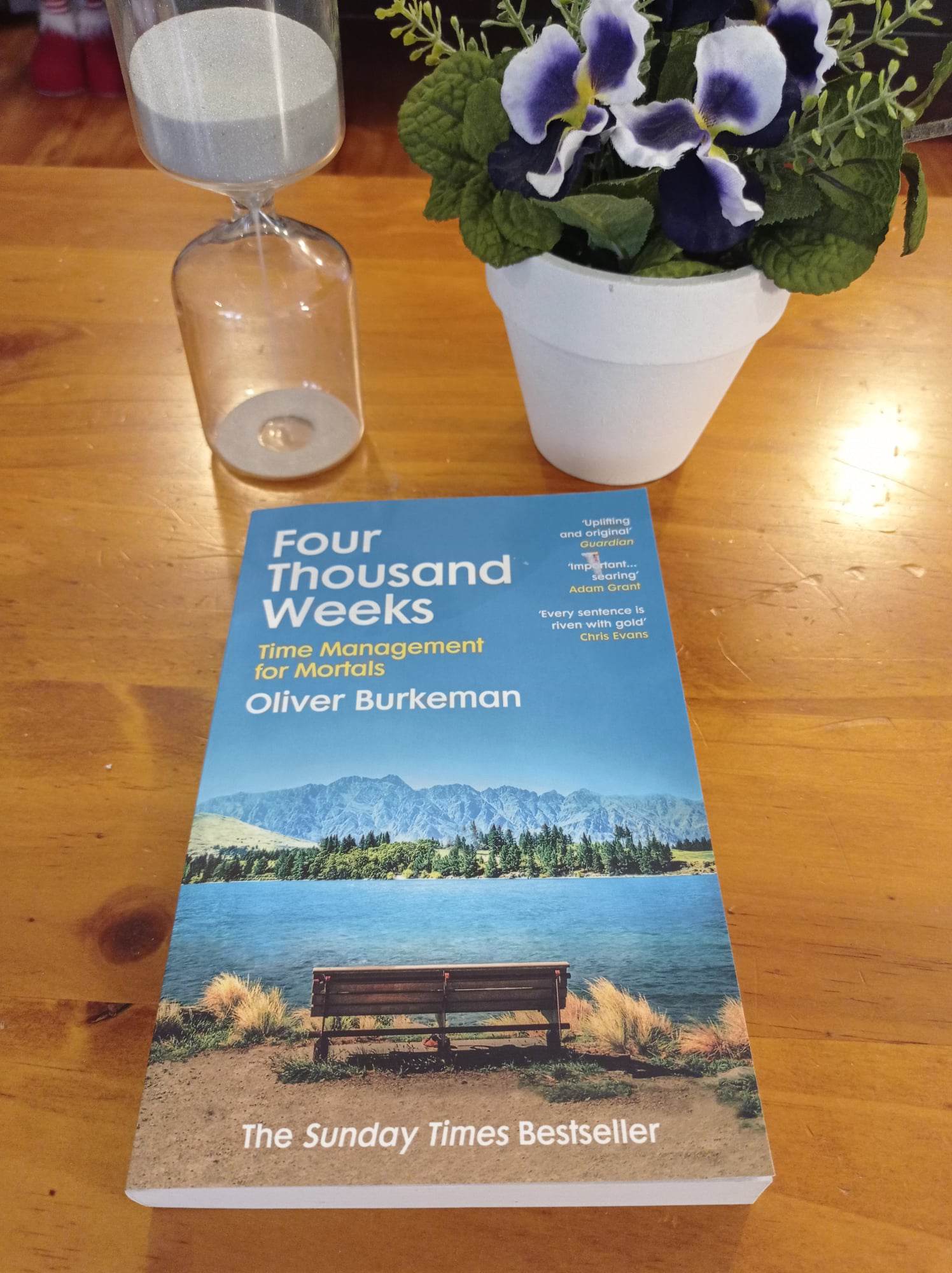
'Four Thousand Weeks' by Oliver Burkeman


The average human lifespan is absurdly, insultingly brief. Assuming you live to be eighty, you have just over four thousand weeks.

Nobody needs telling there isn’t enough time. We’re obsessed with our lengthening to-do lists, our overfilled inboxes, work-life balance, and the ceaseless battle against distraction; and we’re deluged with advice on becoming more productive and efficient, and “life hacks” to optimize our days. But such techniques often end up making things worse. The sense of anxious hurry grows more intense, and still the most meaningful parts of life seem to lie just beyond the horizon. Still, we rarely make the connection between our daily struggles with time and the ultimate time management problem: the challenge of how best to use our four thousand weeks.

MY THOUGHTS:

My Dad passed away aged 84, at the start of 2017. Along with the grief of losing him I experienced an acceleration of the time crisis I've had simmering for several years. His death really brought home to me how lightning fast is the passage of years. I remembered events which took place when he was my age, which seemed scarily recent. Those sorts of memories persist to this day, and as the gap lessens the sense of urgency increases. Dad had time to retire and tick off many things he aimed to do, yet time still seems to have moved like wild fire. The title of this book by Oliver Burkeman made me wince. 4000 weeks is approximately 76 years; a rough life palette in which to get done the things we want to do. Knowing how fast one week passes, the thought of only having something between 4000 or 4500 to play around with is intended as a wake-up call. It certainly worked for me.    

The book is about changing our relationship with time and how we think about it, rather than offering 'time management hints' as such. I'll outline some of the parts that impressed me most.

Why do we procrastinate good things we really want to do? 

Frittering away our time by ticking small, pressing tasks off our list each day seems an easy default. I'll sweep floors, fold washing, or head off to the shop rather than sit for an extended time writing at my computer. Burkeman believes we must claim time for the great plans our hearts really wish to prioritise, or else they'll remain untouched by the end of the day. (I used to be quite good at what he's talking about. Taking an hour or two to work on my novels when my kids were small was part of my routine, even if there were dishes in the sink and emails awaiting replies. I knew the housekeeping stuff needed to be relegated to second place, where it belonged.) 

Another serious time sucker is outlined in a chapter called The Watermelon Problem, and specifically addresses using social media to procrastinate. The chapter's name alludes to viewers who once watched several large rubber bands being applied around a watermelon. They were hanging out to see at what stage the whole thing would burst in a spectacular shower of red watermelon flesh. The suspense was so prolonged that people started commenting, 'I really should be getting more important things done than sitting here waiting, but I'm hooked.' Eventually, the big smash was an anti-climax, as everyone knew in their hearts it would be. The great spectacle of green rind and red flesh flying everywhere released them to return to other, more important activities they were still, for some reason, strangely reluctant to do. 

Why are we seduced by checking social media and deferring our cool passion projects even when there is a block of time at our disposal? An obvious answer is that we're addicted to the affirming likes, hearts and comments that flow our way, but Burkeman suggests a deeper, more primitive reason that gels with me. It's all to do with an unconscious dread of falling short of our own romantic and passionate expectations! When we make a start on our passion projects, we may even, heaven forbid, find the time spent is mildly boring. It's all because whenever we're free to pursue the great things we want to do, we come painfully face to face with our own limitations. What we produce in reality seldom lives up to the brilliant execution of our imaginations, especially at first. So our impulses to defer the let-down by sitting on social media or carrying out jobs with lower stakes are nothing more than pitiful efforts to shield our fragile egos. 

Whoa, understanding this doesn't solve the problem itself, but does empower us to press on with our passion projects regardless. Oliver Burkeman simply says that we need to stop expecting the discomfort to be otherwise and get on with it. I guess this initial resistance is as true a fact of life as the state of flow we long for. (For my part, I earnestly want to take up fiction writing again, specifically some fan fiction inspired by great books I love. But I fear my nooby efforts to create something accurate and worth reading, let alone fathom fan fiction platforms and make a good go of it may fall short. So my challenge is to still plow on regardless, even knowing this. Knowledge is power.)   

Limit Rods in the Fire

Burkeman suggests having no more than three passion projects on the go at any one time. (I guess keeping this blog must be one of mine because occasional attempts to cut back or quit have been fruitless. But I enjoy curating my thoughts about books, so that alone is reason enough to continue. And it's another point of his. Sometimes even leisure feels like a chore to tick off, so purposely choosing a pastime or two with no personal gain whatsoever is vital.) 

Burkeman suggests that vaguely interesting, second-tier projects ought to be swept aside, because they're insufficiently important enough to form the core of our lives, yet seductive enough to suck our attention away from the things that really are. If we figure out what they are, we can sweep them aside with the finality they deserve. 

And he counsels us to Stay on the Bus, even when something else looks better. When we've decided some activity is a good use of our time, we should resist the urge to veer off toward something seemingly new or novel, which is actually a strong cultural pressure. For when we do that, we leave nothing but a few short, fruitless tracks. (This puts me in mind of Toad in The Wind in the Willows. Oliver Burkeman would surely tell us not to be as unstable and emotion driven Toad of Toad Hall, who always dumped one passion in favour of the next big thing.)

Cosmic Insignificance Therapy

Burkeman has advice for those moments when we doubt the point of whatever we're doing with our lives. Sometimes it's easy to assume our lives, over the long term, don't amount to anything much. We've surely all been there, but he suggests that we've set the bar too high. We become victims of widespread grandiosity, when in actual fact, our life choices don't matter that much, for our couple of thousand weeks on this planet aren't the lynch pin of history. When we decide our lives are meaningless, we've possibly adopted a towering standard of meaningfulness to which few can measure up (or indeed ever have). We surely don't disapprove of a chair for being unable to brew a cup of tea, after all. What a nice reminder for the end of the book.

Finally, he reminds us that whatever compelled our attention from day to day and moment to moment is what our lives will have been composed of. So when we pay attention to something we don't especially value, we're paying with our lives. 

I borrowed this book from the library and got so much out of it that I went and bought a copy of my own, so I can keep coming back and mulling over these points. I think it deserve full marks for this reason alone.  

Update: This book gave me a jump start on my fanfic writing projects. For this reason alone, it's been a game changer for me. If you're at all interested, check here.

🌟🌟🌟🌟🌟