Monday, September 28, 2020

'Anne of Ingleside' by L.M. Montgomery


Or 'The One with all the Kids'

When we last saw Anne and Gilbert, they were rejoicing in their one beloved baby boy, not long after the loss of the daughter who didn't live out the day she was born. But Gilbert suggests they upgrade to a more spacious house closer to town. It's a good thing they did, because a mere six years later, they're expecting baby #6. In this book, we become acquainted with all the young Blythe kids, as we become flies on Ingleside's walls.  

What I loved even more than before.

1) Lucy Maud was super clued-up on how children tick, and the Blythe kids' headspaces are fun and original places to visit. I think I love the boys best. (As I mention further down, the Blythe parents themselves shouldn't have favourites, but we readers are allowed to.) Jem is a vibrant, active lad with a flair for drama and throwing himself wholeheartedly into life. Walter has a brilliant, poetic imagination, and might nowadays be considered an Indigo child. We're told his ancient soul knows too much for his young brain to comprehend. And Shirley is most famous for never being highlighted in any specific incident. That boy is a consummate attention-dodger. Just too down-to-earth to do anything worthy of a yarn, perhaps. I wonder what LMM thought, since she was the one who withheld the spotlight from him.  

Talking about the Blythe boys, the foreshadowing is none too subtle. Montgomery had already completed the rest of the series by the time she backtracked to write Anne of Ingleside, and her main purpose seems to be to fill in some time gaps in the Blythe kids' early years. Whoa, she doesn't hold back from dropping some very broad and grim hints of what's in store. It's no spoiler at this stage to say we're clear that Jem, Walter and Shirley are heading off to war in their none too distant future. And one of them isn't coming back! 

The girls are very cool too, and Nan is probably up there with her brothers as a favourite of mine. She appears a bit distant and haughty to outsiders, but is merely enjoying the wild world she conjures in her own head. Practical, sensible Di has rotten luck at choosing decent, loyal friends. And the baby Rilla is born near the start of the book, and becomes everyone's princess. 

2) I like the multi-faceted nature of the book, as we get glimpses into the lives of many different people. For example, the story of the bitter, morbid women at Peter Kirk's funeral has a way different tone to the incident when cute little Rilla was too self-conscious to walk down the street with a cake. I suspect books like this might never even be published today, as editors might decide the author has no idea of her target audience. But I can't help wondering if modern novels swing too far the other way, and lack this presentation of people from all stages and walks of life, which results in very rigid, genre-bound readers.

3) Anne's deep satisfaction with life as a stay-at-home-mum gets big thumbs up from me. She makes the lifestyle come across as a work of fine art, requiring all sorts of wisdom, sensitivity and insight to pull off. I'm sad about the many fellow reviewers I've read who think she's sacrificed her unique identity and ambition to become a boring housewife who's chained to the sink. Even my daughter took that view of things during a discussion we had. But these ladies don't seem to realise that they're echoing the digs of Christine Stuart in the last chapter. 

Get ready for a string of exclamation marks, as I feel strongly about this. Anne was an orphan! Living under a roof with a large family of her own was always the ultimate dream! And she achieved it! She expressed her joy with the way life panned out in so many different ways! Anyone who can't be happy for her might be denying a woman the right to work out her own destiny in a way that suits her to a tee!

4) Susan Baker! What a good old stick. 

5) The accidental way Anne manages to finally get rid of Gilbert's aunt Mary Maria, who's way overstayed her welcome. Fantastic! 

6) The last couple of chapters is a revelation that not even Anne is immune from having to guard her mind, and that full-on bad moods develop quickly from stinking thinking. It doesn't even have to be true to be powerful. Interesting stuff. 

What I was on the fence about.

1) Is there a Brady Bunch style formula happening here? As a little kid of the 1970s, I couldn't help noticing parallels, including droll housekeepers (Susan/Alice) who love them all unconditionally. They're both 6 kid families with boy/girl splits, and each child taking turns at the centre of some drama which their parents help them overcome. (Well, everyone except the ever elusive Shirley.) In this case, that's mostly Anne, since Gilbert is an overworked local doctor. An old high school teacher of mine loathed The Brady Bunch because it was trite in his opinion, and never helped young viewers accept the existence of insoluble problems. 

I honestly think Anne of Ingleside escapes a similar quick fix-it stigma, because Anne does face a few of those sticky issues, especially from threads involving Jem and Diana. Jem suffers heartache when he loses two beloved pet dogs under different circumstances, and Di's faith in human nature takes a beating after exposing two false friends she'd trusted completely. Anne knows she can do no more than offer her deepest sympathy, and a shoulder to cry on while they process grief as best they can. She also embodies the assurance that there will always be beauty and fresh tomorrows in life. What more can we ask for from a mother?  

What I wasn't a fan of this time round.

1) The favouritism factor is something that never fails to shock me. Especially after the birth of Rilla when Anne says, 'All our babies were sweet, Gilbert, but she is the sweetest of them all.' She drops that one right in front of Walter! But I guess it's just the way LMM rolls. Di is Gilbert's favourite, Shirley is Susan's favourite, and Jem is Aunt Marilla's favourite. Nobody seems the least put out about it ever. But sheesh! I cringe every time. 

2) The chapter with the ladies quilting day is rather on the long side. Young Walter's cameo appearance toward the tail end of it is priceless, but it's a tedious road to get there. 
  

Some great quotes to take on board.

She would hold all the threads of Ingleside life in her hands again to weave into a tapestry of beauty. 

Anne: Gilbert is always a little depressed when he loses a patient he thinks ought to have lived. (Haha, I would sure hope so.) 

It's the little things that fret the holes in life, like moths, and ruin it.

Nan: I'm in the habit of believing people.
Mrs Six-Toed Jimmy: Well, it's a habit you'd better get out of in this kind of a world.

There was always change. Well, that was life. Gladness and pain, hope and fear. You had to let the old go and take the new to your heart, learn to love it, then let it go in return.

Anne: An imagination is a wonderful thing to have, but like every gift, we must possess it and not let it possess us. I know that rapture. But you must learn to keep on this side of the borderline between the real and the unreal. Then the power to escape at will into a beautiful world of your own will help you amazingly through the hard places of life. I can always solve a problem more easily after I've had a voyage or two to the Islands of Enchantment.  

Stay tuned, because next up will be Rainbow Valley. 


Monday, September 21, 2020

'My Antonia' by Willa Cather


Through Jim Burden's endearing, smitten voice, we revisit the remarkable vicissitudes of immigrant life in the Nebraska heartland, with all its insistent bonds. Guiding the way are some of literature's most beguiling characters: the Russian brothers plagued by memories of a fateful sleigh ride, Antonia's desperately homesick father and self-indulgent mother, and the coy Lena Lingard. Holding the pastoral society's heart, of course, is the bewitching, free-spirited Antonia.

MY THOUGHTS:
This is my choice for the 20th Century Classic in the 2020 Back to the Classics challenge. It was published in 1918, the year my grandmother was born. 

Jim Burden is a 10-year-old orphan who gets sent to live with his grandparents in rural Nebraska. On the same train is 14-year-old Antonia Shimerda along with her family, who are migrants from Czechoslovakia. They share the same destination and once they settle down, the pair become good friends. Jim narrates us through the years ahead as he continues to share a lovely platonic relationship with Antonia, although at times he wouldn't have minded something more. 

Jim is a deep and reflective kid from the get-go. There are no ants in his pants at all. He knows the immense value of just soaking in the sunshine, for example. Although the writing's wisdom comes from the older Jim, it's clear that he's drawing on discoveries made by the young boy. 'Nothing happened, I did not expect anything to happen. I was something that lay under the sun and felt it, like the pumpkins, and I did not want to be anything more. At any rate that is happiness, to be dissolved into something complete and great.' 

The Shimerda family, with their foreign background, are ingenues when it comes to spotting American shysters. They're ripped off when they purchase their house, land and stock package, and never totally recover. Mrs Shimerda is self-pitying, boastful and entitled; the sort of overbearing personality who becomes a liability rather than an asset. Ambrosch, her eldest son, is grouchy and self-important. The sensitive, music-loving dad, who never really wanted to move to America, eventually succumbs to his broken heart and commits suicide. But Antonia turns out to be made of far sterner stuff. 

Although she remembers her childhood land with clear, loving detail, Antonia rises to the challenge of adapting to the new environment, since that's her only option of maintaining some level of satisfaction. She pulls it off to the extent that Jim comes to regard her as a symbol of the great country itself. That's some pretty successful assimilation. When the Burden family move into the nearest small town, Antonia is hired by their next door neighbours to help with housework, and continues to take everything in her stride. 

She's a very admirable character because she's genuinely aware of what she enjoys and never feels inclined to bow to fashion or copy others for nods of approval. She eventually finds her grinding life as a country mother of a huge family suits her perfectly. 'I'm never lonesome here, like I used to be in town. You remember what sad spells I used to have, when I didn't know what was the matter with me? I've never had them out here. And I don't mind work a bit, if I don't have to put up with sadness.' It's a fair trade-off indeed, and sets us readers reading between the lines to figure out why her embracing of anonymity is so refreshing. 

I really appreciate the staunch and simple faith of these characters. Otto the hired man tells a story in which he basically complains that good karma never caught up with him. And Mrs Burden, Jim's grandmother, says she's sure the Lord has remembered these things to his credit, and helped him out of many a scrape when he didn't realise he was being protected by Providence. Her husband has the gift of saying very moving prayers. Jim decides that because Grandfather is not a big talker, his words have a peculiar force whenever he does open his mouth. 'They're not 'worn dull from constant use.' What cool encouragement for quiet people. 

Jim's experiences studying hard at University are an interesting offset to Antonia's rural simplicity. He has doubts whether or not he's a true academic at heart, since the old faces from his childhood keep crowding into his memory which he wants to fill with 'more important things'. He blitzes it anyway, and gets a decent job out in the world at large. And their friend Anna says, 'It must make you very happy, Jim, to have fine thoughts like that in your mind and words to put them in.'Yet although Willa Cather doesn't say as much, we're left with the strong conviction that Antonia's lifestyle is no less dignified, meaningful and worthwhile, and perhaps hers is even more satisfying over the long haul.

Perhaps the wonderful descriptions of the landscape which she's famous for help push the appeal of Antonia's beloved bleak country over the line. 

'There's nothing but land. Not a country at all, but just the material out of which countries are made.' 
'The scanty detail in that tawny landscape made any detail at all so precious.' 
'The snow spilled out of heaven like thousands of feather beds being emptied.' 

Cather's books are non-eventful and anti-climactic in many ways, but I do feel compelled to go on reading them.  

 ðŸŒŸðŸŒŸðŸŒŸ½   

Monday, September 14, 2020

'Anne's House of Dreams' by Lucy Maud Montgomery


Or 'The One with the Creepy Amnesiac Dude'
Warning: These discussions may include a few minor plot spoilers, but I consider old classics are fair game. 

It's the big day Anne and Gilbert have been waiting for. They tie the knot and head off to their new home sixty miles from Avonlea, where Gilbert is about to launch his medical practice. It's the halfway point of the series, which is evident through the tone. From now on, the action will take place around their new home at Glen St. Mary and Four Winds Harbour rather than Avonlea. The tang and romance of the sea is more present too. 

What I appreciated even more than before.

1) I realised Anne and Gilbert are the only couple LMM ever took beyond their wedding day. None of her others get this honour. Not Emily and Teddy, nor Pat and Hilary, nor Valancy and Barney. It puts Anne and Gilbert in a class of their own, and we get to share those wonder years of family planning and setting up house when you're married to your best friend. There's no other life season quite like it, which makes me think even more stories should probe beyond the 'happily ever after' of the wedding day. 

2) There's a sense of groundedness I love after the flotsam of characters who stream into Anne of Windy Willows and straight out again. I guess that's ironic since the lure of the sea and distant lands is a repeated motif, but it's like a breather to have a small cast we can get to know well. They are the closest neighbours of our super-couple, and all live a fair way out of the nearest town. There's Captain Jim, a retired sea-captain who's now the district lighthouse keeper, and the kind of guy every reader would love to have for their granddad; Miss Cornelia Bryant, a hilarious man-hater with a kind heart; and Leslie Moore.

3) Wow, Leslie is surely one of Anne's most complex and multi-layered friends ever written! She's a ravishing beauty with a tragic past, married to Dick Moore, who was once 'a big handsome fellow with a little ugly soul' but has a longstanding case of amnesia after an accident. Now Leslie is his baby-sitter rather than his wife, but either way she's trapped. A protective skin of aloofness has developed over her heart, although she knows in her head that it's unreasonable.I like the imagery LMM wraps around this girl, including the splash of scarlet she always adds to her clothes, whether it's a scarf, hat, belt or necklace, which Anne believes represents the vivid personality she's almost successfully suppressed.

4) I've seen The Blue Castle and The Tangled Web referred to as LMM's only novels for adults, but Anne's House of Dreams should be up there on the list too. It's assumed to be a kids' book since it belongs in a juvenile series, but the themes have a depth and maturity perfect for older readers. It's sad to think people with the potential to adore it may pass it by. They'd miss Anne's grappling with deeper reasons for the loss of her first child, Joy, who died the day she was born. (I can't say I loved that part, but it touched me deeply.) There's also Leslie's preoccupation with the heartbreaking events she's witnessed, and Captain Jim's lifelong devotion to one woman who was swept away from him. 

5) Gilbert's awesomeness deserves a mighty cheer. He has a major disagreement with Anne over an intense matter of conscience, but what she's asking him to do is something totally unethical which would be enough to have him struck off the medical register in our era. I don't think that aspect occurred to me as a younger reader, but I loved the conflict this time round. The fact that Gilbert would doggedly do the right thing, even if it makes Anne mad at him is very impressive. But would we expect anything less of our boy?  

6) The outcome of his decision is breathtaking! It's a re-read for me and I knew it was coming, but still loved it as much as ever. 

7) James Matthew Blythe, aka Little Jem! Isn't it fantastic when a new baby can change the dynamics of a household and infuse so much sunshine and delight, just by his mere arrival? No baby could have been more eagerly awaited than this one. I love everything, from the earliest evidence that he'll be another redhead to Anne's insistence on talking baby talk to him, even though she'd always vowed not to. For a very short time, this little boy is Numero Uno in everyone's lives, so take a breath before the Blythe family explodes exponentially in the next novel.

 I was baffled when they talked about 'shortening' him, but it seems that was the normal process of moving babies from long, flowing dress-like clothes into shorter dresses when they begin to get more mobile. Yep, even the boys wore dresses. I reckon Anne might have appreciated the little onesie suits we use today. Nothing could be more handy and functional.    

What I wasn't a big fan of this time round.

1) Where were all the Blythes? I know Gilbert's parents were just side characters in the early books who never actually appeared in a scene, but at least they were given lip service. Now they don't get a mention at crucial moments in their son's life at all. Not on the wedding guest list, nor paying a visit to meet their new grandson. Omissions like this irk me, but I guess we must assume they were still there for him at these times, but just unrecorded. 

2) Perhaps occasional moments could've done with a touch of re-writing. For example, how could Anne tell that Leslie's eyes were blue, when she and Gilbert were passing in their horse-drawn vehicle, and Leslie was standing far enough back off the road that Gilbert didn't even notice her at all? Perhaps she should be called X-Ray vision Anne from now on. 

3) Anne comes across a trifle overbearing in her parenting of Little Jem at times. But then again, who can blame her? Anyone who has lost one baby could be forgiven for being extra precious with the second. 

4) The nitpicking quality of those first three points shows there's really not much I would fault. That's why I love this book as one of my favourites in the series.   

Some great quotes to take on board. 

Miss Cornelia: I have had a real placid, comfortable life, and it's just because I never cared a cent what the men thought. 

Miss Cornelia: Fred Proctor was one of those wicked, fascinating men. After he got married, he left off being fascinating and just kept on being wicked. 

Captain Jim: I like to ponder on all kinds of problems, though I can't solve 'em. My father held that we should never talk of things we don't understand, but if we didn't, the subjects for conversation would be mighty few. 

Captain Jim: I've kind of contracted a habit of enjoying things. It's got so chronic, I believe I can even enjoy the disagreeable things. It's great fun thinking they can't last. 

Captain Jim: Heretics get lost looking for God under the impression that He's hard to find, which He ain't, never. 

Miss Cornelia: For my part, I think there are too many books in the world now. 

Captain Jim: It ain't our feelings we have to steer by through life. The only safe compass is what's it right to do?

Anne: I have a little brown cocoon of an idea that may possibly expand into a magnificent moth of fulfillment. 

Anne: I wonder why people so commonly suppose that if two individuals are both writers, they must therefore be hugely congenial. Nobody would expect two blacksmiths to be violently attracted towards each other merely because they were both blacksmiths. 

Stay tuned, because next up will be the cosy domesticity of Anne of Ingleside.

Thursday, September 10, 2020

'Scattered' by Nola Lorraine


Official Blurb: While working in Europe, nineteen-year-old Maggie never dreamed that her family would be ripped apart and scattered across the sea, with her young brother and sister sent to Canada as part of the Home Children Migrant Scheme.

Desperation sends Maggie on a search from England to Canada, with a harrowing shipwreck leaving her stranded on Sable Island. Eventually arriving in Halifax, Maggie is devastated to discover the trail to find her sister and brother has gone cold.

An offer of help from industrialist Thaddeus Tharaday seems like an answer to prayer, but is the wealthy Tharaday her benefactor or nemesis?

With the help of a dashing newspaper reporter, Maggie begins to unravel the web of deceit surrounding her siblings' disappearance. However, the closer she gets to the truth, the more dangerous her quest becomes.

With lives on the line and the threat of everything she loves being torn away, can Maggie entrust the scattered pieces of her heart to the one who will never leave?

Set in Victorian-era Nova Scotia, Scattered weaves together elements of mystery, adventure, faith, and romance to take readers on a journey of hope and courage that will resonate with their hearts today.

MY THOUGHTS:

This is a really fun and impressive debut novel.

I'm in awe of the immense research undertaken by the author, who visited the Canadian Maritimes briefly in 2012, and came home certain she could spin a great story out of the sights she'd seen. It's intriguing that the novel is set in the same place and time as Lucy Maud Montgomery's Anne series, but by a 21st century Aussie author. (Halifax is one and the same as Kingsport, the University city where Anne, Gilbert and several of their children lived and studied at different times.) As we read, the Halifax of 1882 comes to life right down to landmarks, street names and news articles. 

The plot, carefully grounded in history, is one of those desperate quests which absolutely must be fruitful. Failure would be devastating, yet it has the potential to meander off into wild goose chases at any moment. Maggie O'Loughlin is a lovely young woman who has lost track of her younger brother and sister. While she's busy trying to support her family financially away from home, their mother dies and poor Jack and Emily are sent off to Canada as part of the Home Children initiative. Many destitute kids from Britain were sent across the ocean to take up menial roles as domestic servants and farm hands, but in this case, they had a devoted sister who is now doing her utmost to find them. Maggie knows that with each passing day, their trails will grow fainter, and her first obstacle is a shipwreck from which she's the sole survivor. It grounds her for weeks on lonely Sable Island, before anyone can take her to the mainland at all.

Without revealing more of the action, it turns out that some people already in Halifax have good reasons of their own for wishing to prevent Maggie's reunion with her siblings. What follows is some extensive travel across that New Brunswick/Nova Scotia region, while characters unaware of each others' whereabouts make uninformed decisions, dodging people they should be approaching, and vice versa. There are plenty of secrets, making it difficult for characters to figure out who should be trusted, although we readers know, because all scenes are divvied well between heroes and villains.   

The 'baddies' are quite the power couple, doing their best to appear awesome with the greatest PR of the day at their disposal, and it's fun looking forward to the form their downfall will take. Of course it involves clues of all the dodgy activities they've had their fingers in. Past actions tend to catch up with people in the most astonishing ways, and it's always good to see how Nola Lorraine uses her extensive research to make this pan out on the page.  

For more insight into her inspiration and research, here is a good interview.  

Many thanks to the author for supplying me with a review copy. 

Monday, September 7, 2020

Reading Books Reflectively


 I've long been aware of a style of Bible or Scripture study named Lectio Divina (which is Latin for Divine Reading). It's a method featured in western Christianity, made famous in many monasteries, which involves more than merely reading a passage. You turn it over in your mind, considering every word, nuance and feeling evoked. Then you home in on the aspects that stand out most to you, since these are most likely to match whatever is going on in your psyche or deeper self. Several times over the past few years, I've taken turns sharing insights around the table with other ladies during sessions of Lectio Divina. We ponder a passage silently, then discuss what strikes us as most significant. It can be very interesting when the feedback is different, and that's partly what Lectio Divina is all about.

A novel I recently read called In this House of Brede was set in a convent and focuses on a group of nuns. The glossary at the back of the book describes how their founder, St Benedict, approved of Lectio Divina, so personal time was assigned for it across the board each day. But it wasn't confined to the Bible or even theological books. The Dames and Sisters were encouraged to practice a form of Lectio Divina on all sorts of books, including philosophy, comparative religion, music, art, poetry and even novels. And it's all geared toward the same end, which is spiritual understanding and increased wisdom.

Wow, you can bet I was pleased to see that such diverse reading was highly valued at Brede. Especially the mention of novels, which often miss out on the credit they deserve as mediums of great truth. Reading is basically my main hobby, and what this blog is all about. The books we read shouldn't pass through our minds and spirits without leaving residual traces of something good or beneficial. Grabbing a pen to nut out whatever that might be is one of my favourite parts of the process. It doesn't need to have religious overtones, like Lectio Divina in its purest, classical form. Books, and maybe even novels in particular, are some of the best sources of insight, epiphanies and a-ha moments. 

My fun extends from reading and forming my own opinions to reading those of others, in the forms of articles and reviews. If others' thoughts are similar to mine, I get a flash of something characters of Lucy Maud Montgomery might call kindred spirit feeling. If they're different, that can be very confronting and revealing. If I get really indignant by others' opinions, it might signify that self-examination could be handy. We can tell a lot about a person by the nature of their buttons and how easy they are to push. That includes ourselves. Sometimes, if we're open-minded enough, some understanding of the opposite point of view might just rub off on us, probably not enough to change our minds but at least to soften our edges. 

Reading books in the reflective style of lectio divina must be a great workout for the mind and soul. Long may it last.      

Sunday, August 30, 2020

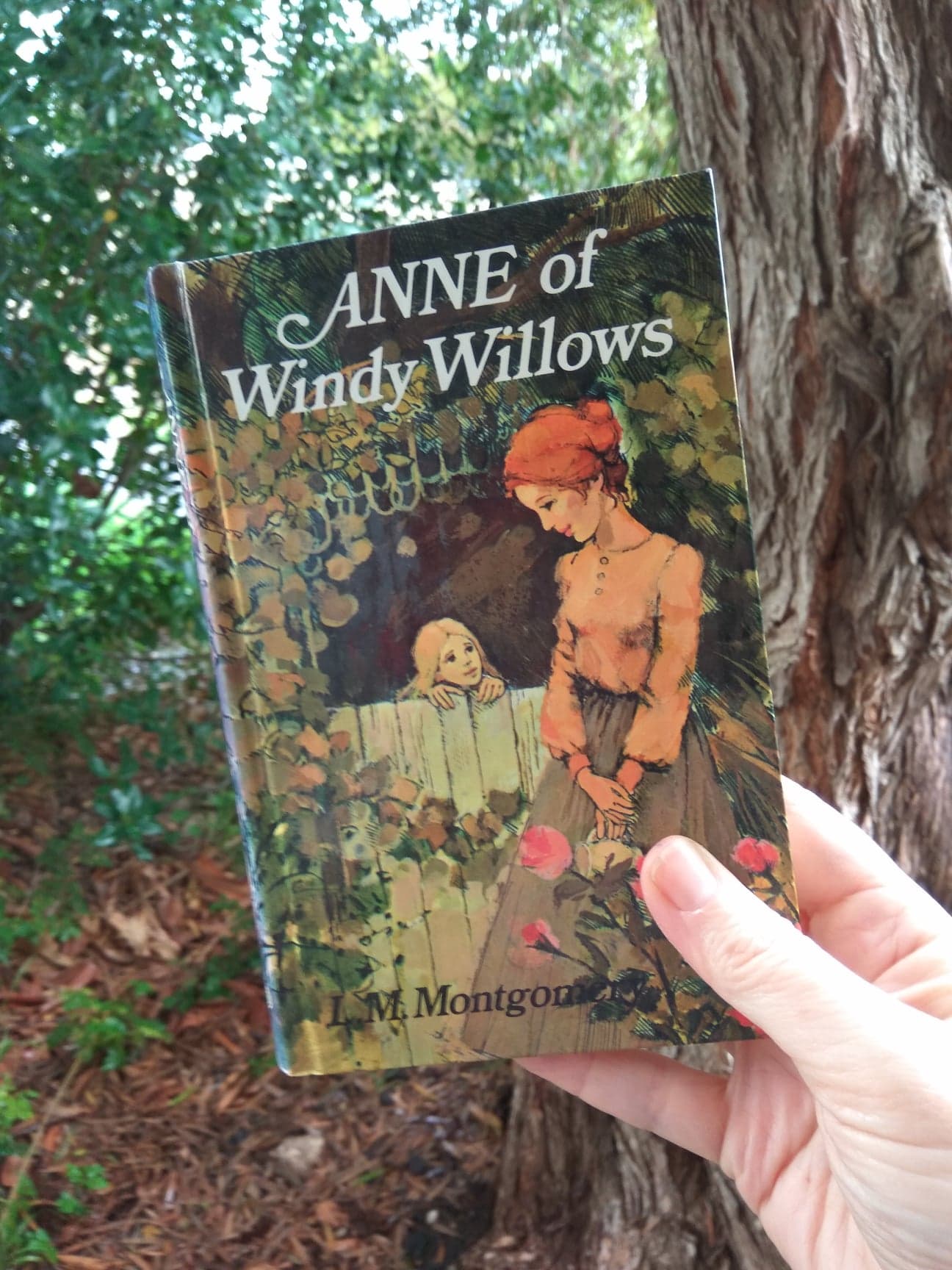
'Anne of Windy Willows' by L.M. Montgomery


Or 'The One with the Two Titles'

After finishing Uni, Anne acquires the position of principal teacher at Summerside High School, and lives in a wonderful old-fashioned boarding house with a pair of hospitable widows and their charismatic hired lady. She contends with the Pringles, who consider themselves the Royal family of the district. They're throwing a collective tantrum because their relative's application for the job was passed over in favour of Anne. In the town are plenty of wistful wannabe brides and cantankerous senior women, both LMM's specialties. The Canadian and USA title is Anne of Windy Poplars. It is called Anne of Windy Willows only in the UK, Japan and Australia. My bit of nosing around the internet reveals that the Windy Willows version was always LMM's preferred choice, but her publisher objected on account of its similar sound to Kenneth Grahame's The Wind in the Willows.  

What I enjoyed more than ever before.

1) Rebecca Dew! The hired lady at Windy Willows is a legend who's described by one man as 'a nice old cat if you stroke her the right way.' She has none of the trappings we women are often urged to aim for (beauty, marriage, education) but that doesn't bother Rebecca at all. Her delightful shrewdness more than compensates for the lack of these things. I enjoyed all of her blunt observations, not to mention her physical presence. As soon as Anne described her as a 40-something tomato with bright, beady eyes and a snub nose, I knew I'd love this lady. Her love/hate relationship with Dusty Miller the cat is one of the highlights for me.  

2) Katherine Brooke! The softening of Anne's dowdy and grim deputy principal really touched me this time round. Jealous characters can be quite cathartic, since it's an emotion we're taught to sweep under the carpet, and it turns out Katherine is jealous of Anne in every respect. It's easy to look at a person like Katherine and brush off her misery as self inflicted, but that's always short-sighted. Other peoples' shabby treatment of Katherine throughout her life helped shape her bitter attitude, and there's no point denying it. That's often the case for the rest of us too, and it always saddens me to see anyone swallow well-meant guilt trips along the lines of, 'Your sour mind is your own fault.' 

But having said that, our own thoughts are the cure, and Anne's simple prescription is really full of power. 'You can put hate out of your mind. Cure yourself of it.' Their holiday break at Green Gables was one of the most satisfying Christmas sections in a book I've read in a long time. It was great to see Katherine discover that simple things of beauty with the potential to heal us are abundantly available to most of us, no matter how bruised our pasts have left us.  

3) Little Elizabeth Grayson! This loving little girl is forced to live a hushed life with a pair of impatient old crones. She daydreams about her absentee Dad and dreams for a better tomorrow. I like how she switches the different versions of her name to suit the mood she's in. On any given day, she might be Betsy, Beth, Elsie or Betty, but rarely Lizzie, which is reserved for the bleakest moments ever. Personally, I rather like Lizzie these days, as much as all those others.

4) Anne's daring streak really stands out for me this time. She cares enough about her friends to take big risks on their behalf which most of us wouldn't dare contemplate. It's easy to justify doing nothing by claiming it's none of our business, so Anne's bold meddling is super satisfying and pays off big time. Her kindness and courage combine to make one super power. Maybe many of us have only one or the other, but part of Anne's secret is having both.  

5) The Prince Edward Island environment is an understated hero all through the book. We're always getting the salty tang of the sea and seeing the people weave their harbours, bays, headlands and gulfs into their social lives. There are rowing jaunts, shore bonfires, rock dances, clam bakes and other fun things. It makes me consider how my own coastal city I call home is woven into my identity.  

6) These folk lived in an era of patience and expertise which impresses me. I love it when Aunt Chatty of Windy Willows gets hold of Sarah Pringle's delicious pound cake recipe. That recipe really is a big deal, requiring 36 eggs and three days of 'sweating', wrapped in brown paper and towels. No wonder Rebecca Dew comments that they might be able to afford it about once a year. In our generation of instant gratification, including twenty minute flat cake mixes, I do appreciate references to such full-on dedication to the household arts. 

What I wasn't a big fan of this time round.

1) Dare I say it, I'd like a dollar for every time Anne thinks about or mentions her B.A. degree. I was wishing I could tell her I've got one too, and in my era it's not such a big deal. In fact, it's often the source of mirth. I've heard many jokes along the lines of, 'What did the Arts graduate say to the Engineering graduate? The answer is, 'Would you like fries with these?' What would Anne think of an era where her proud achievement alone so often leads to a dead end, since it put her straight in line for a plum job? I wonder if my perspective would deflate her ego, which sometimes seems as puffed up as those sleeves she used to long for! 

2) Along similar lines, her smug tone can get irritating. As a prime example, her student Lewis says, 'I wonder where this Dawlish Road goes to.' Anne replies, 'I might be horrid and school-teacherish and say that it doesn't go anywere; it stays right here. But I won't.' That response got an eye-roll from me. How I wish he'd replied, 'Well, if we're really splitting hairs, you just did.'  

3) I wonder if I'm the only one who'd agree Little Elizabeth's thread was concluded far too quickly.  LMM dashed off the finish of her story toward the end with a bit of heavy-handed and unnecessary melodrama. (Did anyone else get the feeling she just wanted to finish writing the book at this point?) But it didn't stop me wondering what the future held in store for this girl who Anne described as a sensitive Aolean harp, so finely tuned to any breeze of sympathy. 

4) The number of characters who pass through and then never appear again, is bewildering. Yet they each claim to love Anne with great devotion. LMM is back to the episodic plot structure that worked so well in Anne of Green Gables. I discovered that this is one of the books she wrote down the track, long after she thought she'd finished with Anne entirely. The main reason was to give her fans what they demanded, which was more of the format which originally took off so well. Yet I think it makes Anne of Windy Willows feel more at times like a disparate short story collection connected by one character than a novel with a fulfilling arc of its own.    

Some great quotes to take on board.

Anne: I don't like reading about martyrs, because they always make me feel petty and ashamed to admit I hate to get out of bed on frosty mornings and shrink from a visit to the dentist.

Aunt Mouser: After all, even if you aren't very happily married, it's likely you'd be more unhappy not.

Anne: Nobody is ever too old to wear just what she wants to wear. You wouldn't want to wear it if you were too old. 

Anne: In daylight I belong to the world and in the night to sleep and eternity. But in the dusk I'm free from both and belong only to myself.

Aunt Chatty: I've often wondered why things should be arranged so. Me loving to talk with nothing to talk about, and Kate with everything but hating to talk. But I suppose providence knows best. 

Rebecca Dew: If we were all beauties, who would do the work? 

Cousin Ernestine: I can't seem to get over the thought of marrying a minister for love. I'm afraid it's awful irreverent. 

Anne: One can always find something lovely to look at or listen to.

Stay tuned, because next up Anne and Gilbert finally tie the knot at last, in Anne's House of Dreams.

Monday, August 24, 2020

All the Lonely People - Books with Solitary Protagonists


Books with lonely, solitary protagonists are wonderfully revealing because we're allowed a special glimpse into something that is normally closed off to us. Social, ebullient people leave us in no doubt of what they're thinking and feeling. But the rich, vibrant depth of a lonely person's life is not on display. So as well as offering insight into how loners may tick, this list is intended to extend the balm of friendship to those of us who have ever found ourselves in their situation. I hope my suggestions may even form the basis of a great pile to read back to back for a solitary retreat. I can guarantee you'd find these protagonists most interesting company.


1) Aaliya
This senior lady perseveres year after year with one of the most brainy, yet futile hobbies you can imagine. Each year she translates a great work of literature or philosophy into Arabic, her own native tongue. Aliyah knows it's pointless trying to interest publishers in a project whose market would be minimal. The painstaking treasures go straight into her drawer and never see the light of day. This makes her a great example of somebody for whom the satisfaction of the pursuit is its own reward. She's a bit cantankerous, but her non-impact is very impacting to me. (See my review of An Unnecessary Woman)

2) Stevens
He's a polished professional who has poured every ounce of effort and energy into becoming  what he considers an icon - the quintessential British butler. But he has nothing of himself left over for anything else. Stevens is pretty old before it dawns on him that his personal life has suffered as a result of his all-consuming pride. He learns to his cost as he edges closer to retirement that being the perfect butler leaves no time to become anyone's beloved friend or companion. (See my review of The Remains of the Day)

3) Lucy Snowe
Whoa, what a gal! She has enough passion and strong convictions to fill the Pacific Ocean, and tries almost successfully to contain it all within her own small frame. For Lucy considers herself a plain and penniless orphan whose wisest course is not to interact with others but focus on making her own quiet way in the world. To her fellow characters in Villette, she's an eccentric, prim little oddity. To us readers, she's one of the most restrained, repressed, passive and self-controlled characters to be found within a book's pages. (See my review of Villette)

4) Frankenstein's monster
His is a tragic tale of a curious, exploratory nature turned vengeful and dangerous because of the prejudiced terror with which he's treated, and the unbearable loneliness it creates in him. This smart and emotional fellow has observed the sweetness of human bonding, and would like nothing more than to be anybody's dear friend. When he learns that he repulses people because of his horrific looks, he turns his energy into revenge against his creator, Victor Frankenstein, and Victor's whole family. It's a candid study of human loneliness and alienation at it bleakest. (See my review of Frankenstein)

5) Fanny Price
This girl is one of literature's most celebrated introverts, courtesy of Jane Austen. Shy and diffident by nature, her retiring personality is strengthened even more by being the poor relation in a household of wealthy relatives who make it clear she's their charity case. When bossy, demanding, self-appointed rescuers are breathing down your neck, your self-expression is pretty effectively paralysed. Your teeming thoughts must remain enclosed in your own headspace. Yet this story shows what it takes to cause nervous, obliging Fanny to dig in her heels and stand up for herself. (See my review of Mansfield Park)

6) Jakop Jakopsen
This guy is a more obscure example but a perfect case of what a lonely person may resort to. He attends the funerals of strangers, just to bask in the atmosphere of family togetherness for the duration. Jakop has never known anything like this himself, having been the only child of a preoccupied single mother and bullied by his peers at school. He comes to funerals with made-up tales of how he knew the dear departed. Jakop knows he risks exposure as a fraud but considers it worthwhile for the warm, brief encounters that set him up until the next one. (See my review of An Unreliable Man)

7) Eleanor Oliphant
This young woman has become one of the general public's favourite lonely oddballs of recent times. Crowds of readers have taken blunt, abrasive Eleanor to their hearts, proving that the plight of lonely people must strike a chord with us all. She's revealed as a battler who has survived some shocking events which helped form her into a sharp observer who stands on the periphery of others' lives. This book seems to have become a clarion call to reach out to the people who may be easiest to sweep straight past. (See my review of Eleanor Oliphant is Completely Fine)

I suspect loneliness will always be a problem, because self-absorbed human nature doesn't tend to notice the quiet person watching from corners. Yet book characters help soften the blow. They have the potential to be counted among our friends in a deeper, different way than the flesh and blood people we knock shoulders with. And they are true allies in our quest to avoid being completely drowned in a tidal wave of loneliness. Sometimes the deep and non-threatening evidence that others have shared our exact plight is all we need to square our shoulders, tilt our chins and plug on. 

Are any of these familiar to you? And can you suggest any others who may fit well as another friend on this particular list?