Monday, April 27, 2015

'The Next Happy' by Tracey Cleantis


22750280
2015 Reading Challenge, Week 17 - A Non Fiction.
I haven't come across another book like this one. It's high time somebody wrote one. 

When the best option is to let go of the life you planned for yourself and find a new path, a world of possibilities can surprisingly open up. Learn whether it is time to let go, and if so, how to move through your grief and find your way forward in The Next Happy.

If you believe, you can do anything.
Although well-meaning, these intended words of inspiration can make us feel like failures. The reality is that no matter how positive our outlook or how tenacious our approach, our dreams simply do not always come true—and there is nothing we can do about it.


In The Next Happy, Cleantis offers a roadmap for that journey, teaching you how to
face the possibility of letting go of a dream that isn’t working
accept and face sadness, anger, and shame
understand the true reasons why you wanted what you wanted and the real-life causes for why you didn’t get it
ask the questions that will let you move on and set realistic goals for finding a new way forward.


MY THOUGHTS:
It's not often I come across a non-fiction book which I find so hard to put down. This book's target audience is people who are facing the fact that their big dream is dead. The author helps us through the grieving process with a lot of empathy and compassion, having a history of shattered dreams herself.

We live in a world where latching onto your dreams like a bull-terrier is fashionable advice. Quotes fly around cyberspace from illustrious people such as Walt Disney (all dreams can come true if we have the courage to pursue them) and Winston Churchill (never, never, never give up). The theme of dreams coming true spills over into popular media and movies. It's difficult not to buy into the myth that if we don't make our dreams come true, there is something wrong with us.

Tracey Cleantis sets out to help us set the record straight. Sometimes they don't come true. Then we deal not just with the grief of losing a dream but guilt trips making us feel responsible for falling short. She helps us understand that giving up does not make us a failure or quitter. To the contrary, staying on the 'never give up' treadmill can be damaging in every way. Physically, our bodies develop inflammation caused by years of frustration and anxiety. Emotionally, we may take on the identity of a failure. She likens us to the mythical Sisyphus, endlessly pushing a rock up a hill and having it roll back down on us. There may come a point when giving up is the wise and braver option.

Another section of this book shows how statistics alone prove it impossible for everyone to achieve their dreams anyway, especially when they may conflict with the dreams of others. Also, the rate of tertiary graduates is disproportionate to the number of jobs available which require their degrees. Cleantis gives tips on how to reply to well-meaning, but insensitive Pollyannas who may try to convince us not to give up yet. We each know when we've reached our limits.

I've heard people refer to themselves as 'midwives of dreams', meaning that they help other people achieve theirs. This author humorously imagines herself as more of a smotherer, a Dr Kevorkian, helping people know when it's time to pull the plug. She wasn't expecting popularity, but like many others, I'm so glad she's written this book.

I'll finish with some of my favourite parts.
1) She advises movie therapy, recommending several significant titles to help us through the process.
2) The personal anecdotes from several of her clients are refreshing. Over the years, I've read so many stories about people who have achieved their dreams. Having similar stories about people who gave it their all and had to stop is a good balance. Especially when there's light at the end of the tunnel. This brings me to point three.
3) I was hanging out for her advice on what to do next. It can be summed up in a sensible sentence or two. Rather than looking immediately for the next big thing on the rebound, we should allow new interests to come organically, without judging their value through our blinkered eyes.  As she says, forcing a cognitive, purposeful decision is never as delightful or surprising as welcoming the unexpected. A little spark of interest may do it.

I'd recommend this unusual and helpful book to anybody who may need it.

5 stars. 

Saturday, April 25, 2015

The Anzacs - Remembered for 100 Years


I wrote this some time ago, but it seems very appropriate to share it today, for the centenary of the ANZAC arrival at Gallipoli Cove. This is a summary of the story I'm planning to write as a historical book.

I was reading through some genealogy research I'd typed out for my dad several years ago. There is a long and interesting section about his father's experience in the First World War. Charlie Mitchell was born in 1892. He was nicknamed 'Red' because of his bright hair. My father, Bryon, is his second youngest child, born in 1932. I am the youngest of the next generation, born in the very last week of 1969. I'm proud to have had a grandfather serve his country in WW1, although he and my grandma both died in the 1960s before I was born.

The true story of Red Mitchell's war experience begins when he left Adelaide, just before Christmas, 1915, with the expectation that he and his fellow soldiers would reinforce the ANZACs on the beach of Gallipoli. It turned out their battalion evacuated Gallipoli one week earlier, so they joined them at Alexandria, Egypt. Next, they joined the trench warfare in France.

Typing it out brought the hardships vividly to life. My grandfather was one of the brigade runners, whose job it was to sprint and deliver messages between trenches, the sort of thing electronic communication would later be used for. Running at top speed while trying to breathe through a gas mask took its toll on him, and he suffered from rhinitis, which was severe inflammation of the mucous membrane. At one time, he was severely shell shocked while running, and couldn't avoid breathing in a lungful of chlorine gas. He never recovered his sense of smell for the rest of his life.

Dad's story describes how the soldiers lived with deafening and unceasing shell fire, unable to get any quality sleep. They had to march through muddy trenches, after weeks of downpour. The boggy ground sucked their gumboots off and seeped through to their skin. Whenever anybody peeled off his boot to examine his chafed feet, it was almost impossible to wriggle them on again. 'Trench foot' was the most common condition treated by the medics.

My extended family still has an old postcard, sent from Charlie Mitchell to his mother in Adelaide, telling her that they were soon expecting to go to the front line but for her not to worry.

Here is one of my favourite parts of Dad's story. One day, my grandfather and a mate were walking in the vicinity of a German prison camp and heard wild cheering and singing from the captives within the walls. They popped into a bistro in the nearest village to learn that the War was declared over. Something about both sides being united in their happiness and relief touches me.


Throughout my life, I've had moments of being a worrier and control freak. Reading this brought something home to me. If I'd been conscious somewhere in 1915 to 1918 to witness how many times my grandfather's life had been at risk, I might have panicked about never being born. As it all worked out without my input, I find it a good reminder to entrust other aspects of my life to God too.

Still, I think of the young soldiers in several wars who made the ultimate sacrifice and never returned home to have children. In the 1970s, when I was a little girl watching the ANZAC march in Adelaide, there were still a number of frail old diggers from the first World War, as well as a pretty large number from World War 2. My mother would always cry.

 When I think of the spirit of Australia, still a reasonably new nation at the time of WW1, rising to the serious occasion, I feel very proud.

Friday, April 24, 2015

'A Stranger's Secret' by Laurie Alice Eakes

 22574074
As a grieving widow, Morwenna only wants to make a life for herself and her young son at her murdered husband s estate. Until an unconscious man washes up on her shore, entangling her in a web of mysteries that threatens everything she holds dear.

Still grieving the loss of her husband, Morwenna Penvenan fills her days preserving her son s heritage: the dilapidated estate his father left them. But all attempts at restoration are thwarted when she is accused of deliberately causing ships to crash on her shore in order to steal their cargo. While seeking clues to the true culprits, she finds an unconscious man wearing a medallion with the Penvenan crest enameled upon it.

Upon learning of his father s death, David pursues answers to the many questions left in his father s wake: Why was his father in Cornwall when he said he would be in Scotland? Why did he die in possession of a medallion belonging to a prominent Cornwall family? Why did his father take money from the family s ship-building business? And why did someone kill him? Only after waking up at the Penvenan estate under Morwenna s care do the pieces start falling together.


MY THOUGHTS:

OK, over the last few years, I've come across a few other plots involving washed up, unconscious men discovered by heroines on the shores of their beaches, ponds or swamps. I wondered what would make this one special or different. Being set on the rugged coast of Cornwall was the drawcard for me. It's that nineteenth century time period when wreckers were notorious for deliberately luring ships to their doom for treasure and extra revenue. I was intrigued by the fact that the hero, although a stranger to the heroine, was wearing a medallion bearing her family crest when she found him.

Although she helps nurse him back to health, Lady Morwenna Trelawny Penvenan and shipbuilder David Chastain both believe they have good reason to regard each other with suspicion. All he knows is that he'd been on a mission to bring his dead father's body back from Falmouth, and suddenly finds himself a seriously injured guest beneath her roof. And David is well aware that Lady Morwenna is under suspicion of being part of a wreckers' ring herself. She certainly could use the money. For her part, she's desperately trying to clear her name and preserve her infant son's inheritance. Morwenna wonders why that medallion had been in David's possession, and who stole it the moment she was gone.

As I read, I wondered whether there might have been a previous novel, as references to Morwenna's grandparents and cousins made the plot sound thicker than it seemed on the surface. Her absent cousins, Elizabeth and Drake, seemed to be written larger than life, making me wonder if their escapades were part of other stories which I missed. I checked and saw that it was true. I should have read 'A Lady's Honor' first, which might have helped make a few aspects of this story clearer. Some sequels can stand alone but I'm not sure this is one of them.

Although I liked David from the start, it took me longer to warm to Morwenna. She comes across as very defensive and snippy. Not having read the prequel, I saw no problems with her grandparents' behaviour early on, for example, making me wonder why Morwenna had to keep her stand-offish pride intact. Even as secrets are gradually revealed, I feel her mysterious, self-sufficient attitude helped distance me from this main character who I would have preferred to relate to. She tries so hard to keep everyone at arm's length, it works even with the reader. However, if I'd read that prequel, it might have made all the difference.

Being reminded of David's attraction to Morwenna's stunning beauty got a bit tedious, along with how slight and delicately built she is. This was getting to the stage where I was saying, 'Yeah, come on, we know already,' whenever yet another mention popped up.

 In many ways, the plot is good, with a romance involving a decent dash of mystery and threats of danger. I'd just recommend that you read the first book first, so you're not floundering as I was.

Thanks to NetGalley and Zondervan for my review copy.

3 stars

Monday, April 20, 2015

'The Forgotten Garden' by Kate Morton

19228990

2015 Reading Challenge, Week 16 - A book with more than 500 pages. 
I read each of those 500+ pages very quickly, as I wanted to know what was going to happen. 

A foundling, an old book of dark fairy tales, a secret garden, an aristocratic family, a love denied, and a mystery. The Forgotten Garden is a captivating, atmospheric and compulsively readable story of the past, secrets, family and memory from the international best-selling author Kate Morton. 

MY THOUGHTS:

In 1913, a little girl is taken aboard a ship and told to wait quietly by a mysterious woman she knows only as the Authoress. When the lady doesn't return, the ship takes the 4-year-old with it to Australia. In 2005, the granddaughter of that little girl heads back to Cornwall to try to figure out the mystery of the family past.

I have to say, many of the characters have very melodramatic motives for their actions. As the plot itself delivers its share of melodramatic moments, maybe they're a good match. It's no wonder the heroine, Eliza, is able to make several of her dark fairy tales semi-autobiographical! The story hooked me in so I had to pick it up whenever I had a spare moment. Stories with mysteries that span more than one generation and time period always do that to me, and this one bounded back and forth like a yo-yo. We're in the early 1900s with Eliza and Rose, then we're in 1975 with Nell, and then 2005 with Cassandra. I like the feeling of time flying, and the way each thread makes us more curious about the others. I like the concept that Cassandra inherited the mess to sort out.

The theme of a long-abandoned, hidden garden surrounded by its four walls reminded me of the children's classic, 'The Secret Garden.' There's even a cameo appearance by that author, Frances Hodgson Burnett, in this novel. Apparently, as she tells the characters, she's so intrigued by the garden on this property that it gives her ideas for a story of her own. Very cool little extra.

I think my favourite of the main heroines is Eliza, with her originality and uniqueness, who ends up finding herself in a no-win situation if ever there was one! Who wouldn't be fascinated by the inner workings of an author of fairy tales? I also like Nell, with her knowledge that she herself is the mystery she's trying to solve, and Cassandra, with her natural bashfulness combined with determination.

The antagonists, Linus and Adeline Mountrachet, are memorable. Linus is a nasty character, treating those he should hold dear with the same contempt he suffered when he was young. I would think if there was really a ghost haunting the old place, it would be him, still consumed with his creepy obsession. His wife is equally easy to hate. There is no control freak like a self-seeking control freak.

Although he wasn't really a main character, I found myself pondering Nathaniel's plight, and the sacrifices he was willing to make to further his career and keep the peace. Where do you draw the line and declare enough is enough? He wanted to do the conventional thing and please his new family, yet what they were asking him to do was definitely not conventional! Although he felt every choice he made was for the good of himself and his young wife, I feel he became a puppet man whose strings were too easy to pull. I was hanging out for him to stand up to his pushy mother-in-law and tell her to go jump (and his wife, for that matter). At the end, his is one of those cases when the right thing may be the scandal causing choice.

Some of the even more minor characters are interesting storytellers who offer food for thought. There's old William Martin, who told many tales, but had an obvious gift of 'spinning straw into gold.' And Julia Bennett, the hotel owner and former fiction author, who believes that people really do belong to stock character types. 'Even the person who insists such things don't really exist is a cliche, the dour pedant who insists on his own uniqueness. We're all unique. Just never in ways we imagine.'

I'll finish with some of the quotes from Eliza, as I enjoyed my glimpse into the mind of such a prolific storyteller.

Eliza knew scrutiny was akin to stealing. 'She liked to store images in her mind to be replayed, re-voiced, re-coloured as she pleased. To weave them into wicked stories, flights of fancy that would horrify the people who'd provided unwitting inspiration.'

'The more she wrote, the louder the stories seemed to grow, swirling in her mind, pressing against her head, anxious for release. She understood the power of stories, their magical ability to refill the wounded part of people.'

4.5 stars

Friday, April 17, 2015

Postcards from Heaven


Have you ever come across an unspoken feeling that people who like to spend time reading or writing are time wasters? Perhaps loved-ones have rolled their eyes when they've seen that you're still reading your novel. During the years I was writing fiction, I've experienced polite and unintentional brush-offs. They come from the type of people who seem to believe that as it's a short life, there are more important things to occupy ourselves with than entertainment.

'I don't have the time to read novels, but all the best to you.'

I've seen missionaries, social activists and people in helping capacities rush around me, doing an excellent job of making this world a better place. When you get the implicit message that what you love to do is a sideline sort of occupation, you may start to wonder about its value.

But here's a fresh way of regarding the subject which appeals to me. Books and other output from creative folk are like signposts pointing toward a far-off destination, or postcards from heaven. When we are moved by paintings, novels or musical compositions, it's more than just the artist's work itself getting into our hearts. It's like a message from a home we've forgotten about.

This is similar to how a character from a novel on my shelf expresses it. 'All of us are meaning seekers. We approach every painting, novel, film, symphony or ballet unconsciously hoping that it will move us one step further on the journey toward answering the question, 'Why am I here?' The character is a musicologist named Liam Cudder. The novel is 'Chasing Francis' by Ian Morgan Cron.

The characters in the novel delve even deeper into the subject. Here is my paraphrased summary of their conversation. We post-modern people face a dilemma. Our hearts long to find ultimate meaning, while our critical minds have been trained to believe it doesn't exist. We are homesick wanderers with no home. Creative acts of beauty are far more than distractions without much substance. The arts and literature point us toward a heavenly country we have not yet visited but long to find. Those who create art, music or stories may not realise it, but they help people see or hear beyond the immediate to the eternal.

Perhaps the artistic mind is as valuable as the practical or scientific. And perhaps the artistic mind catches snatches of the nature of God in its own valuable way. So let's keep reading books and sharing them with others. And let's not be too shamefaced or reticent to express what we can in our own way, whether it's written word, painted image or musical note. You never know who may find it to a be a postcard from heaven.


Tuesday, April 14, 2015

10 Inspiring Quotes from Books


I was delighted when I saw this week's topic put forward by the Broke and the Bookish. I love jotting down quotes which jump out and resonate with something in my heart when reading books. It's part of what being a reader is all about. This was a matter of limiting myself to just ten, and here they are.

1) 'If you have men who will exclude any of God's creatures from the shelter of compassion and pity, you will have men who will deal likewise with their fellow men.' Saint Francis of Assisi, from Chasing Francis, by Ian Morgan Cron

2) 'This place was made to be beautiful. It is pretty now, but just not how it was meant to be.'
Josia from A Thing of Beauty by Lisa Samson

3) 'I derive delicious pleasure from the two Georges' carelessness about the judgment delivered by smaller hearts and minds than their own.' Rebecca Mead, talking about George Eliot and George Henry Lewes, from her book, My Life in Middlemarch

4) 'The world can be a tough, gritty place. We need to seize beauty wherever we find it.' Luke to Anna, in Beyond all Dreams, by Elizabeth Camden

5) 'Gravy is like happiness. You can't store it up and put a label on it. You've got to learn to take it as it comes, moment by moment.' Aunt Ruby from The Good Day Baking Company, by Adele Wyn Eddy.

6) 'Being content is not a lack of ambition. It's being able to rest and relax and know your worth doesn't come from what others think of you, or even what you think of you.' Chaplain Calhoun from Every Waking Moment by Chris Fabry

7) 'When Laura walked away from our marriage into an affair, her sin was condemned publicly, but for years, my sin has been congratulated and affirmed.' Nathan, from Sensible Shoes by Sharon Garlough Brown.

8) 'If only she could be so oblivious again, to feel such love without knowing it, mistaking it for laughter and bread with only the scent of jam spread over it.' Markus Zusak, The Book Thief

9) 'How could one turn the other cheek to this evil when the cheek being turned was not one's own but that of innocents?' Title character from March by Geraldine Brooks

10) Eliza knew scrutiny was akin to stealing. 'She liked to store images in her mind to be replayed, re-voiced, re-coloured as she pleased. To weave them into wicked stories, flights of fancy that would horrify the people who'd provided unwitting inspiration.'

'The more she wrote, the louder the stories seemed to grow, swirling in her mind, pressing against her head, anxious for release. She understood the power of stories, their magical ability to refill the wounded part of people.' From The Forgotten Garden by Kate Morton

Monday, April 13, 2015

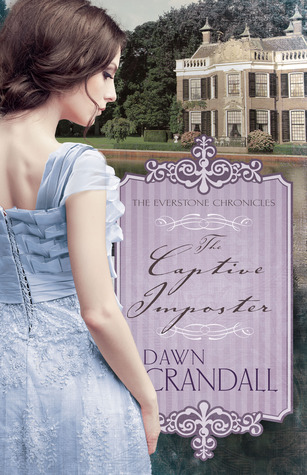
'The Captive Imposter' by Dawn Crandall

 21490845

2015 Reading Challenge, Week 15 - A book by an author you've never read before.
I don't always read the third book of a trilogy first, but this time I enjoyed doing so. I'm looking forward to reading more by Dawn Crandall in the future. 


Sent away for protection, hotel heiress Estella Everstone finds herself living undercover as a lady’s companion named Elle Stoneburner at one of her father’s opulent hotels in the mountains of Maine—the one she'd always loved best and always hoped to own one day, Everston. The one thing she doesn't like about the situation is that her ex-fiancé is in the area and is set on marrying someone else. Reeling from her feelings of being unwanted and unworthy, Estella reluctantly forms a friendship with the gruff manager of Everston, Dexter Blakeley, who seems to have something against wealthy young socialites with too much money, although they are just the kind of people Everston caters to. 


  MY THOUGHTS:
I was invited to read this third book of a trilogy, curious to see if it could stand alone, and maybe even intrigue me to read the first and second books too. From the first page, I had the impression that the heroine, Estella Everstone, had been featured in the two prequels as a younger, more minor character. This time it's her own story, which she tells in first person, with many twists and turns, changing attitudes, revelations and changes in fortune.

I like the Great Gatsby sort of atmosphere the story evokes. It takes place in a similar setting, on America's east coast, in the gilded era time period. Like Fitzgerald's classic, many of these characters have worked hard to achieve the prosperity they're enjoying. Estella is the youngest child of wealthy hotel magnate Bram Everstone, but begins the story travelling incognito as Elle Stoneburner, hired companion to an elderly widow, Mrs Granton. In the course of her duties, she's forced to return to Everston, her favourite of her wealthy father's mountain hotels.

The narrative makes it clear how hard Estella/Elle must work to keep her identity concealed. Her predicaments are often amusing to read about. One on side, she admires the handsome hotel manager, Mr Dexter Blakeley, but senses that his opinion of young women born into fortune isn't very high. On the other side, Jay Crawford, the ex-fiance who broke her heart, is around the place too. As Elle is so busy with this dance between identities, it takes her by surprise to consider that Mr Blakeley may be concealing a few secrets of his own, not to mention the desperate and needy young women beneath his roof.

Talking about him, the heroine's first impression of the hero has to be among my favourites. Through a stagecoach window, Elle notices 'his chiselled, almost statuesque face which consisted of sharp, drastic angles.' It's set off by 'dark hazel, brooding eyes that seemed to cut into everything he turns his gaze upon.' However, at this stage, that's cancelled out by the fact that he has the demeanour of a wild boar. I'm sure many readers will be hooked to find out more about the goings-on of these two from this point.

I think I would be interested in reading 'The Hesitant Heiress' and 'The Bound Heart' to catch the earlier stages of this story.

Thanks to the author for my review copy.

4 stars