Friday, February 27, 2015

How the Mighty Fall

This is a piece from the archives of my old blog. I wrote it back in 2012, and it was interesting to read it over and see how the main points have held true. Here it is, with just a few tweaks for 2015. 


I'd been sad in previous years because the main Christian bookshop chains in Australia didn't seem to support their compatriots the way we would like them to. The truth is they honestly believed they were. They thought that poking a few copies of our books on their shelves was really going all out for us. They declared, 'We support fellow Australians' but never gave our books the same exposure they would give American ones. When asked why, they'd reply, 'Australian books don't sell! But we're still supporting you because at least we have them on our shelves. Anybody who is looking for you will find you. Or if they can't, they only need to ask us.' It always gave the impression that even fellow-Aussies (the bookshops) thought we were producing second rate material without even bothering to read it. The fact is, many Australian authors write wonderful, thought-provoking, entertaining and compelling books.

  The last few years have revealed how shortsighted I'd been without knowing, for my dependent attitude on the book stores. For over a decade, I'd been regarding them as monoliths we need to scale, and getting featured in their catalogues was making it closer to the pinnacle. Well, the spread of ebooks has shown us that maybe we don't need to be Sir Edmund Hilary in the business of writing and selling books after all. Huge structures can actually crumble suddenly while we're still trying to scale them.

In 1989, the Berlin Wall, an apparently permanent and impregnable bastion, was dismantled seemingly overnight. After hundreds of years of supremacy, the Roman Empire ended in quite an unobtrusive way. The strength of its citizens was undermined by the lead pipes of their water system, of all things. Poor Henry V died of dysentery soon after winning the Battle of Agincourt, when he was on the pinnacle of having both England and France under his feet. Napoleon's topple from his pedastal has become a proverb, as he faced Lord Nelson at the Battle of Trafalgar and 'met his Waterloo.'  And King Belshazzar of Babylon was feasting and carousing when he and his company suddenly read 'the writing on the wall.' In the morning, his reign was over. And just last week, my son, Blake, and I learned during a history lesson that the mighty Attila the Hun died of a nosebleed! History reinforces the folly of relying on huge structures, but it's a hard lesson to believe when they appear so solid.


As for bookshops, I thought I could sense their foundations beginning to tremble back in 2012, and three years has reinforced it. At that time, I was browsing in Borders bookshop, near the iconic silver balls in Adelaide. After passing their Gloria Jean cafe, where many people were eating and drinking, I took the escalator to the top storey and sat in a plush armchair to look at books. Nothing could have seemed more opulent and substantial. But a few short weeks later, before I had time to make another trip down from the Hills into Adelaide, it was gone! Angus & Robertson followed on its heels. And Word bookstore, which had been in the heart of Adelaide for as long as I could remember, had been forced to shuffle out to some obscure suburb I never visit. At present, Dymocks still seems to be holding on, and I'm sure we all hope it will last.

It's fairly obvious what is shaking the foundations of bookshops. In January 2012, I was given a kindle. Now, my days of driving down to Adelaide especially to visit Koorong are over (or at least very rare). Electronic books are cheap, swift to download and don't have a shelf life. I'm pretty sure that if I have a recommendation for some good old book written years ago, I'll have more chance finding them on Amazon than in Koorong, Dymocks or any other shop. It seems that e-books may be the iceberg to the Titanic of the bookshops. Just twenty or even ten years ago, whoever would have imagined it?

Although there is sadness in this situation, there are a few positive thoughts for writers like myself. We no longer need to get downhearted because the big bookstores aren't interested in us. 'Big' seems to be shrinking daily. We need to keep our chins up, never stop writing or producing whatever we do best, and trust that more opportunities are opening up to spread our voices further than we might believe possible. As King Hezekiah was warned by God not to trust in the horses and chariots of Egypt, I believe He would say the same thing to authors regarding bookshops.

Ironically, straight after I originally wrote this post, they televised 'You've Got Mail' with Tom Hanks and Meg Ryan. Do you remember loving that movie in the 90s as much as I did? Her quaint, family-owned bookshop was forced out of business by his mega-chain. Who would have believed that in such a short period of time, even his mighty business would be getting shaky? 

If you liked this post, you may also like my list comparing electronic and hard copy books.

Wednesday, February 25, 2015

'Still Life' by Christa Parrish

 21556057

 A tragic plane crash. One woman who lost her husband. Another who gave up her seat for him.

Ada spent her first twenty-five years with her family as part of a fringe religious sect. Her only contact with the outside world was through customers at their farm store. Then she met Julian, a photojournalist who'd come to document their lifestyle. They eloped mere days later and Ada was thrust into a completely new life as a wife, city-dweller, and an individual allowed to make her own decisions. But she has no idea who she is.

On her twenty-sixth birthday, Julian plans to fly home from an assignment to give her her first-ever birthday present. He's thrilled when Katherine Cramer gives up her seat so he can make the flight. But the plane crashes and everyone on board is killed, including Julian.


MY THOUGHTS:

This story really drew me in. I didn't want to stop reading, and didn't take long to figure out that my overall impression would hinge on the final resolution of the plot. The question forming the main theme is something we've all tussled with and placed in the 'too hard' basket. Why do some people die prematurely, while others are spared, regardless of the apparent goodness of the person? It's such a biggie, I was intrigued to see what Christa Parrish would make of it.

The first part follows the lives of two female main characters in the aftermath of a fatal plane crash. The young widow, Ada, has to come to terms with the death of her husband, Julian, who was flying home to celebrate her birthday. Katherine is the woman who should have been on the plane, but offered him her seat, so she could spend time with her lover behind her husband's back. We later learn more about Julian himself, and also Katherine's teenage son, Evan, who had been born with a serious heart defect.

It's a perfect example of why I love reading and writing contemporary fiction. Apart from the crash itself, several characters had traumatic events in their pasts, but while not being glossed over, these were not the focal points. Ada's history in the cult headed by her extremist father, Katherine's decision to have an affair, Evan's heart problems. In spite of these, each of the characters come to a place where they are able to look forward to their futures with courage and hope. The book offers the hope that it can be the same for any of us.

It highlights the value of human life. How terrible that Ada lost Julian, but the alternative would have been that Katherine's teenage sons would have been left without a mother, and Will without a wife. I like the flashbacks to Julian's reflections about the value of his own life. Even though he was a famous, award-winning photographer, he sometimes felt inferior, believing that leaving a record of images on paper didn't help the world or save souls. However, what he came understand about the value of his work helped Evan, who had photography aspirations of his own.

What huge world news a commercial airline accident of that calibre would be, so I'm glad they are so rare. Although the story of how Ada and Julian came to be together may come across a little far-fetched, I've definitely read similar stories declared to be fact. The pilgrimage she undertakes after his death is rewarding to read about, and Ada possibly didn't even plumb all there was to know. Some of the habits she takes up, such as the personal photo blog, are simple things we can all do, and as several characters often remind us, we don't have to be Julian Goetz to appreciate the benefit.

I think the big question in the theme was addressed in the best way possible, and was glad to have read this novel.

Thanks to Thomas Nelson and NetGalley for my review copy.

5 stars


Tuesday, February 24, 2015

'The Fear Cure' by Dr Lissa Rankin

22323749
Not many people in the medical world are talking about how being afraid can make us sick—but the truth is that fear, left untreated, becomes a serious risk factor for conditions from heart disease to diabetes to cancer. Now Lissa Rankin, M.D., explains why we need to heal ourselves from the fear that puts our health at risk and robs our lives of joy—and shows us how fear can ultimately cure us by opening our eyes to all that needs healing in our lives.
     Drawing on peer-reviewed studies and powerful true stories, The Fear Cure presents a breakthrough understanding of fear’s effects and charts a path back to wellness and wholeness on every level. 


MY THOUGHTS:
I appreciate the chance to read how somebody trained as a traditional medical doctor probes into the spiritual, unseen roots of disease. Dr Rankin made it her project to stir around where science and spirituality intersect.

Part 1 emphasises the enormous toll fear takes on our physical bodies. False fear which makes it feel as if we're at the mercy of a dangerous world so often doesn't pan out in reality, but is still taken on by every cell in our bodies. Natural healing mechanisms are inhibited when fear is left to rage unchecked. She even looks into the modern subject of over-diagnosis - when routine screenings can cause more harm than good.

Part 2 deals with four courage cultivating truths we need to take on to begin the change.
1) Uncertainty is the gateway to possibility (as opposed to wanting to control everything).
2) Loss is natural and can lead to growth (and even drifting friendships may simply be running their natural course, rather than being anyone's 'fault').
3) It's a purposeful, friendly world (rather than a random and hostile one. She quotes Albert Einstein, who said the most important decision we make is whether we believe in a friendly or hostile universe).
4) We are all connected (as opposed to being lonely entities at the mercy of upsets).

Part 3 offers Dr Rankin's prescription for courage, based on the 4 truths of Part 2. She urges readers to be willing to entertain the idea that there's something we can trust under-girding our lives. As long as we trust nothing but our cognitive minds, we're bound to feel fear as our normal state.

The food for thought in this book is interesting and varied. It includes the theory that we give our cognitive minds, based on limited, 5-sensual 'certainty', far more clout than we should, because the underlying orderliness and protection operates far beyond what we can see. I like her discussion of how true, intuitive hunches tend to differ from the sort of paranoid panic thoughts I've had millions of over the years. I couldn't help smiling at her revelations that many of us need to behave more 'eggy' and less 'spermy.' This simply means to adopt a receptive, 'que sera sera' attitude rather than an active and busy one, but I love the analogy.

I belong to the Christian faith and like to read accordingly, but it's great to delve more widely into books based on science and philosophy, like this one, which I find end up strengthening my faith rather than shaking it.

Thanks to Net Galley and Hay House for my review copy.

4.5 stars

Monday, February 23, 2015

'The Settling Earth' by Rebecca Burns

23725275

2015 Reading Challenge Week 8 - A book set in a different country.
The country I've chosen is fairly close to me, just slightly to the east, but I still have never managed to visit yet. 

 Marriage transplants Sarah thousands of miles from home; a failed love affair forces Phoebe to make drastic choices in a new environment; a sudden, shocking discovery brings Mrs Ellis to reconsider her life as an emigrant — The Settling Earth is a collection of ten, interlinked stories, focusing on the British settler experience in colonial New Zealand, and the settlers’ attempts to make sense of life in a strange new land.

Sacrifices, conflict, a growing love for the landscape, a recognition of the succour offered by New Zealand to Maori and settler communities — these are themes explored in the book. The final story in the collection, written by Shelly Davies of the Ngātiwai tribe, adds a Maori perspective to the experience of British settlement in their land.


MY THOUGHTS:

This is a book of compelling short stories set in colonial New Zealand. They focus on a number of women who find themselves trying to eke out a living with their families.

At first, I thought the stories seem to follow on from each other like a set of dominoes. In each one, a reference is made to someone else, who then becomes the focal point of the next story. The domino arrangement is circular, as some of the characters we met at the start re-appear toward the end.

Though each of the stories can stand alone, having a book written in this unusual way of interlinked stories highlights something significant. There's a vicious circle which people don't even realise they are part of. In the harsh new southern land, settlers tend to build walls of detachment and aloofness to protect themselves by keeping despair at arm's length. Yet the detachment and aloofness keeps the cycle going. These women are living desperate and lonesome lives separately, yet right beside each other. I can easily imagine that I would have been just the same in their place.

The writing is vivid enough to draw us right into the picture and recreate these rough times as if we're watching them unfold. Even though the tone is fairly bleak and sober, some rays of hope are left in threads which aren't tied up (and I guess they don't have to be, since these are short stories). For me, they come through the younger characters. There's a robust little baby named Dottie, who is still too little to know about the hard world she's entered, and a creative teen named Laura, whose secret art helps her to retreat for a time, and be outside of things.

I wasn't impressed with the men who appear within these pages. It seemed that being male automatically meant being written as an inferior character; controlling, repugnant and nasty. It hardly seemed Miss Swainson, the local madam, needed to warn her girls to leave all their romantic notions at the door with a crowd like that. I'm glad there were passing references to a few good men, although they seemed to have either moved on or passed away. The men who were fixtures in this book all seemed to be the harsh, bestial type for the most part, who would take what they wanted with no compassion. Yet it seemed to be written this way for a purpose. In the last chapter, written by guest author Shelly Davies, the Maori character Haimona sums up the situation with his opinion about the problem with white settlers, of which this inequality between the genders is a feature. I'll leave you to get to that part.

Thanks to the author and Net Galley for providing me with a review copy.

4.5 stars

Saturday, February 21, 2015

'Prayers for People who say they Can't Pray' by Donna Schaper

22267089

Sometimes the time you most need to pray is when you are least able to--these are the prayers you offer.

MY THOUGHTS:

This book was written to help people who struggle with the notion of prayer, for whatever reason. Some may feel thrown in the deep end. They may have recently become Christians and are told, 'Now you have to go and pray,' after never having done such a thing before. Others are what she calls 'Cradle Christians' with a solid grasp of basics and traditions from the very outset, along with a feeling of boredom and dryness.

Schaper aims to show that although prayer needn't be formulaic, if written guides appeal to something in our hearts, we might as well go for it. Some of the prayers in her books are crafted for individuals and others for groups. Some end with the traditional 'Amen' and others don't. Her chapters cover all sorts of situations in which we might find the need for a bit of prayer help. In other words, whether we prefer off-the-cuff spontaneity or some written form to refer to, it's all good, as it is not our methods but God's working which is responsible for the results of prayer.

The author introduces each chapter with a thought-provoking section detailing exactly what she's talking about, which I'm sure many readers will appreciate. It's good to have a book like this, reminding us that God doesn't treat prayers like exam conditions. Although I'm not sure I agree with every point made within the pages, it's good to have some sort of guide like this, rather than just shoving people off to their own devices with no experience or ideas.

In the last section, she puts forward some interesting ideas and tips about writing our own prayers, including where we focus our attention and how we may choose to go about editing. I like how she suggests that not everyone can pray briefly, and brevity is actually an art. I've had several brushes with people who seem to believe the opposite. And she's quite right when she gets us reflecting that prayer is a different sort of discipline than most others, since we're not even supposed to aim to become 'experts' or achieve a platform to show off. She finishes off by suggesting that if we have trouble praying, we may, in fact, be perfectionists, as prayer is a perfect practice for imperfectionists. Hmm, that's worth considering.

Thanks to Abingdon Press and Net Galley for my review copy.

3.5 stars

Thursday, February 19, 2015

'Face to Face' by Monte Kline

 19840761

 Meeting God in the Quiet Places
Has God Spoken to You Lately?
Imagine a whole new way of meeting with God that would transform your Christian life. What if you could create special times alone with God for illumination, direction on decisions, and just the sheer enjoyment of being in His presence like nothing you've ever experienced before? What if you could come face to face with God? Following the pattern of Abraham, Elijah, Paul, and other biblical characters, Face to Face shows the way to create those life-changing encounters. Today we must rediscover the secret and power of meeting God in the quiet places.
You will discover:
-A way to meet with God and hear his voice
-Keys to escaping the noise and busyness of life
-An alternative to Christmas list praying
-How to capture your spiritual transformation
-How to encounter God through Personal Retreats


MY THOUGHTS:

This is a very handy and easy-to-read guide for anybody who wants to plan a personal retreat with God. I'm happy to be able to recommend it to anybody who never knew there was such a book, but could benefit from the advice about tailor designing one to suit our needs.

In the first part, the author looks at histories of Biblical folk who took time to make personal retreats. There are many more than we may think. He suggests tips for us to get to know the real Person of God, instead of getting away and trying to worship someone we've made up in our own heads. He also gives tips at the outset about how we can increase our thirst for God, if we find it lacking. This includes the way we may prioritise 'urgent' demands and our true attitude toward mundane, routine tasks. There's also a good, comprehensive section about fasting, if we should choose to include this component in our retreats. As I've often found instructions about fasting a bit waffly and unclear in other books, I appreciated this one.

So that was all interesting, clear reading, but my favourite section is the one which sets out recommendations about setting up our own retreats. I love the idea that rather than regretting the fact that we can't take many long retreats in a year, it's possible to take several one day, closer to home ones for the same benefit. I like even more that this book stresses the value of doing just that, to take away the guilt some of us may feel for putting aside the time. (I'm imagining my family saying, 'Mum's taking one of her retreats' and being fine with it.)

Toward the end, Kline even includes an excerpt from a journal he kept on one of his own retreats, to give us a springboard to help plan our own. I'll definitely keep it on hand to refer to when I need it.

Thanks to the author for providing me with a review copy.

4.5 stars 

Monday, February 16, 2015

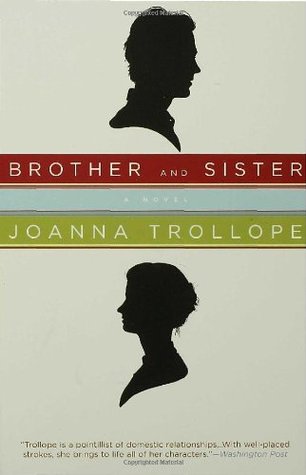
'Brother and Sister' by Joanna Trollope

 201231
2015 Reading Challenge Week 7 - A Book you own but have never read.

I bought this novel from a second shop quite a long time ago and it's been sitting on my shelf. Since I've enjoyed another novel by Joanna Trollope, I thought it's time to take it down for a read, to fit this category of the challenge. 

 Brought up by the same parents, but born to two different mothers, Nathalie and David have grown up as brother and sister, and share a fierce loyalty. Their decision as adults to try to find their birth mothers is no straightforward matter. It affects, acutely and often painfully, their spouses and children, the people they work with, and, most poignantly, the two women who gave them up for adoption all those years ago. Exploring her subject with inimitable imagination and humanity, the celebrated author of Marrying the Mistress and The Rector's Wife once again works her magic.

MY THOUGHTS:

Nathalie and David are the adopted children of Ralph and Lynne Dexter. Now in their 30s with families of their own, they decide to search for their birth mothers. It's easy to see why Joanna Trollope is such a well-known writer of domestic dramas. I feel if she were to discover the secret feelings of any of our families and households, she could probably spin a pretty interesting yarn, with the blends of personalities to be found beneath one roof.

I think another of Trollope's trademarks is giving every character a chance to have a scene written from their point of view, including not only Nathalie's five-year-Polly but David's two-year-old Petey. I was once told that authors should limit point of view characters to six at the most. This is definitely not a rule Trollope adheres to. I tried to think of a character in this novel who didn't get a point of view scene, and there were very few. For her, having so many works well. I think this is partly because it shows how our own lives may be impacted by the decisions of people who remain total strangers to us. To give just one example, David's antagonistic half-brother, Martin, never meets Nathalie, but unbeknown to him, it was Nathalie's idea and pressure which brought David into his life. There are many more such as these. It's interesting to think that ripple effects are often taking place in our lives.

It's interesting to see the number of people affected by the decisions of two people to delve into their pasts. The adopted siblings believe it has nothing to do with anyone but them, yet not only their birth families are affected, but their own spouses, children and adopted parents. Their partners, Steve and Marnie, take Nathalie and David by surprise with their reactions. And although it's never stated outright, it seems that neither of them ever forget that Nathalie and David are not really blood siblings at all. There's always an undercurrent of jealousy.

The other thing I noticed is that it's easy to fool ourselves into thinking something we really don't. Nathalie always convinced herself that she found being adopted liberating because she could forge her own path and wasn't bound by expectations based on her bloodline. However, it comes out that she really feels the lack of knowing her background and the hurt from wondering why her birth mother felt the need to give her away.

I was quite satisfied with the conclusions each of the siblings came to when they finally met their biological mothers.

4 stars