Tuesday, October 14, 2014

'A Lady at Willowgrove Hall' by Sarah E Ladd

 18588426
Willowgrove Hall is full of secrets, but soon everything hidden is brought to light.
Cecily Faire has a secret—and she intends to keep it. But when she arrives at Willowgrove Hall to serve as a lady’s companion, she comes face-to-face with the only person who knows the truth about her past.

As the steward of Willowgrove Hall, Nathaniel Stanton is dedicated to serving those around him. Nothing escapes his notice—including the beautiful new lady’s companion. He is certain the lovely Miss Faire is hiding something, and he determines to uncover it. But Nathaniel has a secret of his own: he is the illegitimate son of Willowgrove’s former master. Falling in love was not part of his plans . . . until he meets Cecily Faire.

When Willowgrove’s mistress dies, everything changes. Fear of exposure forces Cecily to leave under the cover of darkness, embarking on a journey to finally find her long-lost sister. When the will is read, Nathaniel’s inheritance makes him question his future plans. Cecily and Nathaniel are forced to make decisions that will change the course of their lives. Is their love strong enough to survive?


MY THOUGHTS:
Cecily Faire was sent to school at Rosemere College in disgrace by a furious father, for a reason she tries hard to keep to herself. Now that she's been offered the position of companion to an elderly gentlewoman, Mrs Tryst, she feels she has to guard her background more closely than ever before.

Nathaniel Stanton is the young, hardworking steward/bailiff of Willowgrove Hall. He's attracted to the new companion, although he knows it's no use because Mrs Tryst always turns her companions against him, for a reason he has no control over.

I love visiting the British Regency era in novels such as this, when social classes were so marked that a wealthy woman could afford to hire a companion just to have some company. Despite her formidable reputation, I found myself feeling a bit sorry for Mrs Tryst even before meeting her, as it seemed she was surrounded by young men just waiting for her to die so they could inherit their future estates. As for her gripe against Nathaniel..., well, although not fair, it's easy enough to understand.

 This novel is written with such nice, detailed descriptions of buildings, rooms, gardens and landscapes, that I wouldn't be surprised if the author had some photos and other research to base them on. I enjoyed how she put us right in the picture, and I was a bit concerned about the future of beautiful Willowgrove Hall itself, at the finish.

Cecily is an exemplary heroine, except for one pivotal lack of judgment toward the end, which I suppose every heroine is entitled to. Basically, she decides not to give Nathaniel a chance to react however he might, fearing what he might say. Of course, her behaviour gives him another chance to shine, and heroes like Nathaniel are the reason why we ladies like to read these Regency romances after all.

Thanks to Thomas Nelson and NetGalley for my review copy.

4 stars


Monday, October 13, 2014

Guest Post by Autumn Macarthur

It's my pleasure to welcome a fun author who did what I'd once dreamed of doing, and left Australia to live in England, where she currently resides. Autumn is also a loyal supporter of other Christian fiction authors from around the world. I'm so glad she chose to use the brilliant analogy of the labyrinth, which has been on my mind recently too. Make sure to check out her two Christmas stories at the end of the post, which sound like excellent reads for the festive season almost upon us. She is offering a bundle of both new releases as Kindle mobi files for one commenter on this blog post. Now, here's Autumn.
 
THE LABYRINTH OR THE MAZE?
How did an Australian girl from Sydney end up living in England and writing English set romances, when I came to London seventeen years ago planning a one year working holiday?
The answer is that God sometimes has unexpected plans for us, and sometimes His paths for our lives take us in directions we never imagined. Since I read Paula’s post on her It Just Occurred blog on labyrinths, I’ve been thinking what an interesting symbol and metaphor labyrinths are. Just like a labyrinth, my life has certainly been full of unexpected twists and turns, though at times it’s felt more like a maze.
By staying in England, I repeated the twists and turns in my father’s life, an Englishman who on a working holiday in Australia back in the late 1950’s met and married my mother, and didn’t return to Britain until he came back to attend my wedding to an Englishman, forty years later!
My spiritual life has followed a similar winding path.
We live not far from this turf maze in Hilton, Cambridgeshire.


Although in Britain labyrinths are called mazes, they are very different to a true maze. Unlike a maze, there are no dead ends in a labyrinth, no blind corners, no wrong choices. A maze is designed to confuse and entrap the walker. In a labyrinth, despite all its loops and curves, now moving closer to the centre, now moving further away, there’s only one pathway. Keep following it, and you will reach the centre. It’s impossible to get lost once your feet are on the path.
The labyrinth is a symbol of our journey toward God. There’s no magic in the labyrinth itself, it’s not what brings us closer to God. But it’s a reminder of the path we are on, the One path that leads to God through Jesus. A symbol, and a powerful one, just like our communion bread and wine or grape juice are symbols of His death for us.
Walked slowly and prayerfully, a labyrinth reminds us to slow down, to focus on God, and on His path for us, rather than our own rush to reach our short term goals.
Once we start into the labyrinth, as long as we keep walking steadily, following the path even when the direction it’s taking seems to make no sense, we will reach the centre. No matter where we are in the journey, we have only two choices, keep moving forward on the winding path that leads ultimately to Him, or turn away from Him and go back.
Even so, our feet are on the path He made for us. Walking the labyrinth is a reminder of obedience to Him.
To follow His long and winding path for our lives, when it looks like there’s an easy and obvious short cut to the centre, when we may be see other getting there sooner. To prayerfully keep our feet on the path on which He sets us. To follow his guidance with joyful obedience even when it seems counter-intuitive and as if it will take us further away from our destination.


That’s been a difficult lesson for me to learn. Too many times, rather than following God’s path, I’ve tried to take short cuts instead of staying on the path He’d laid out for me, and found my paths took me further away from Him, my real goal. And my short term goals, the ones that tempted me from His path, proved elusive anyway.
God tends to lead us on spiral paths, where it can feel as if we’ve made no progress at all when in fact we’ve come a long way. Thankfully, no matter how far we stray from Him, He never lets us go and will always lead us back to the right path again. All it needs from us is the willingness to turn our feet back to his ways again.
In my writing, just as much as my life, I’ve followed a roundabout path. My October release, Believe in Me, a London set Christmas romance with a strong faith element, started life two and a half years ago as a sweet but secular short novella, at a time when I’d chosen to take some big steps away from God’s path for me. Thankfully, the publisher I’d aimed it for rejected the story! It had been longer than they wanted 22,000 words not 15,000, but shortening it the required 30% didn’t do the story much good. Not a surprise really!
I see all those rejections when I was writing secular stories as blessings, as God still working in my life even when I’d chosen to follow my own path not His. I wanted the short cut to fast publication, God had other plans. Like a loving parent, He refused to let me have what wasn’t good for me. He called me out of the maze, and back to the labyrinth, to His path, to living and writing for Him.
And setting my feet on His path had a sense of rightness I hadn’t felt anywhere else. I’ve discovered there’s a comfort in the labyrinth, in the one sure path to the centre. There’s a joy in trusting that the twists and turns will bring us home. When a friend suggested a Christian publisher was looking for a novella with a London setting, I saw how that old rejected Christmas novella needed a faith arc to make it whole. Without God in it, the story was lopsided, like a broken Christmas tree. Only God could give my deeply wounded heroine the healing she needed to turn her from Ms Scrooge into someone who could feel the joy of Christmas again.
Unfortunately that publisher wanted shorter novellas too, so this story wouldn’t fit there, but when I saw the announcement for Harlequin’s So You Think You Can Write contest last year, it seemed Heartsong, one of their Christian romance lines might be a good fit. I began the rewrite of Believe in Me, entered the first chapter, and was blessed and surprised to semi-final, then as a result get an enthusiastic invitation to revise and resubmit the story from the lovely Heartsong editor.
It seemed this story may have found its home. But no, in the revisions the story grew to 60,000 words, far too long for Heartsong. God had other plans. After much prayer, instead of resubmitting Believe in Me to Harlequin, I was guided onto a different path, to indie publish this story.
And so in October, the story will finally be published. It feels so fitting to me that a story with the Prodigal Son or Daughter as a theme was the story God used to call me back to walking His path! I’m sure the labyrinth has plenty of twists and turns, but one thing I can be sure of is that the path leads to Him.
I’m not sure where He’ll lead me in life, but I do know with my stories, there will be several more Love in Store books, set in Britain. Then back to Australia for my Haven Bay series. I can’t wait!


You never forget your first love…
With her eye for design and her cut-glass accent, no-one would guess Beth Forrest’s impoverished background. It’s all throw pillows, china patterns, and upper class brides as she manages the Wedding Registry at Pettett & Mayfield, the stately maiden aunt of London department stores. It’s not quite her dream job, but each bride she helps to select beautiful and oh-so-expensive items for their gift list brings her one step closer to buying a little home of her own, and financing the education she longs for.
When physics professor James Tetherton-Hart, brilliant in his research lab but awkward and disorganised in everyday life, comes to the store in desperate need of both a gift and a partner for a wedding that evening and recognises her, all her careful plans and meticulous checklists are turned upside down.
Now her first love is back, determined to make her his partner for life, not just the evening. But unless Beth can let go of the mistaken beliefs that separated them in the past, and appreciate the depth and breadth of God’s love for us all, her only gift from the wedding will be another heartbreak.


Bah, humbug!

All Cara Talbot wants for Christmas is for it to be over.

The workaholic accountant has good reason to hate Christmas, along with charmers like actor Nick Callaghan, playing celebrity Santa at the failing London department store she has the thankless job of managing.

She’s determined to save her staff’s jobs, Hollywood golden boy Nick just wants to live up to his Mr Unattached reputation and enjoy life. They couldn’t be more opposite. But if accepting Nick’s dare – dates showing her the magic of a London Christmas – can raise enough publicity to keep the store open, she’ll do it. Even if she risks falling in love with him in the process.

Can this surprising Santa allow love to deepen his untested faith and learn to commit, while helping Ms Scrooge believe in Christmas, and in God, once more?

Book 2 in the Love In Store series of sweet inspirational romances.

Believe In Me semi-finalled in Harlequin’s So You Think You Can Write contest 2013


Autumn Macarthur is an Australian writer of inspirational romance living near London with her very English husband, three spoiled cats, and a guinea pig with a dandelion addiction. She loves reading, cooking, gardening, and writing deeply emotional stories to make you smile and remind you how big and wide and deep God’s love and forgiveness can be.

She tends to talk a little too much and laugh a little too loud, her sleep schedule is all over the place so you’ll often find her on the internet at 5am, and she’s grateful to be blessed with some good friends and a very patient husband. She’s also eternally thankful for God’s great love and mercy.

When she’s not talking to her strawberry plants or cherry blossoms, she can be found blogging at www.faithhopeandheartwarming.com ; on Facebook as Autumn Macarthur, and on Twitter as @autumnmacarthur.

She loves hearing from readers so do get in touch! You can subscribe to her mailing list here- http://mad.ly/signups/116735/join

Saturday, October 11, 2014

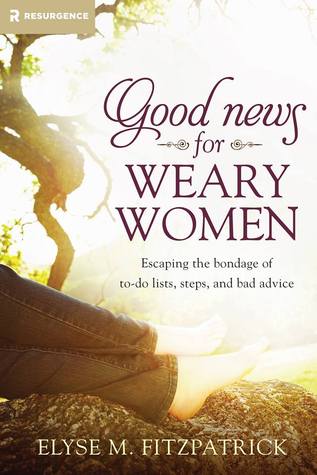
'Good News for Weary Women' by Elyse Fitzpatrick

 21556360
Are you exhausted? Women today really do feel the weight of the world on their shoulders. Every morning we are greeted with a long list of to-dos: get the kids up and out the door on time, have a meaningful quiet time, put in a full day at the office, spend an hour at the gym, prepare a healthy and delicious meal (organic and locally grown, of course), and make sure the sink sparkles before you go to bed. Oh, and don't forget to look great and smile while you're doing it. These are all good things to do, of course. But the bigger problem occurs when we start to feel as if our worth is measured by our to-do lists. And the messages we receive at church, on Facebook, and from the media only perpetuate these unrealistic expectations, creating a relentless cycle of exhaustion. As Elyse Fitzpatrick has traveled this country, she has seen increasing evidence of this weariness epidemic invading our churches and communities. And she has good news for women everywhere: there is hope! God doesn't judge us by our to-do lists. Instead, He calls us to faith. Free yourself today from the endless stream of bad advice and discover the true rest God offers.
 
MY THOUGHTS:
This is a wonderful resource for those of us who wear ourselves out with anxiety about measuring up to whatever the world tells us we should be doing. We are anxious to perceive clear callings in our lives, and then carry them out. But when asked directly what we must be busy with to be sure we're doing the work of God, Jesus replied that our only work is to believe in Him whom God sent (John 6:29, backed up later by Acts 16: 30-31). In the light of all the to-do lists, hard work, people pleasing and guilt-trips we put ourselves through, I think this has the potential to be as radical now as it must have been when He said it, if only we slow down long enough to let the repercussions sink in.

Elyse Fitzpatrick explains that we sadly live in a Christian culture which is essentially the same as the world around us, based on a 'what goes around comes around' principle. We have the programmed belief that if we do good things, God is obligated to bless us, and if we do bad, He'll punish us. This, she says, is nothing more than karma dressed in a Christian dress.

I've been sucked into the performance mode, and found this book's emphasis on the free gift of grace most refreshing. The New Testament stance of boasting in our weaknesses and knowing that Jesus' righteousness covers us is something we rattle off, but is so counter-cultural to the way we truly think. We need the reminder that we are free to boast only in the truth, that we are loved by God. All the law we must obey has already been obeyed by Jesus on our behalf. It's such a needless burden to think that our identity is derived from our actions and others' approval.

This book has got me all set to believe that God is as good, powerful, wise, loving and friendly toward me as He says He is, and relax at last. Why listen to the voice of guilt when forgiveness has been freely granted? It's crazy!

The book has its share of quotes which get straight to the point. 'Something must occupy the centre of our lives, and if it isn't the strong medicine of the Good News, it will be the poison of stupid rules,' Fitzpatrick tells us. 'Will we trust human strategies of self-rescue or prophetic promises of divine grace?' Finally, we all need to remind ourselves that we who believe in God's Son, receive the same benediction He received. 'You are my beloved son or daughter. With you, I am well pleased.'

Thanks to Net Galley and Tyndale House for my review copy.

5 stars.

Friday, October 10, 2014

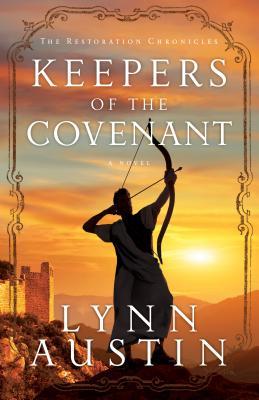
'Keepers of the Covenant' by Lynn Austin

 20665083
In one life-changing moment, the lives of the Jewish exiles in Babylon are thrown into confusion and despair when a decree arrives from the king's palace in Susa. It calls for the annihilation of every Jewish man, woman, and child throughout the empire on the thirteenth day of Adar, in less than one year. Ezra, a quiet Jewish scholar and teacher, is suddenly called upon to lead the community as they seek God for a reason for this catastrophe. When a second decree arrives, authorizing them to fight back, Ezra is thrust into the role of military leader as they defend themselves against their enemies.

When the battles come to an end, Ezra's brother Jude is dead and Ezra is required by the Law he so diligently studies to marry Jude's widow, Devorah, and provide an heir. Fatherhood changes Ezra, and he asks God to make a way for him and the other exiles to leave Babylon for good and return to Jerusalem. His prayers are answered and the exiles move to Judea to revitalize worship at the temple--but the fight to keep God's Law is never easy. As more and more of his community are tempted, a new battle emerges...this one for the survival of God's covenant and the souls of His chosen faithful.


MY THOUGHTS:

This is a fascinating story about Ezra, one of God's chosen Biblical leaders, and the duties and passions that consumed him. I love how Lynn Austin features such large figures from Bible history alongside her own fictional characters, for her story is also about Reuben, the young Jewish boy who loses the plot when his beloved father dies for the God who could have saved him; and Amina, the lame little Gentile girl who comes to love her surrogate Jewish mother and her God with all her heart.

 For a long time, the three threads remain totally separate to the point where I was getting impatient for them to come together. It wasn't until at least sixty percent through the story that they began to merge, but by then, I decided it was a strength after all, because that's how life works. A book focused on my immediate family would have my husband's story separate from mine until we were in our early twenties. It makes the story more powerful in the second half, because even though the characters were strangers to each other, I knew them all very well.    

Although this is considered a sequel to 'Return to Me', they really stand alone, as the events of 'Keepers of the Covenant' take place around eighty years later. One thread tying them together is Hodaya. It was great to trace her life, from the discarded, crippled newborn in the first book, to a gracious matriarch and grandmother, living out her full lifespan.

I found Ezra a more likeable leader than Iddo, in the first book, who came across as pushy and autocratic at times, even though his zeal was well placed. Ezra is earnest and humble, finding himself thrust into the leader's role rather than striving for it. In spite of his great learning, he's never too lofty to seek advice from others, such as his wife, Devorah, and younger brother, Asher. (One of my favourite scenes, which highlights Ezra's human vulnerability, is when he describes his mental and physical exhaustion to his brother.)

What makes Lynn Austin my favourite biblical author is the way her characters seem just like us, yet without compromising the authenticity of the times in which they lived. I understand their puzzlement when they hear of King Xerxe's death decree, under the influence of the evil Haman, as they are dealing with two contradictory, fixed opinions; God's Covenant on one side and the Persian king's edict on the other. While Ezra and his cohorts scanned the Torah for answers, I appreciate the irony that the solution ended up having nothing to do with them. (This, of course, is history.) In the story, the characters spend years referring to the events of 'The 13th of Adar' just as we do to September 11th.

I totally get his teenage twins' fascination with Babylon, which seemed grander than anything they knew, and their frustration with their father's passion to keep separate when they felt inferior in so many ways. It's the modern questions about relevance, which we also deal with, and like us, Ezra learns that you can't force feeling into a young person's heart. Since our modern world has been compared to Babylon, it has to make us think. When it came to the issue of mixed marriages, Ezra's personal angst over finding the right balance between grace and mercy was heartbreaking.

I love fiction like this, because so much is explained through the daily lives of the characters and their natural conversations. If Ezra can impact a fixed-minded young rebel like Reuben, he can do the same for readers. 

Thanks to Bethany House and Net Galley for my review copy.

4.5 stars


Tuesday, October 7, 2014

'The Brickmaker's Bride' by Judith Miller

 20665081
Yearning for a fresh start, Ewan McKay travels with his aunt and uncle from northern Scotland to West Virginia, promising to trade his skills in the clay business for financial assistance from his uncle Hugh. Hugh purchases a brickmaking operation from a Civil War widow and her daughter, but it's Ewan who gets the business up and running again. Ewan seeks help from Laura, the former owner's daughter, and he feels a connection with her, but she's being courted by another man--a lawyer with far more social clout and money than Ewan. Besides, Ewan has resolved he'll focus on making the brickmaking operation enough of a success that he can become a partner in the business
and be able to afford to bring his sisters over from Scotland.

But when Hugh signs a bad business deal, all Ewan's hard work may come to naught. As his plans begin to crumble, Laura reveals something surprising. She and her mother may have a way to save the brickworks, and in turn Ewan may have another shot at winning Laura's heart.

 
MY THOUGHTS:
As her father was killed in the war, Laura and her mother feel compelled to sell his beloved brickyard, and the only people who seem to be looking to buy in the economically tough times is an uncle and nephew partnership from Ireland, Hugh and Ewan. But are they quite on the level?

This book is a good example of why it's sometimes good to persevere beyond first impressions. I had initial preconceptions of both main characters which I had to push through, and it was worth it.

At first, Laura's self-assurance bordered on brash, especially for a young lady of those times. The explanation is given that she had to watch her mother learn to speak up for herself the hard way, which is fair enough, but Laura's outspokenness seems to go beyond the bounds of self-defence. She certainly knew the ins and outs of her father's business to the extent that her mother would entrust her with such an important matter as the sale of the family business. (I'm not sure it was ever explained why Mrs Woodfield didn't go along on that occasion, even though she wasn't sick.)

 Laura has a good heart, but I couldn't help feeling all through the book that if I knew her personally, I'd probably find her one those annoying friends who contradict people all the time. In fact, it would be an interesting exercise to go back over all her dialogue. I'm sure the percentage of times she delivers a rebuke or puts somebody else in their place would have to be high.

Still, when we discover Laura's personal secret which has kept her heartbroken since she was young, it gives her a vulnerability which she lacked earlier on, and we can't help feeling for her. And if the rather wimpish Kathleen is the alternative type of heroine, Laura's forthrightness is probably preferable.

My first impression of Ewan was that he was one of those perfect, 'what a guy' types. Some heroes start off flawed and develop good character traits as they go. As Ewan seemed pretty awesome to begin with, I couldn't see what the plot could possibly draw out of him. That was before I saw him floundering way out of his element, trying to secure future customers for the brickyard, cope with Laura's sarcastic suitor, Winston Hawkins and learn silly etiquette rules all at the same time. I was right on Ewan's side from then on!

I loved Ewan's three sisters, and Uncle Hugh's relationship with Aunt Maggie is fun to read about, leaving readers to decide for ourselves whether their marriage is happy or not. 

The parts to do with running the brickyard are well researched and interesting. Down in my city is an old brick works which has been turned into a market, and I love this glimpse into how it would have functioned back in its heyday. The historical times were certainly different to now. Laura and her mother were determined to stay living in their mansion, yet in twenty-first century times, they probably would've considered it far too big for just two women and wanted to put it on the market along with the business.

Thanks to Net Galley and Bethany House for my review copy.

3.5 stars

Friday, October 3, 2014

'The Sacred Year' by Michael Yankoski

 18848939
Frustrated and disillusioned with his life as a Christian motivational speaker, Michael Yankoski was determined to stop merely "talking" about living a life of faith and start "experiencing" it. The result was a year of focused engagement with spiritual practices--both ancient and modern--that fundamentally reshaped and revived his life. By contemplating apples for an hour before tasting them (attentiveness), eating on just $2.00 a day (simplicity), or writing letters of thanks (gratitude), Michael discovered a whole new vitality and depth through the intentional life.
Guided by the voice of Father Solomon--a local monk--Yankoski's Sacred Year slowly transforms his life. Both entertaining and profound, his story will resonate with those who wish to deepen their own committed faith as well as those who are searching--perhaps for the first time--for their own authentic encounter with the Divine.


MY THOUGHTS:

I'm so glad I read this book because I almost let the opportunity slip past. Books in which authors embark on spiritual journeys have seemed a bit gimicky in the past, as if they're seeking attention, and sort of shallow. I'd ask myself how indulging in each discipline for such a short time could allow them to get an accurate picture? But I'd heard good things about this book, which made me curious to read it after all.

Michael Yankoski was disillusioned at a Christian conference at which he was a guest speaker. (It had a name like 'Change Your World' something as audacious and cheesy as only a crowd of well-meaning Christians can be, he says.) He witnessed all sorts of drama from prima-donnas and broken people backstage which didn't match their polished, crowd-pleasing on-stage personas. Discouraged by all the falsity, he headed to a monastery retreat centre, where he met Father Solomon, who suggested that Michael dedicate himself to a number of spiritual practices for a year.

I love this book because rather than just going through the mechanics of each of them, Michael delves into the madness of the world and quirks of human nature which make each of them so beneficial. We spread ourselves too thin, sacrificing depth in favour of breadth in our activities. We automatically assume false selves to suit occasions, choosing from a wardrobe of masks we don't even realise we own. We emphasise external productivity at the expense of contemplation, and we get overly attached to the things we produce. We are quietly terrified that if we don't stop 'swinging our hammers' of productivity, we'll sink into insignificance.

So he tries a variety of disciplines to overcome the twenty-first century mold he found himself pressed into. He contemplates the surface of an apple, gets lost several times, bakes his own bread from basic ingredients, observes the Sabbath, volunteers at a local hospital and tries communal living, to name a few. He even retreats to a cave like a hermit, and digs a grave. (His chapter about coming to terms with our eventual death was one of my favourites, even though I usually shy away from the idea.)

Michael makes it clear that we don't do these actions out of some misguided attempt to earn our salvation, which is already a free gift of grace. It's more that we want to position ourselves to detect and reflect God's grace, rather than just being rushed through life, ignoring it. It's not a book you'll want to read through in a hurry. I'd recommend you take it as a gift, and a personal tool to savour and reflect. I've saved it among my favourites, to dip into often whenever the mad world gets too stressful.

One of my favourite quotes is made by Father Solomon, who told Michael at their first meeting, 'A carnival is a wonderful place to go every now and then, but a terrible place to live.' From that moment, I was keen to see how he'd go in his attempts to escape the carnival we all know so well.

There's plenty of challenge for us to try some of these disciplines ourselves, or all of them if we dare!

Thanks to Net Galley and Thomas Nelson for my review copy.

5 stars

Tuesday, September 30, 2014

'Home to Chicory Lane' by Deborah Raney

 22150105
Audrey Whitman s dreams are coming true. Now that their five kids are grown, she and her husband, Grant, are turning their beloved family home into a cozy bed and breakfast just a mile outside of Langhorne, Missouri. Opening weekend makes Audrey anxious, with family and friends coming from all over to help celebrate the occasion. But when Audrey s daughter, Landyn, arrives, the U-Haul she s pulling makes it clear she s not just here for a few days. Audrey immediately has questions. What happened in New York that sent Landyn running home? Where was Landyn s husband, Chase? And what else was her daughter not telling her? One thing was for sure, the Chicory Inn was off to a rocky start. Can Audrey still realize her dream and at the same time provide the comfort of home her daughter so desperately needs?"

MY THOUGHTS:

This is an entertaining story about the subtleties of extended family relationships. Audrey and Grant have recently seen their fifth and last child, Landyn, married. Now they are focusing on Audrey's deferred dream of turning their lovely old home into a guest house. On opening day, Landyn turns up towing a whole lot of furniture. She's left her husband, Chase, after six months, because he made a spur-of-the-moment decision about where they were to live without waiting to ask her input. And Landyn has never taken kindly to being told what to do.

The story turns into a comedy of errors at times, as they all try to work things out. There are four main characters; the father, the mother, the daughter and the son-in-law. What I like about this book is the realism, showing that nobody's life will ever look picture perfect. Even when you're living your best dream, there will always be a certain amount of messiness, mundane and less than ideal situations to contend with, so we might as well get used to it. Marriage, raising families and working weren't designed to be a piece of cake, and we get along best when we don't expect them to be.

The characters match the plot with their mixtures of great and annoying personality traits. Audrey may place making a good impression on strangers above being a caring parent and easy-going grandparent at times, but she still gives her daughter the wise advice that when you allow your spouse to pursue their dreams, you must do it with no strings attached. Grant has some prejudices and fixed ideas about how the younger generation should behave, but to his credit, he bites his tongue and lets Chase and Landyn make their own decisions. Landyn has a headstrong and secretive streak, making trouble for herself by asking her parents to keep things from her husband and vice versa, but she genuinely loves the significant people in her life.

It was harder to come up with Chase's bad points, as he was my favourite character. If anything, it would have to be insecurity and lack of confidence. I love the way he reasons that God made him an artist, and it's not his fault if society makes it almost impossible to make a living as one. Like many of us, a lot of Chase's anxiety comes from financial burdens, reminding me of the saying, 'The best things in life are free, but the second best things are very expensive.' 

I appreciated his depressed musing that he wasn't hearing from God while he made an important decision, even though he was certain he was. The answer given to him (and us) to ponder comes from a minor character, Grandma Cece, who reasons that God's ways rarely make sense to us while they're happening, but we may see their significance some time down the track.

Although this book was a quick and easy read on the surface, the undercurrents kept me thinking for a while.

Thanks to Net Galley and Abingdon Press for my review copy.

4 stars